
Bangladesh's plan to construct a fence along its 270-kilometer border with Myanmar has drawn international attention to the pivotal role of the Arakan Army (AA), which now exercises de facto control over the vast majority of the frontier on the Myanmar side.
Bangladesh Home Minister Salahuddin Ahmed announced the border fencing initiative during a parliamentary session on June 17, stating the project aims to strengthen national security.
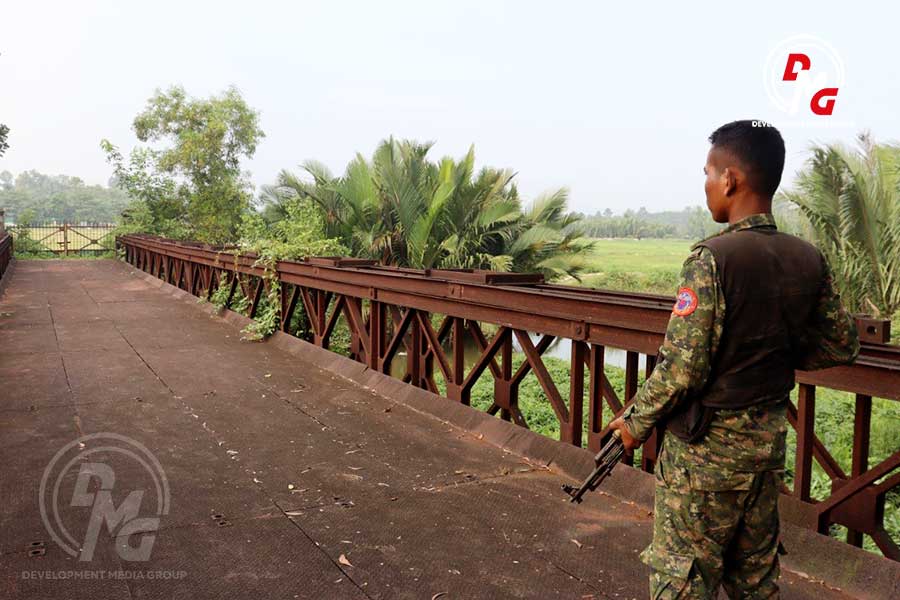
The Bangladesh-Myanmar border directly adjoins Maungdaw and Buthidaung townships in northern Rakhine (Arakan) State—both of which have been completely captured and are currently administered by the Arakan Army.
Dhaka authorities stated the project is designed to curb cross-border crime and illegal entry by constructing barbed-wire fencing and high-altitude border roads in remote, mountainous terrain.
The Bangladeshi government also plans to deploy advanced technology, including thermal imaging scanners, night-vision binoculars, CCTV cameras, and drone surveillance systems, to combat illegal crossings and narcotics trafficking.
However, border analysts and observers note that the Myanmar military junta no longer possesses effective control along the country's western frontier. While Bangladesh maintains formal diplomatic relations with the junta in Naypyidaw, experts emphasize that any long-term border security framework will necessitate direct engagement with the Arakan Army.
“Since a border fence is merely a physical barrier, real security does not exist in bricks and barbed wire,” said an Arakanese student leader from the 88 Generation movement.
“It will only be effective if Bangladesh cooperates directly with the United League of Arakan (ULA), which holds actual control on the ground. Without that, the project will likely become an expensive but ineffective form of 'paper security'.”
Dhaka has consistently maintained that tighter border control is essential to preventing cross-border militancy and managing refugee-related security issues.
Bangladesh currently hosts over 1.2 million Muslim refugees from Rakhine State, and the government has continued bilateral discussions with the Myanmar junta regarding potential repatriation efforts.
Despite these formal talks, regional security analysts argue that coordination with the Arakan Army is critical for the project's success. Armed groups, including the Arakan Rohingya Salvation Army (ARSA), the Rohingya Solidarity Organization (RSO), and the Arakan Rohingya Army (ARA), continue to launch cross-border attacks against the Arakan Army along the volatile frontier.
“Whether Bangladesh is building the fence for defense or immigration control, it cannot effectively implement this project without engaging the ethnic armed group that controls the territory,” an Arakanese observer monitoring Bangladesh-Arakan affairs stated. “Regardless of whether Dhaka officially recognizes the Arakan Army, the plan cannot succeed without their on-the-ground cooperation.”
While Bangladesh does not publicly acknowledge formal ties with the AA, observers hint that practical, low-level tactical cooperation already exists in certain border sectors to manage security incidents.
Since the announcement of the fencing project, the Myanmar military regime has intensified its retaliatory airstrikes on Maungdaw and Buthidaung townships.
Regional political analysts warn that these ongoing junta attacks and the resulting instability could severely undermine Bangladesh's border infrastructure plans.
In light of these challenges, border monitors suggest that the Arakan Army needs to fortify frontier security by establishing permanent and temporary outposts at key strategic choke points, while collaborating with local border communities to form community-based monitoring teams.