
Despite Thailand’s push for the Association of Southeast Asian Nations (ASEAN) to re-engage with Myanmar’s military regime, the 10-member bloc is unlikely to formally accept junta leader Min Aung Hlaing due to his failure to implement agreed-upon peace protocols, regional activists and analysts say.
Speaking at the ASEAN Secretariat in Jakarta on August 4, Thai Prime Minister Anutin Charnvirakul urged member states to reconsider their policy of isolating the Myanmar military leadership.
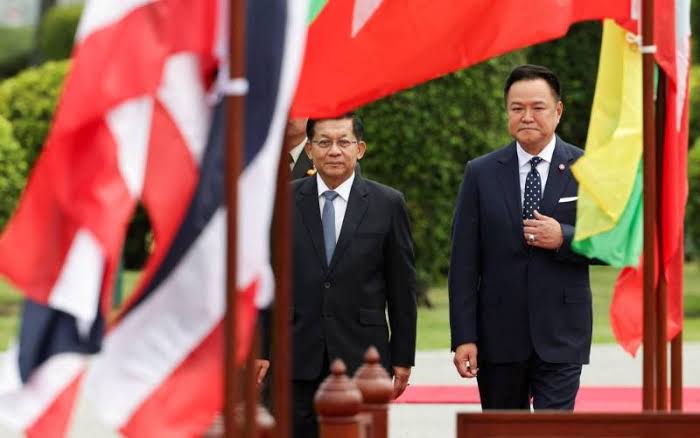
Following the address, Bangkok hosted Min Aung Hlaing on an official two-day visit on August 6–7, extending full state honors—a move widely interpreted as formal recognition by Thailand.
However, rights advocates suggest Thailand's diplomatic overtures reflect national interests rather than a broader consensus within the regional bloc.
“Thailand’s push seems driven primarily by its own interests rather than those of ASEAN as a whole,” said Ma Tin Tin Nyo, a member of the policy leadership committee of the Burmese Women's Union (BWU).
“Diplomatically, Bangkok appears to be legitimizing coup leader Min Aung Hlaing to advance its bilateral agenda.”
Analysts note that Thailand’s engagement is largely propelled by urgent cross-border challenges, including the refugee crisis, rampant narcotics trafficking, online telecom scam networks operating along the border, and the desire to revive border trade and bolster national security.
Despite Thailand’s efforts, significant legal and diplomatic hurdles prevent ASEAN and the broader international community from formally recognizing the junta, according to Khun Myint Tun, chairman of the Pa-O National Federal Council (PNFC).
“Myanmar’s constitutionally elected president remains U Win Myint, and Daw Aung San Suu Kyi remains the legitimate foreign minister,” Khun Myint Tun said. “For ASEAN to formally recognize the junta, it would have to explicitly strip recognition from these elected leaders—a step the bloc is unlikely to take.”
He added that while neighboring powers like China and India maintain direct ties with the military, international bodies like ASEAN and the United Nations operate under strict institutional rules and consensus guidelines.
A primary barrier to normal relations remains the military’s total failure to implement ASEAN’s Five-Point Consensus (5PC), agreed upon in 2021.
The framework demands an immediate cessation of violence, inclusive political dialogue among all stakeholders, humanitarian aid distribution via the AHA Centre, and unhindered access for an ASEAN special envoy to meet all political parties, including detained leaders.
Currently, China, India, Russia, Belarus, Laos, and now Thailand engage with the junta as Myanmar’s de facto government. However, activists emphasize that Thailand’s individual stance does not signal a shift in overall ASEAN policy.
“Rolling out the red carpet in Bangkok does not mean ASEAN as a whole has altered its position,” Ma Tin Tin Nyo said. “ASEAN must continue to uphold the Five-Point Consensus and respect the will of the Myanmar people.”