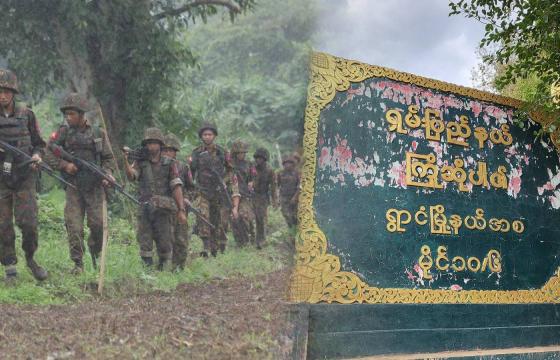


Locals blamed the devastating blast at an explosives depot in Namhkam Township in northern Shan State not only on the Ta’ang National Liberation Army (TNLA), which oversaw the facility, but also on China.
On May 31, a massive explosion occurred at a depot storing explosives used for mining and quarrying operations run by the TNLA’s economic department.
According to local rescue teams, the deadly blast in Kawngtat Village, Namhkam Township killed more than 60 people, including women and children, and injured more than 100 others.
The TNLA issued a statement on the same day in both Myanmar and Chinese, saying the explosion was merely an accident with no evidence of foul play, and promising to take action against those responsible. However, the response did not do enough to quell public outrage.
“The TNLA said it will carry out a thorough investigation and take action over the explosion. However, there is growing doubt about whether this is truly possible. The group has already gone too far by stockpiling large amounts of explosives near a residential area. With such dangerous munitions stored close to a village, it is hard to dismiss the blast as a mere accident,” a Namhkam resident said.
The TNLA’s information department announced on the evening of June 1 that 43 people were killed and 112 injured in the explosion, but rescue organizations reported more than 60 deaths and over 600 people left homeless.
“The TNLA has not released a list of people who were working at the depot at the time of the incident, making it difficult to determine the exact number of casualties. So far, more than 50 deaths have been reported, including those who died in hospitals and bodies recovered from the site. The workers present at the time of the explosion appear to have gone missing without a trace,” a local rescue worker told Shan Herald.
Residents of Namhkam said the TNLA failed to inform locals about the storage of explosives near a residential area, and video footage taken after the blast showed no warning labels indicating the bags contained explosives.
“The explosion scattered orange, pipe-like containers filled with gunpowder. Although the containers bore logos, there were no warning labels on them. Locals said they had no idea that such dangerous explosives were being stored near their homes,” another Namhkam resident reported.
A legal expert from northern Shan State pointed out that the TNLA’s large-scale storage of explosives near residential areas, its failure to inform locals, and the absence of warning labels could amount to negligence equivalent to homicide.
“We need to look at the broader scope of this incident. It cannot be downplayed as a mere accident based on the explosion alone. The TNLA stored explosives near a residential area without adequate warning signs. Setting up an explosives depot in such close proximity to homes, despite the known risks, reflects negligence that could amount to homicide. This is not a simple accident,” he said.
Reports also suggested that Chinese experts may have been working at the depot in Kawngtat Village, about two miles from Namhkam Town, although Shan Herald could not independently verify this. Chinese authorities have only confirmed that a Chinese national was injured in the incident.
Meanwhile, BBC Burmese reported on June 1, citing a rescue worker, that three Chinese nationals were among the bodies recovered from the blast site.
Foreign Ministry spokesperson Lin Jian said on June 2 that the Chinese government would closely monitor the aftermath of the explosion in TNLA-controlled Namhkam Township and provide necessary assistance in the investigation and follow-up process.
“The key question that should be addressed here is where the high explosives came from. According to eyewitness accounts, they are believed to have been imported from China. If a major power like China supplied explosives to an armed group in Shan State, does that mean arms trade laws no longer apply?,” the aforementioned legal expert said.
The United Nations Security Council (UNSC) arms embargo regulations also impose strict guidelines on the sale of explosive munitions, including gunpowder, he explained. Similarly, the UN Arms Trade Treaty (ATT) sets out requirements that must be followed in the transfer of military equipment. Having ratified the treaty, China is also responsible for monitoring how the explosives it exports are stored and used, he added.
“China is also being held responsible for the deaths in this explosion. It should have carefully assessed the safety risks before selling the munitions and ensured proper storage standards after their transfer. In this case, however, locals were not even aware that explosives were being stored near a residential area, and the bags had no warning labels. For these reasons, China, like the TNLA, should also be regarded as bearing responsibility for the incident, could even be considered an accomplice to homicide,” he said.
The TNLA announced that it has provided 10 million MMK in compensation to the family of each person killed in the blast. On June 6, TNLA leaders attended a traditional donation ceremony for the deceased, expressed their condolences, and promised to support locals in their rebuilding efforts.
More than 70 of those injured in the blast are still receiving treatment in hospitals in Namhkam and Muse. Major challenges also remain in rebuilding homes and other structures that were damaged or completely destroyed by the explosion.