

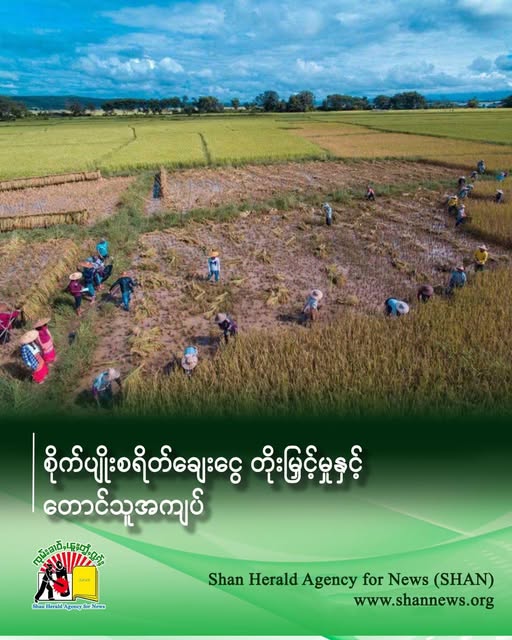
The junta’s Ministry of Finance and Revenue announced it will double agricultural loans for farmers cultivating rice and other crops in the 2026–27 fiscal year.
The loan per acre of rice cultivation will increase from the current 150,000 MMK to 300,000 MMK; however, farmers said the higher loans would not ease their hardships due to rising costs of fertilizers, pesticides, and fuel.
Farmers said the price of a bag of commonly used urea fertilizer, which used to cost about 90,000 MMK, has now risen to over 170,000 MMK, while compound fertilizer, which previously cost around 100,000 MMK, has increased to over 200,000 MMK.
“The increase in agricultural loans to 300,000 MMK per acre is encouraging news, but it still falls short of covering other rising expenses. In fact, it is less than half of the total cost of cultivating an acre,” a farmer from southern Shan State said.
He added that it would be more helpful for farmers if the authorities focused on controlling the prices of fertilizer and fuel rather than increasing loans.
Additionally, although it has been announced that agricultural loans will be doubled, farmers argue that it appears to be an ineffective measure.
“It doesn’t make sense to announce an increase in agricultural loans when preparations for the rainy-season rice planting are already underway. At this point, farmers are left wondering what they are supposed to use that money for,” a farmer from Ponginn village in Taunggyi Township, Shan State, told Shan Herald.
In addition, he said there are many difficulties in accessing loans, noting that strict requirements—such as the named borrower having to be physically present—would place a burden on elderly farmers.
Furthermore, farmers said they never received the full loan amount, as deductions for interest, bank fees, and other charges were already taken out.
The junta has also been providing loans for equipment purchases to encourage a shift from traditional to mechanized farming. However, equipment prices have soared and spare parts are in short supply, making progress noticeably slow.
Farmers would only see real benefits if the junta itself took responsibility for importing fertilizers, seeds, and agricultural equipment and sold them with reduced taxes, they also pointed out.
In the current situation, with rising agricultural costs and no stable market for farm products, many farmers are struggling with financial losses, another farmer from Ponginn said.
“The current situation is like giving a placebo to a patient who clearly needs hospitalization,” he explained.
In Ponginn, farmers said that, beyond financial difficulties, natural disasters and labor shortages are causing even greater challenges.
Ponginn farmers said that natural disasters and labor shortages are creating even bigger headaches than financial difficulties. The authorities in the region have dug drainage ditches, but only in a superficial, ceremonial way rather than properly. As a result, the area still suffers from annual flooding. Furthermore, due to Myanmar’s current military, political, and economic situation, rural areas are facing a severe labor shortage.
As the junta plans to increase agricultural loans, farmers fear they could be trapped in a never-ending cycle of debt. In a situation where fertilizer prices and other agricultural costs are too high, simply increasing loans does not address the root of the problem. Farmers emphasized that what they really need is concrete, direct support to reduce costs and a reliable guarantee of a stable market.
“In the current situation, farmers are happy even if we can make only a small profit, because there is no guarantee of a stable market for us,” said a farmer from Ponginn.