
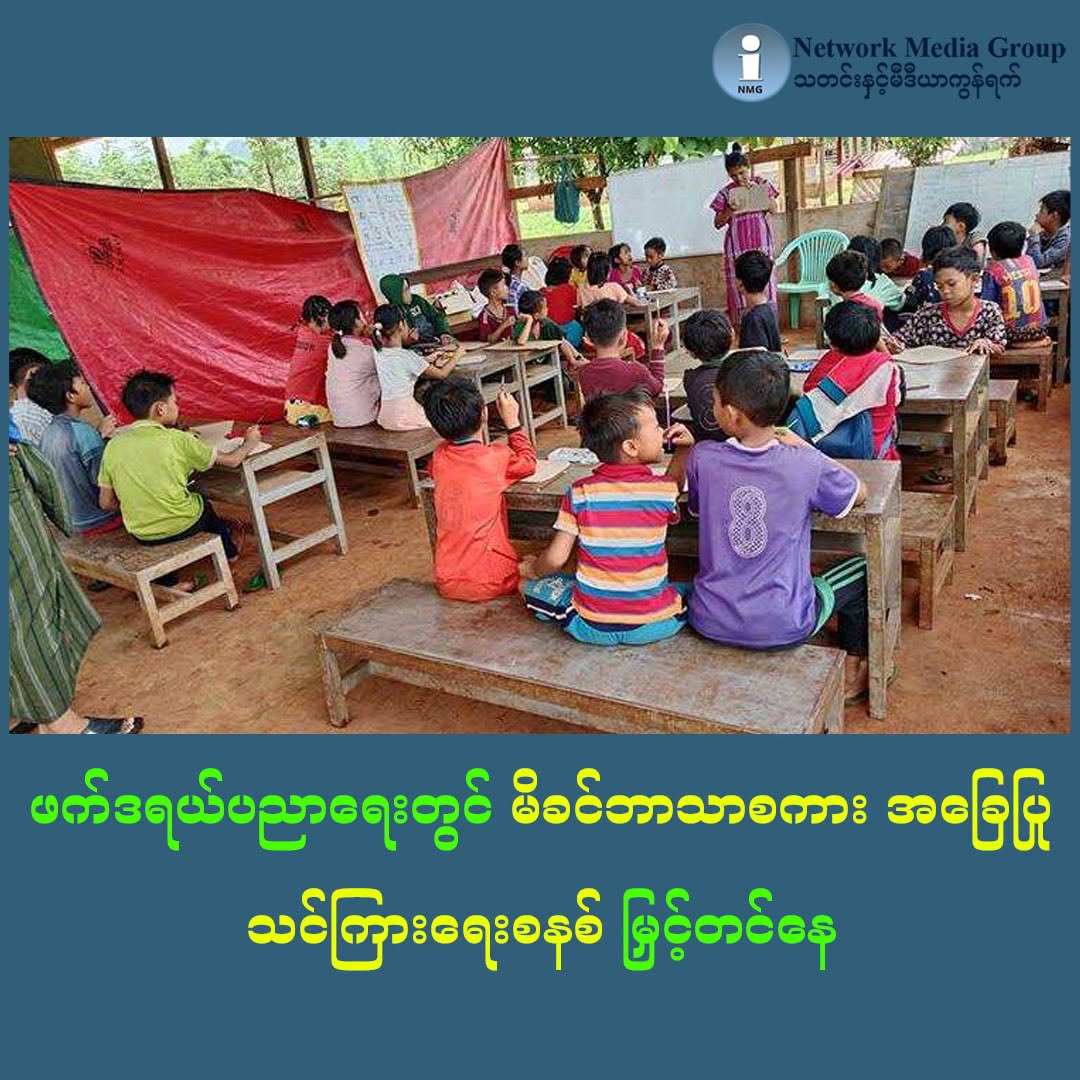
The resistance-run Interim Federal Education Council (IFEC) is seeking to formally embed mother tongue-based education within the interim federal education system to improve access and learning outcomes for ethnic children, the council said.
Education officials from IFEC said during the Organizing Committee for the Federal Democratic Higher Education and Vocational Education Conference held on May 30 that the council is collaborating with relevant federal units to strengthen and expand the system.
Currently, the IFEC, the Ministry of Education (MOE) under the National Unity Government (NUG) is working with local federal units in ethnic areas to develop curricula, with a primary focus on implementing mother tongue-based teaching at the primary school level.
Sayar Thein Naing, an official from IFEC, said the policy framework for a future federal democratic education system already guarantees the right to learn in mother tongues, ethnic languages, and indigenous languages.
“Our federal democratic education policy clearly states that learners must have full access to education in their mother tongues and ethnic languages. We also aim to integrate ethnic literature, culture, and traditional customs into formal education so they can be preserved and passed on to future generations. Education should no longer be built around a single language,” he said.
He added that the policy specifically mandates a multilingual, mother tongue-based approach at the primary level and that preparations have already been made to formally integrate ethnic language instruction into the school system.
In addition, standards are being developed to enable multilingual teaching and learning within the official curriculum.
“These plans have already been incorporated into the formal education system. If subjects such as mathematics, science, and social studies can also be taught in local ethnic languages, it will strengthen children's understanding and make learning much easier for them. It can also help build a stronger foundation for social cohesion. That's why IFEC and the relevant federal units are working to fully integrate a mother tongue-based education system,” Sayar Thein Naing added.
Beyond basic education, the interim education framework is also preparing to grant federal units greater autonomy in vocational education and training.
Officials said that vocational education councils and education councils that emerge under future federal units are expected to continue developing opportunities for teaching and learning in ethnic languages based on local needs.
Daw Win Mar Soe, a representative from the Vocational Education (VE) sector, noted there is growing potential for establishing vocational education bodies under individual federal units.
“There is a strong possibility that vocational education units will be formed under the respective federal units in the future. When that happens, there are plans to ensure that mother tongues and ethnic languages are used in teaching and training according to the needs of each federal unit,” she said.
To support these goals, IFEC and relevant federal units are currently providing as much technical and institutional support as possible to ensure that mother tongue-based education policies and implementation mechanisms reach classrooms practically and meaningfully.