
Chinese and Russian-backed tungsten mining projects are advancing in Mongton Township, the southwesternmost part of eastern Shan State, with local communities already experiencing a range of negative impacts from the operations, according to the Shan Human Rights Foundation (SHRF).
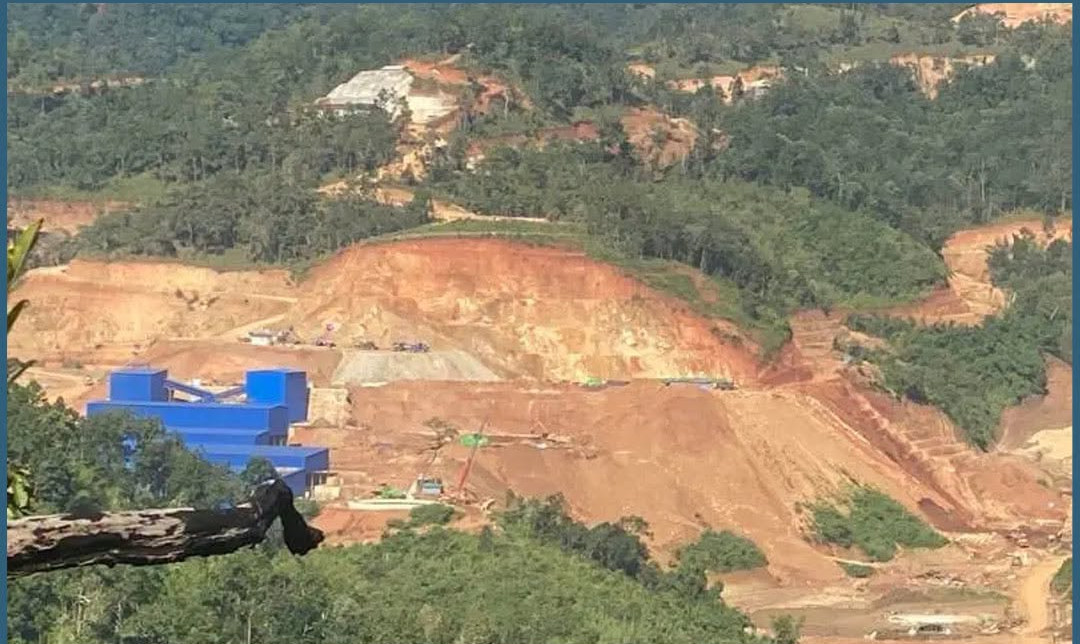
One of the projects is being jointly undertaken by a Chinese mining company and the United Wa State Army (UWSA) about six kilometers northeast of Möng Kyawt Village, on the southern side of the Loi Che Li mountain range, the highest peak in Mongton Township.
Located around 20 kilometers from the Thai border, the project began on the northern slopes of the area in February. SHRF said the operation is already affecting local communities’ health, farming activities and livelihoods.
“There’s no real benefit for local people from these mining projects. Chinese and Russian companies are doing the mining, but the ones profiting are the junta, the companies and the armed groups. Meanwhile, the Thanlwin (Salween) River is already being polluted. If the Thanlwin is contaminated, then the streams in the mining areas are polluted too. We’re already seeing cases of skin disease, and now sediment from the mining is causing flooding. The risks are growing all the time,” said SHRF spokesperson Ying Leng Harn.
Residents of Wanwa Village, located about one kilometer from the mine, are reportedly suffering from skin diseases caused by wastewater flowing from the mining site into Phatgwat Creek.
Phatgwat Creek flows from north to south, joining the Nam Kyut River before eventually feeding into the Thanlwin River. As a result, residents living along the Nam Kyut River are increasingly concerned about the impact of mining waste and chemical pollutants discharged from the operation.
“Mining may create some jobs, but it also destroys farmland, contaminates drinking water sources and causes long-term harm to local people’s way of life. Local communities will be left to bear the environmental damage and health impacts, while the profits from resource extraction go elsewhere. If the project is not properly managed, landslides could occur and become a serious threat to nearby communities,” an environmental conservation worker active in eastern Shan State said.
According to SHRF, the Chinese company currently operating in partnership with the UWSA only holds a permit for mining activities in Monghkan Village, north of Mongton Township, and is not authorized to conduct mining around Möng Kyawt Village.
However, the company has reportedly been allowed to continue operating because of its partnership with the UWSA, leaving the junta with little leverage to intervene.
Since the end of the Chinese New Year holiday in February, the company has reportedly been transporting minerals to China in convoys of around five vehicles at a time. The shipments pass through the junta-controlled town of Tachileik before entering China via the border town of Mongla.
Ying Leng Harn said the company employs more than 100 Chinese technical workers and over 250 Shan and Bamar workers, most of whom are not locals.
“Even the workers aren’t local people. Most of them have been brought in from other areas,” she said.
Myanmar workers reportedly earn between 300,000 MMK (about 2,200 THB) and 500,000 MMK (about 3,800 THB) per month. Local sources familiar with the health risks warned that the work could have long-term consequences for workers.
Meanwhile, Chinese technical workers operating machinery reportedly earn between 100 and 400 THB per hour.
“The Chinese workers are the ones operating the machines. They don’t have to do the heavy labor, like hauling earth and materials. They’re paid at international rates. Shan and Bamar workers are the ones exposed to the dangers, yet they receive very low wages and are assigned the hardest work,” a Mongton resident said.
The junta has also reportedly granted Russia permission to conduct tungsten mining around the Loi Che Li mountain range.
Ying Leng Harn said that on January 28, 2026, three Russian nationals and a junta strategic commander surveyed the area in preparation for the start of mining operations.
“The junta has already approved all the sites where Russia plans to mine. In other words, it was the junta itself that brought the Russians in,” she said.
In addition, a Russian company has reportedly been granted permission to carry out antimony mining about 15 kilometers north of an existing wolfram mine.
Experts predict that the three mining projects currently being jointly implemented by the junta, Chinese and Russian firms will become some of the largest publicly known mining ventures in eastern Shan State.
Human rights and environmental activists have condemned the projects, saying they will bring no meaningful benefits to local communities and instead leave them facing significant harm.
Mining activities have already caused environmental damage in the area. During the 2025 rainy-season farming period, sediment and mining waste washed into rice fields along a section of Phatgwat Creek near Möng Kyawt Village, damaging crops.
Residents also said that after a reservoir was completed in late 2025, water from Phatgwat Creek was diverted to fill it. This diversion caused waterways downstream of the reservoir to dry up, affecting agriculture and other water-dependent livelihoods.