
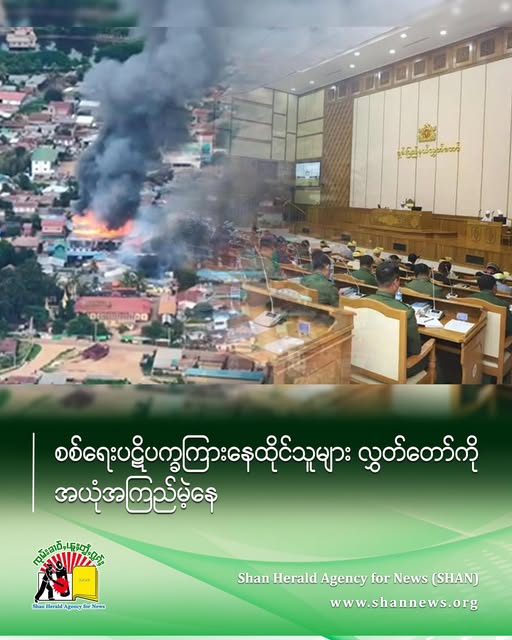
People living in conflict zones have lost faith and hope in the new parliament formed through elections organized by the junta.
The military coup took place on February 1, 2021. More than three months later, on May 23, the Mobye (Mongpai) People’s Defence Force (PDF) launched its first attack on the Mobye police station, marking the start of the PDF’s nationwide resistance campaign against the regime.
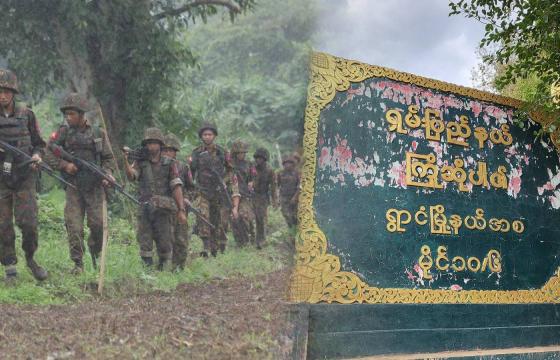
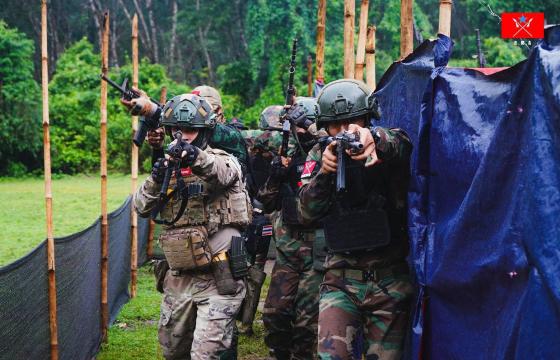
In northern Shan State, the Three Brotherhood Alliance—a coalition of three ethnic armed organizations (EAOs)—launched a major offensive against the junta, known as Operation 1027, on October 10, 2023.
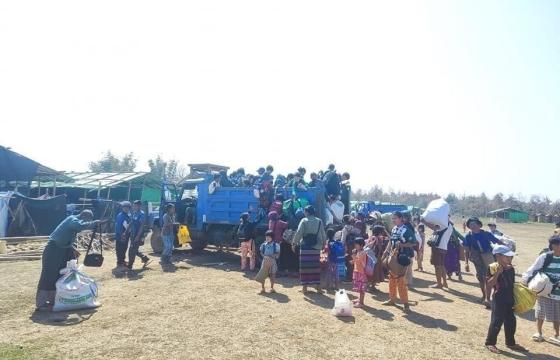
During Operation 1027, members of the Three Brotherhood Alliance captured numerous towns in northern Shan State. However, under pressure from China and following military concessions, alliance members Ta’ang National Liberation Army (TNLA) and Myanmar National Democratic Alliance Army (MNDAA) later handed towns including Naungcho (Nawnghkio), Lashio, and Kyaukme back to the junta. The fighting caused casualties and widespread property loss, and the return of these areas to junta control left local residents disheartened.
“During Operation 1027, there was a lot of destruction in our communities. Later, the junta regained control of Lashio through negotiations that took place solely between the armed groups. No one compensated people for the losses we suffered due to the conflict, and it felt like no group cared about what we went through,” said Nan Sai, a woman from Lashio City.
In early August 2024, Lashio and the junta’s Northeast Region Military Command headquarters there were captured by the MNDAA and allied groups. Eight months later, in April 2025, the junta retook the city without firing a single shot, following Chinese intervention.
During the MNDAA’s control of Lashio, the group focused on collecting taxes from the public and opening gambling dens to boost its funding, with little regard for compensating residents for the losses they had suffered.
Even though there is now a Shan State parliament, the party that won in the Lashio constituency is the junta-backed Union Solidarity and Development Party (USDP), leaving people with little hope, locals said.
During Operation 1027, the TNLA took control of Thibaw, but failed to carry out effective reconstruction for local residents. On October 17, 2025, the junta recaptured the town; however, it has yet to restore proper administrative functions, leaving locals still struggling to recover. The Shan and Nationalities Democratic Party (SNDP) won the Thibaw constituency, and its MPs are attending the current parliamentary session in Naypyidaw.
Thibaw Township’s People’s Assembly representative, U Kaung Thet San, proposed repairing roads and bridges and restoring electricity networks in the township during a parliamentary meeting on March 24.
“At the March 24 session, I highlighted the urgent need to repair roads, bridges, and communication networks in Thibaw. We also need to conduct more on-the-ground inspections to better understand the situation,” U Kaung Thet San told Shan Herald.
In 2010, decades of military rule ended and a quasi-civilian government was established. However, the current political reform differs significantly in context. The Myanmar military, which has brutally repressed and killed many people, still maintains full control over the elected government.
People have no hope or trust in the parliament, which will be controlled by the same junta officers who killed civilians and burned homes under the guise of civilian rule, Nan Sai, a woman from Lashio, said.
“Will we really get enough help from them to rebuild? There’s no hope for the people—we shouldn’t expect anything,” she said.
In the junta-orchestrated election, the USDP emerged as the winner, while parliamentary speakers were also chosen by the military. As a result, the parliament is likely to function as a rubber stamp for the junta, a Shan political analyst told Shan Herald.
“The responsibility of MPs is to stand up for the people in their constituencies. Asking for roads and bridges to be built isn’t really their job—that’s the responsibility of the relevant local authorities. MPs should be the ones speaking out boldly about the people’s losses and grievances. They really need to understand the role they’re meant to play,” he pointed out.
Despite the current ceasefire with the MNDAA and TNLA, locals believe that the junta still plans to retake all the towns lost during Operation 1027. Therefore, locals worry that military tensions could reemerge in these areas at any time and are not interested in the parliament.