
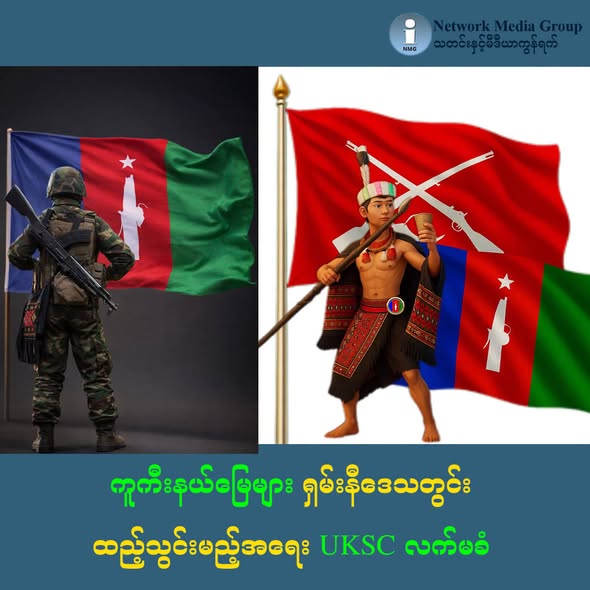
The United Kuki State Council (UKSC) announced its opposition to a proposal to incorporate the ancestral lands of the Kuki people in northern Sagaing Region into a proposed Shanni self-administered region.
During a June 4 meeting with the junta’s National Solidarity and Peacemaking Negotiation Committee (NSPNC), the Tai-Leng Nationalities Development Party (TNDP)—the political wing of the Shanni Nationalities Army (SNA)—reportedly proposed designating Homalin Township, Hkamti Township, Kale Township, and Tamu Township in northern Sagaing Region as a Shanni self-administered region, a move that drew opposition from the UKSC.
The UKSC asserted it would not accept any forced annexation of the historic lands where Kuki ancestors lived into the territory of another ethnic group.
In its June 7 statement, the UKSC said the Kuki people have long faced historical injustices, including being treated as a minority in their own ancestral lands due to British colonial divide-and-rule policies and unfair territorial divisions made by successive post-independence governments.
In a cited example, the UKSC said a 1967 military campaign burned more than 40 Kuki villages and forcibly displaced over 20,000 people, describing the incident as ethnic cleansing.
The UKSC added that current administrative boundaries were shaped by such tragic and unjust historical events, noting that the mistakes of the past should be learned from and corrected.
It also stressed that the proposal to create a self-administered region based on already inappropriate boundaries would distort historical truth.
NMG has contacted the UKSC for further details on its position following the statement’s release but has not yet received a response.
The UKSC also made clear that it is not seeking to create disputes with other ethnic groups that coexist with the Kuki people. However, it said it will continue to pursue its goal of establishing a self-governing Kuki national state.
The UKSC further stated that it respectfully urges ethnic groups such as the Shanni and Naga to sit together and peacefully resolve territorial disputes, rather than making unilateral decisions.