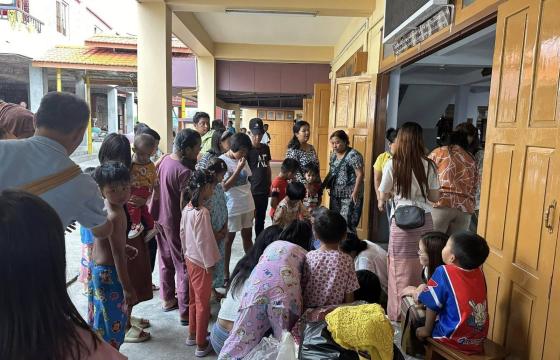


Nearly half the residents in a Kesi Township internally displaced persons (IDP) camp have been suffering from respiratory problems, fever, chronic diarrhea and skin rashes throughout November, according to volunteers working in the area.
Wan Wa, home to over 1,000 of central Shan State’s 10,000 IDPs, sits on the Nam Wa, a small stream. Locals worry that the stream, the IDP’s primary water source, is now contaminated and causing widespread illnesses among children and the elderly in the camp.
By 27 November 419 camp residents had complained of health problems.
Sai Hin Hseng, a volunteer in the camp said the IDP’s “drink water upstream in the Nam Wa, and they bathe downstream.” He suspects that poor sanitation might also be partly to blame, noting that there are “not enough” toilets to accommodate 1,000 people.
Dr. Vit Suwanvanichkij, MPH/MD, with the Center for Public Health and Human Rights at Johns Hopkins University told SHAN that in addition to malaria and dengue, which are common in Burma, the IDPs are also at risk of malnutrition, respiratory infections, diarrheal diseases including cholera and that women who have to deliver babies in conflict zones are facing labour complications.
He said: “The result [of these conditions] can only be a health disaster.”
There are currently six medics working in the Wan Wa IDP camp with limited resources. Volunteers said that no doctors have been able to visit the area.
According to The Long Road to Recovery, a 2015 comprehensive report on community-based health care in ethnic regions of Burma, 70 percent of people in ethnic areas relied on local medics rather than government services to meet their basic needs.
But Sai Hin Hseng feels that: “Now, a doctor is necessary.”
Of the 419 IDPs who are sick, 293 complained of trouble breathing, as well as a fever, 99 people suffered from chronic diarrhea and 27 said they had developed unexplained skin rashes in their current living conditions.
Temperatures in central Shan State can drop to less than 10 degrees Celsius as early as October and Irrawaddy reported that many IDPs lack warm clothing to protect themselves from the cold weather.
Dr. Suwanvanichkij, who is also an advisor to the Mae Tao Clinic on the Thai-Burma border, explained that most of these symptoms and diseases are preventable or easily treatable.
He said: “The bottom line is that these are all direct consequences of the denial of access to primary health services.”
According to Dr. Suwanvanichkij limitations on aid to the IDPs should cease and their health and living conditions should be properly assessed so that they can receive necessary and appropriate assistance as soon as possible.
He said: “Continuing to neglect the plight of displaced ethnic civilians will not only be complicit in fueling a growing health crisis, it will likely also endanger prospects of true national reconciliation and sustainable peace in the country.”
On 27 November the total number of IDPs in Wan Wa Camp had reached 1,023. The population has since grown and there are now an estimated 1,103 IDPs at the camp.
After almost two months of fighting between the Burma Army and the Shan State Progress Party/Shan State Army-North (SSPP/SSA-N), community-based organisations estimate that there are over 10,000 IDPs in central Shan State.
On 18 November SHAN reported that the main source of emergency aid for displaced communities are funds collected and delivered by local groups, rather than international agencies.
The IDPs in the Wan Wa camp have fled seven villages in the area. Offensives by the Burma Army against the SSPP/SSA-N began on 6 October. Since then the region has only experienced five days without armed conflict.
By Simma Francis and Zaai Zaai Lao Murng for Shan Herald Agency for News (S.H.A.N)
Edited in English by Mark Inkey for BNI