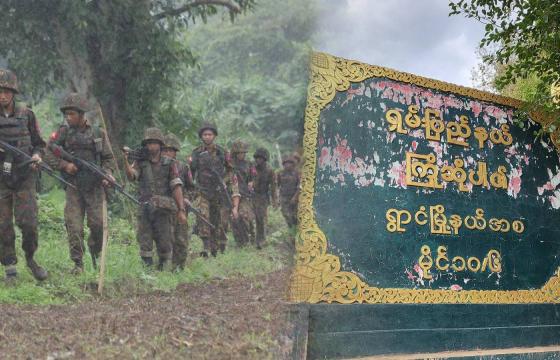

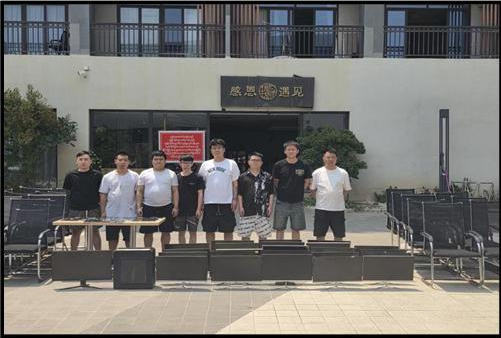
A total of 52 Chinese and Myanmar nationals involved in telecom scam operations, locally known as Zhapian, were arrested along with a large amount of scam-related equipment in Tachileik Town, eastern Shan State on the Thai border, the junta announced on April 27.
Around noon on April 27, junta authorities raided a hotel in Tachileik’s Weinkyauk Ward and arrested three Chinese men and a Myanmar woman allegedly operating a telecom scam business, the junta claimed. Authorities also seized 3 computers, 13 laptops, 320 mobile phones, 108 tablets, and other related equipment.
On the same day at around 2:00 p.m., junta authorities searched a house in the same ward and arrested 8 Chinese men and 1 woman, as well as 27 Myanmar men and 7 women, along with 23 computers, 52 phones, and other equipment.
A total of 52 people were arrested in the two incidents, and the junta said it would take effective action against all of them.
However, Shan political analyst Sai Wan Sai said such actions are merely a ploy by the junta to ease international pressure rather than a genuine effort to combat telecom scams.
“The junta’s crackdown on Zhapian in Tachileik and elsewhere is largely a symbolic, superficial move meant to appease China and win favor with the U.S. Federal Bureau of Investigation (FBI)-led anti-scam task force,” he told Shan Herald.
Since late 2023, China has been pressuring the junta to step up its crackdown on online fraud gangs operating along border areas. On the other hand, the U.S. is stepping up efforts to combat cybercrime in the region by forming a special task force targeting telecom scam networks.
The junta claims it treats anti-scam efforts as a national responsibility, but in reality, its top leadership and its ally, the Border Guard Force (BGF), are deeply entangled with these criminal networks, raising serious questions, Sai Wan Sai said.
For example, in Karen State, BGF leader Colonel Saw Chit Thu is widely known for his alleged links to telecom scam networks. In Shan State, criminal groups continue to operate in areas controlled by some ethnic armed organizations (EAOs), reportedly after striking deals or securing protection from local authorities, he added.
“Cyber fraud is easy to carry out in small groups almost anywhere. It’s even easier than drug smuggling. Basically, anyone with a computer can engage in this kind of crime,” Sai Wan Sai said.
It is estimated that U.S. citizens lost more than 7.2 billion USD in 2025 to telecom scam gangs operating out of Myanmar.
On April 24, the U.S. Department of State’s Bureau of International Narcotics and Law Enforcement Affairs announced a reward of up to 10 million USD for information leading to the identification of money-laundering networks linked to scam compounds known as Tai Chang 1.0, 2.0, and 3.0 in Karen State.