
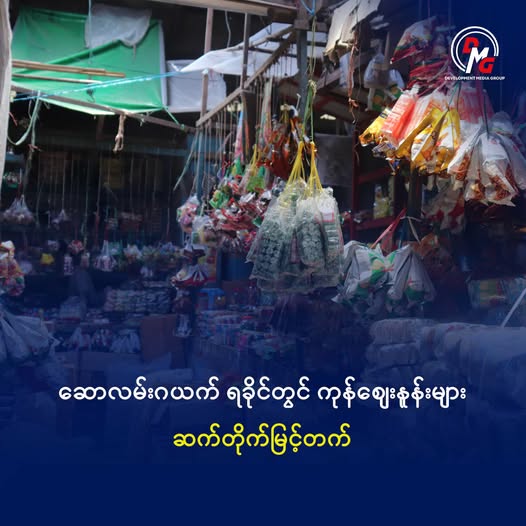
Arakan (Rakhine) State is experiencing a severe shortage of essential consumer goods imported from mainland Myanmar, triggering a sharp price rise after the junta blocked the main trade corridor linking Saw Township in Magway Region to Arakan State.
Since late April, the junta has deployed troops and enforced restrictions in Saw Town and Kangyi Village along the Arakan–Magway trade corridor, effectively cutting off the Arakan–Saw route, which has long functioned as a vital supply lifeline for goods entering the state.
With the route cut off, commodity prices across Arakan State have climbed rapidly. Everyday household items have seen particularly steep increases. A pack of Blue menstrual pads has jumped from 24,000 MMK to 35,000 MMK. A carton of Shwe Wah soap has risen from 180,000 MMK to 240,000 MMK, while Carbolic soap has increased from 147,000 MMK to 180,000 MMK per carton. A bundle of Bago Mya tobacco cigars has also surged from 3,500 MMK to 7,500 MMK. These products are widely used in local communities.
Essential medicines have also seen significant price hikes. A blister pack of Secif birth control pills has risen from 6,000 MMK to 8,000 MMK. A bottle of Htet Lin traditional chest balm has increased from 3,000 MMK to 4,000 MMK, while Maha Phyay Say traditional herbal medicine used for gastrointestinal and digestive issues has climbed from 4,000 MMK to 5,000 MMK per bottle. A blister pack of Vitahome multivitamin and mineral supplements has also gone up from 4,000 MMK to 5,000 MMK.
“Wholesale carton prices of goods have gone up by tens of thousands of kyat in Kyauktaw Township. Consequently, prices in village shops have also increased. Even soft drinks are now about 500 to 1,000 MMK more per bottle,” said Daw Soe Soe, a grocery store owner in Kyauktaw Township.
Arakan State has long relied primarily on the Saw route for mainland imports, alongside border trade routes through India for essential goods. The closure of the Saw corridor has sharply increased the cost of goods manufactured in mainland Myanmar.
Myanmar-made products are also traditionally preferred in Arakan State over Indian imports, with many residents having used domestic goods for years.
“Products from Yangon are still more popular than Indian ones. Stocks haven’t fully run out yet, but traders who stocked up earlier are now selling them at higher prices. If supplies from Yangon are completely cut off and no new shipments come in, everything will eventually run out. The situation could get very difficult,” a trader from Kyauktaw told DMG.
Residents in Arakan State—already struggling with limited job opportunities and low incomes—have been hit hard by rising prices since fighting resumed in 2023.
With the junta blocking the main Saw trade route, the India route remains the only major supply line into Arakan State. However, the early monsoon season has further complicated transportation, with landslides, difficult terrain, and long delays affecting both land and water routes.
Locals are increasingly worried that continued price increases will deepen hardship during the rainy season in already conflict-affected areas.
“If one item goes up by just 1,000 MMK, buying three items means an extra 3,000 MMK. It might sound like a small increase, but for daily wage workers, even a 500 or 1,000 MMK rise really makes a big difference,” said a displaced woman from Kyaukphyu Township.
The overall rise in commodity prices since late April has further worsened conditions for both internally displaced persons (IDPs) and locals across Arakan State.
According to the United Nations World Food Programme (WFP), basic food prices have increased by an average of 18 percent nationwide in Myanmar, while in Arakan State prices have surged by as much as 31 percent.
In a statement issued on May 18, the WFP warned that rising costs are pushing low-income families—who already face depleted savings and scarce job opportunities—to a point where many can no longer afford even basic food necessities.