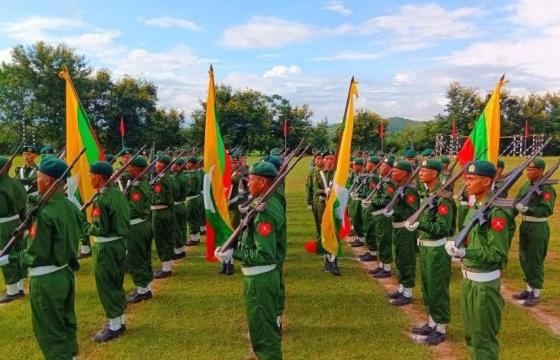

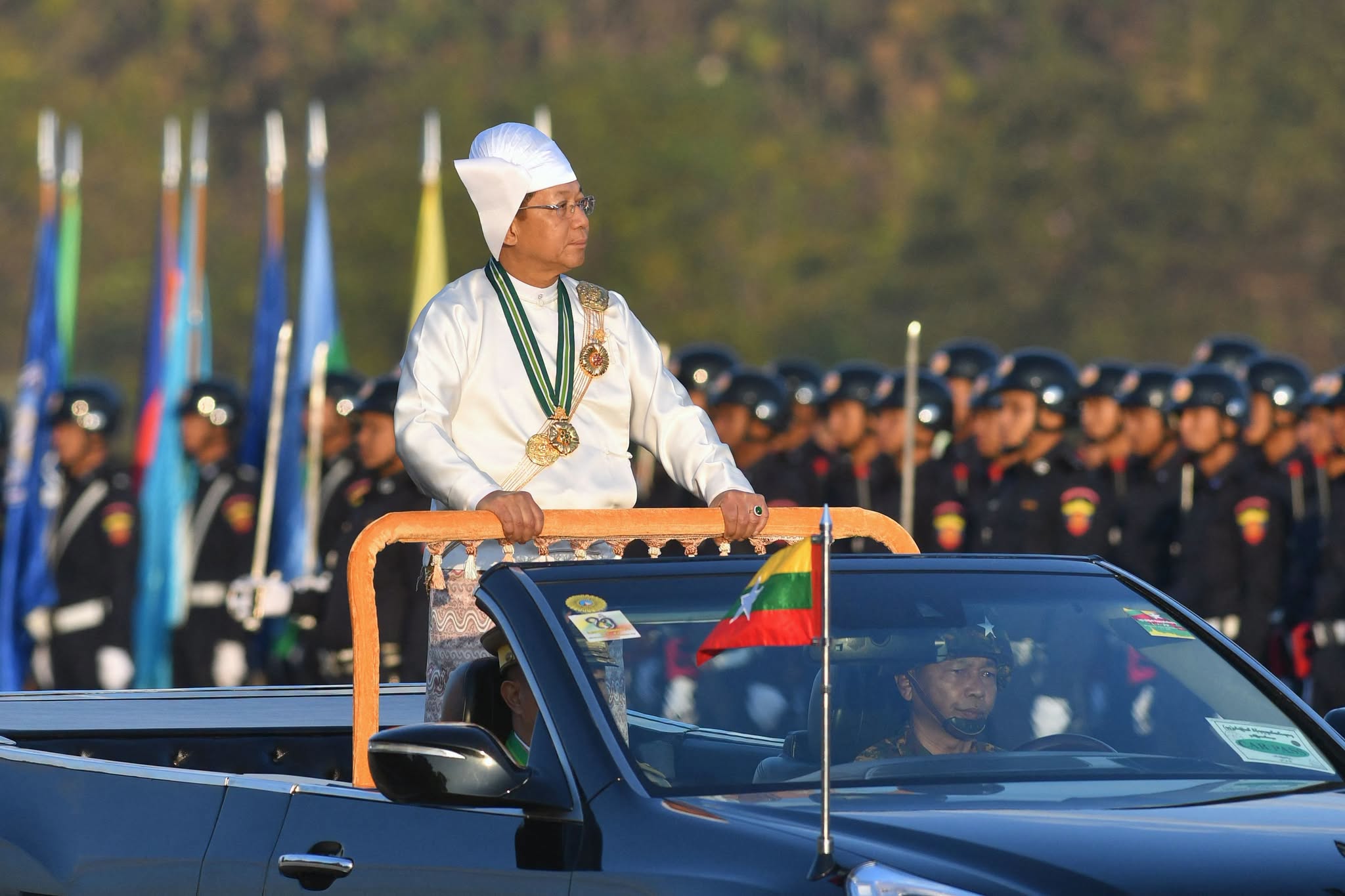
Myanmar junta leader Min Aung Hlaing’s promise to build a “new nation” has drawn widespread backlash, with critics and rights groups dismissing his five-year roadmap as a self-serving attempt to entrench military rule amid deepening civil and economic turmoil.
Speaking on July 31 at a Union Assembly session to mark the first 100 days of his newly styled administration, the coup chief outlined a two-year preparation phase followed by a three-year implementation period. He claimed the regime aims to establish a democratic, federal state while prioritizing national stability and economic development.
However, analysts and local residents say the junta chief’s rhetoric is entirely detached from the grim reality on the ground. Over the past 100 days, living conditions across Myanmar have drastically deteriorated, marked by forced conscription, arbitrary arrests, severe restrictions on border trade, and hyperinflation.
“Min Aung Hlaing wants to extend this plan because it benefits him and his inner circle, but it brings zero benefit to the public,” said a resident who requested anonymity due to safety concerns. “The longer we hear about this ‘new nation,’ the more fearful people become.”
In his speech, Min Aung Hlaing attributed soaring commodity prices to rising global fuel costs, falling domestic production, trade deficits, and government expenditure. Yet critics argue that regime mismanagement and violent repression remain the primary drivers of the country's economic collapse.
While the junta claims to have held talks with 13 Ethnic Armed Organizations (EAOs) and called for a peaceful political resolution, human rights advocates reject the regime’s peace overtures.
Nai Aue Mon, program director of the Human Rights Foundation of Monland (HURFOM), emphasized that the junta’s strategy relies on brutal military force rather than genuine dialogue.
“Under the pretext of stability or territorial clearance, the junta continues to commit severe atrocities—including airstrikes, artillery shelling, burning down civilian villages, arbitrary arrests, extortion, and forced conscription,” Nai Aue Mon stated.
Despite attempting to present a civilian facade, the regime has intensified its crackdown on dissent. Authorities routinely arrest citizens for criticizing the military on social media under anti-terrorism laws and Section 505(a) of the Penal Code, which criminalizes anti-state speech. The junta also recently revoked the operating licenses of six independent media outlets.
Furthermore, young men drafted under the junta's forced conscription law continue to be deployed to active frontlines, where many are used as human shields.
Observers conclude that the regime’s “new nation” project offers no tangible benefits to ordinary citizens. Instead, it serves as a thin veneer to legitimize the dictatorship, secure regime survival, and enrich military loyalists at the country's expense.