
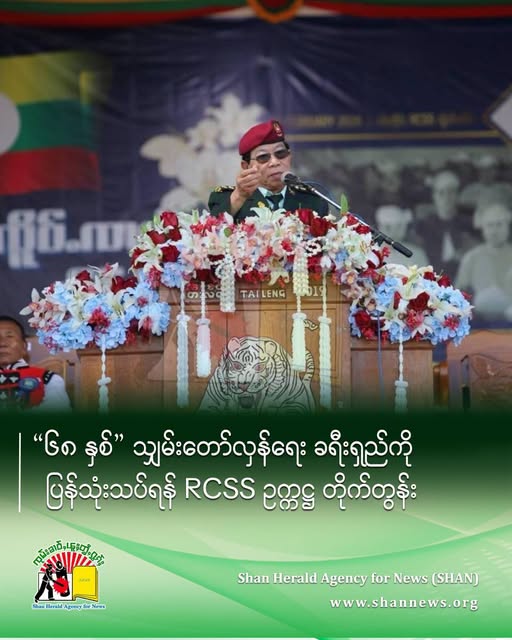
The chair of the Restoration Council of Shan State/Shan State Army (RCSS/SSA) emphasized the need to reassess why the Shan ethnic people’s revolutionary struggle has taken so long, noting that it has already spanned 68 years.
Lieutenant General Yawd Serk made the call in a message dated May 21, marking the 68th anniversary of the Shan resistance.
On May 21, 1958, on the bank of Namh Kywet Stream in Mantong Township, eastern Shan State, 31 patriotic Shan youths led by Sao Hso Yanta established the Noom Suk Harn armed organization through a blood oath, marking the origin of the Shan revolution.
The Shan armed resistance began 10 years after Myanmar gained independence, following the failure of the majority Bamar-led authorities to uphold the promises of the 1947 Panglong Agreement, and as the Myanmar military’s actions became increasingly repressive, leaving no viable political avenue for the Shan people to pursue their rights. The Shan revolution has now lasted 68 years, passing through a long history of key milestones.
Lieutenant General Yawd Serk pointed out that some people fail to understand or sympathize with the Shan armed resistance struggle, viewing revolution narrowly as the actions of armed groups alone. He stressed that, in reality, within any revolutionary landscape, the people and resistance fighters must coexist like fish and water.
He said that patterns of lord-and-slave relations between armed groups and the people, reminiscent of the era of the Saopha (ancient Shan rulers), have contributed to the prolonged duration of the Shan revolution.
Lieutenant General Yawd Serk added that some leaders, although patriotic, lack the necessary skills and expertise for resistance, harbor excessive hostility toward the Bamar people, and focus narrowly on overthrowing the Myanmar military—factors he said have also contributed to the prolonged nature of the revolution.
He also said that armed resistance inevitably involves financial considerations, as it requires funding. However, he criticized that some individuals, once they gain money and power, become arrogant and behave like lords while based in the jungle, engaging in internal conflicts over territory and interests and prioritizing personal gain over the national cause.
“When some groups prioritized their own interests over national interests, divisions gradually emerged. Instead of engaging in dialogue and reaching agreements, conflicts broke out. This is why the revolution has dragged on for so long,” he said.
He also highlighted that many resistance groups lack the necessary skills for revolution and are driven mainly by hatred toward the Myanmar military, without a clear long-term vision.
Lieutenant General Yawd Serk said that without strong commitment, some groups are easily influenced by enemy manipulation and political incentives, eventually leading them to surrender. In this way, he said, certain groups that once followed the revolutionary path have turned into junta-aligned militias and are now being exploited by the regime.
Therefore, patriots who have chosen the path of resistance should learn political and military strategies, support one another, and carry out their duties diligently, he stressed. He also asserted that doing so will ultimately lead to the success of the revolution.