
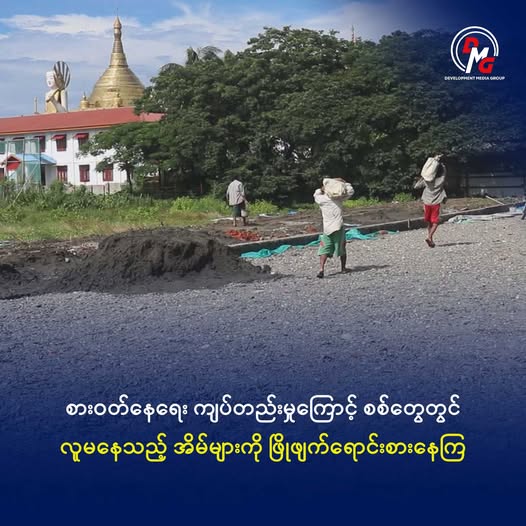
In Sittwe, the capital of Arakan (Rakhine) State, which remains under junta control, worsening poverty and widespread unemployment have pushed some residents to dismantle abandoned houses and sell the bricks, metal pieces and stones to support their families.
These houses were vacated after residents fled to other cities due to the ongoing conflict in Arakan State.
Locals said that with scarce job opportunities and soaring prices for basic commodities, some people have begun tearing down brick walls, door frames and other parts of unoccupied homes to sell the materials as scrap.
“There’s no work here, and people are starving. Some are just trying to survive however they can. They take crowbars, hammers, chisels, and pry stones out of the roads or pull bricks from empty houses so they can sell them,” a woman from Sittwe told DMG.
Local sources said a sack of scraped stones can be sold for around 8,000 kyats, while a sack of crushed cement and broken brick fragments brings about 2,500 kyats. Typically, a poor labourer can only produce about two sacks a day, which others then buy and reuse for construction.
Since renewed fighting erupted in Arakan State in November 2023, the junta has imposed a strict blockade on all sea and land routes into Sittwe. The restrictions have caused severe goods shortages and driven prices to soar sharply.
The same resident described the daily struggle faced by many families.
“Life in Sittwe is incredibly hard right now. People have no income, but the prices of basic things like chili, onions and rice keep going up. Just getting through each day has become a huge challenge,” she said.
Current market prices in the city include onions at 10,000 MMK per viss (about 1.6 kg), cooking oil at 8,000 MMK per liter, pork or beef at 75,000 MMK per viss, high-grade rice at 230,000 MMK per bag, and dried chili at 18,000 MMK per viss. Prices for gasoline and firewood have also risen significantly.
Beyond the worsening economic conditions, residents in Sittwe are also dealing with psychological stress caused by frequent small-arms and artillery fire around the city, as well as repeated overnight guest registration checks carried out by the junta.