
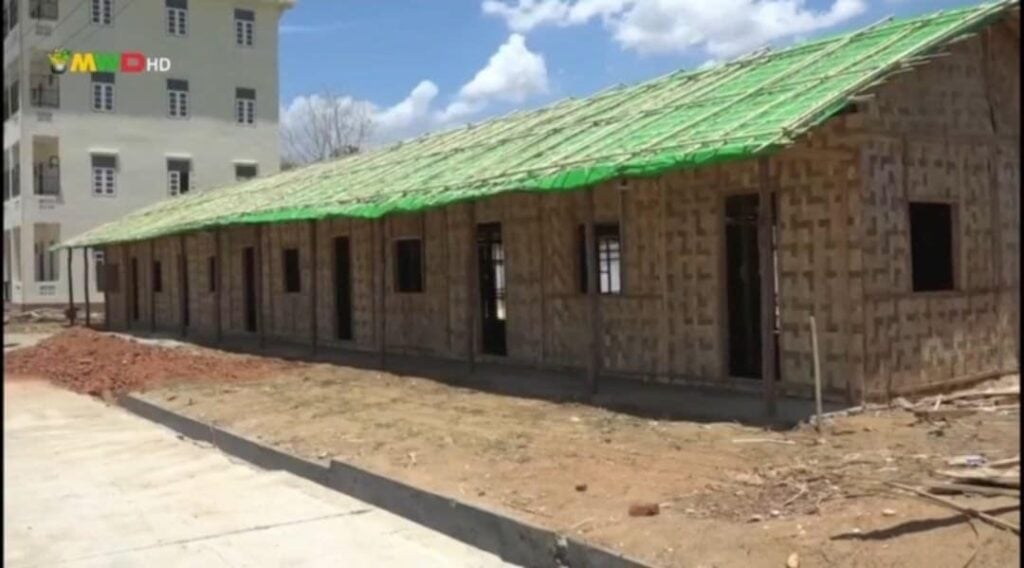
Myanmar’s junta-run Ethnic Affairs Ministry is constructing bamboo huts on its premises to serve as temporary shelters for staff and their families affected by the powerful 28 March earthquake in Naypyidaw, according to state media.
Myawaddy TV, the junta’s propaganda outlet, reported that Minister Khun Thant Zaw Htoo inspected the construction site early on 20 April. The huts, referred to as “basha,” are made with wooden poles, bamboo flooring, bamboo mat walls, and thatched roofs.
During the visit, the minister met with senior officials including the deputy minister and permanent secretary at the ministry’s main entrance.
He stated that the bamboo huts are intended for employees and their families to live in for over a year. He also instructed staff to communicate with lower-level personnel and prepare lists of those eligible for accommodation.
The earthquake caused significant casualties and severe damage to multiple ministries and staff housing in Naypyidaw. The junta, however, has not disclosed the exact number of casualties. According to internal sources, some bodies remained trapped beneath collapsed buildings for several days.
In addition to the Ethnic Affairs Ministry, similar temporary structures are being built on the grounds of other government offices including the Ministries of Home Affairs, Hotels and Tourism, Cooperatives and Rural Development, Religious and Cultural Affairs, Sports and Youth Affairs, and Natural Resources and Environmental Conservation.
These emergency shelters vary in construction. Some are made with iron frames, plywood walls, and galvanized iron sheet roofs, while others at the Ministry of Home Affairs include tarpaulin-roofed tents with bamboo matting walls.
Authorities have reportedly instructed that these temporary accommodations be completed by the end of May.
A list circulating on social media claims that only 946 out of more than 1,500 staff housing units in Naypyidaw are deemed potentially habitable pending full inspection and necessary repairs. Meanwhile, 610 buildings have been declared uninhabitable.
Some government staff who lost their housing have returned to their hometowns. Others are currently living in rented homes, junta-provided shelters, community halls, the National Museum, pagoda prayer halls, parking areas inside office compounds, and even in school buildings.