
Leaders of the United Wa State Army (UWSA) and the National Democratic Alliance Army (NDAA) have confirmed that they will participate in the “21st Century Panglong Conference,” championed by Burma’s State Counselor Aung San Suu Kyi.
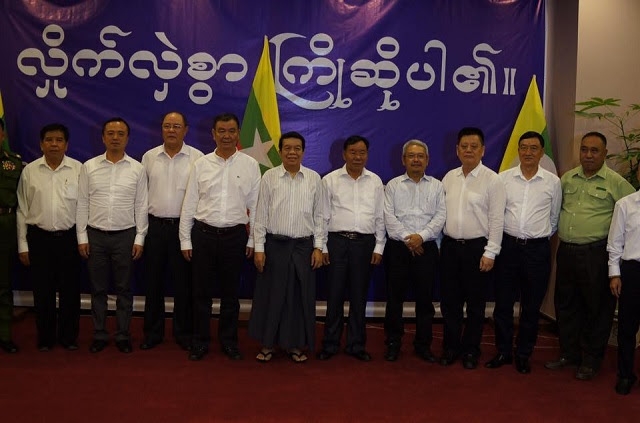
Dr. Tin Myo Win, the chairman of the 21st Century Panglong Conference Preparation Committee (21-CPCPC), and his government-backed team on Friday sat for talks with representatives of the UWSA, led by Zhao Guo-ang, and a delegation from the NDAA, headed by Sai Leun, at the NDAA headquarters in Mongla, close to the Burma-China border.
An official from the NDAA who attended the meeting said: “After we both held separate talks with the 21-CPCPC delegation, we [the NDAA] and the UWSA representatives held a further meeting with the government delegates, and we agreed to attend the conference.”
The decision will mark the first time that the UWSA, widely regarded as the strongest ethnic armed force, and its ally the NDAA have agreed to sit down at the same table for peace talks with the central government. Neither group signed the so-called Nationwide Ceasefire Agreement (NCA) with the then Thein Sein government in October last year, declining on the basis that they had already signed bilateral accords with Naypyidaw.
Both the Wa and NDAA representatives did, however, agree to continue talks with the government.
Earlier this month, a government-backed peace negotiation team met with delegations from the United Nationalities Federal Council (UNFC), an ethnic alliance comprising of non-NCA signatory groups, including the Ta’ang National Liberation Army (TNLA) and the Kokang-based Myanmar National Democratic Alliance Army (MNDAA).
The 21st Century Panglong Conference is scheduled to be held some time in July 2016 in the Burmese capital, Naypyidaw.
In 1947, the leaders of the Shan, Kachin and Chin peoples met with Burma’s independence hero, Gen. Aung San, the father of Aung San Suu Kyi, in the Shan town of Panglong, where they drafted a constitution as part of the process of gaining independence from Britain.
The 1947 constitution guaranteed the signatory ethnic groups the right to secede 10 years after the formation of the Union. However, Aung San was assassinated just months after the agreement was made, and the ethnic peoples’ hopes of autonomy were further shattered in 1962 when his successor, General Ne Win, staged a military coup.