
The Chinland Council has reaffirmed its commitment to collaborating with allied resistance forces to build a federal democratic union, emphasizing that anti-junta groups must demonstrate real governing capacity to earn domestic and international recognition.
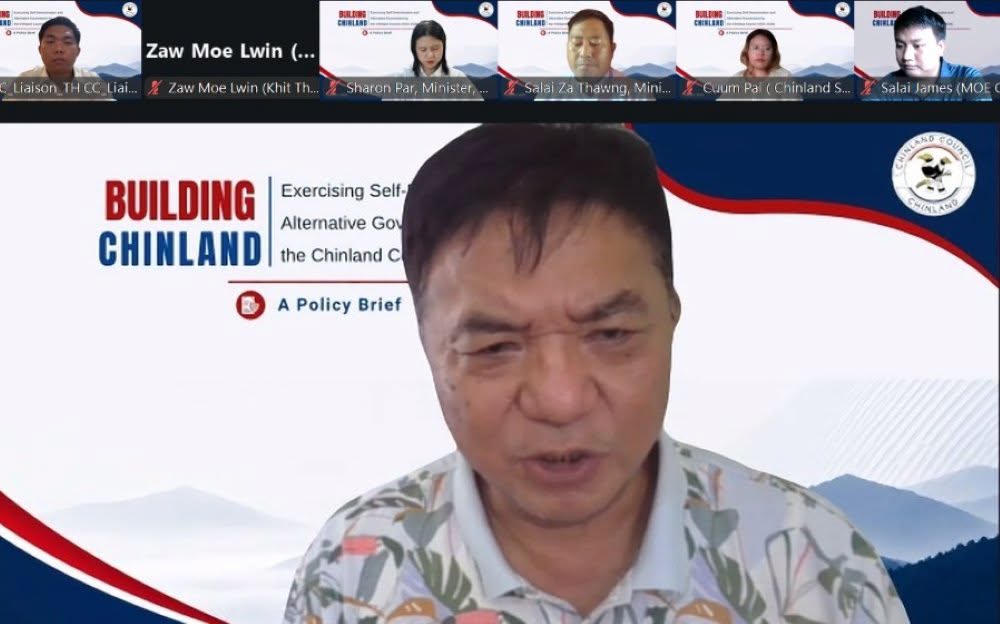
The assertion came during the August 28 virtual launch of the council’s progress report, “Building Chinland: Exercising Self-Determination – Two and a Half Years of Alternative Governance by the Chinland Council.”
Produced with support from the Chin Centre for Peace and Reconciliation (CCPR) and drawing on input from 19 townships and administrative zones, the report details how alternative administration has taken root in Chin State following the collapse of central military control after the 2021 coup.
“To give the public a real alternative to military rule, we must show that we possess both the vision and the capacity of a functional government,” said Salai Kep Chin Than, Secretary of the Chinland Council. “Ethnic revolutionary organizations must demonstrate this to gain the trust of our people, neighboring countries, and the international community.”
According to the report, the council currently administers areas home to more than 250,000 residents across Chin State and operates through the legislative, executive, and judicial branches.
Key administrative milestones highlighted in the report include the expansion of administrative networks across 19 townships and regional areas, the active operation of 23 out of 25 local courts, and the enactment of nine laws by the Chinland Parliament under which courts have already ruled on 18 cases.
Despite these achievements, the council acknowledged critical operational hurdles, including severe shortages of funds and skilled personnel. In the education sector, the council relies heavily on local community donations to pay teachers’ salaries.
The report also candidly addressed political fragmentation in the region, admitting that rival administrative mechanisms and local political friction have complicated efforts to achieve full resistance unity in Chin State.
To overcome these obstacles, the council said it is prioritizing inter-factional cooperation, capacity-building for local officials, and stronger accountability systems. It also urged international partners to bypass traditional bureaucratic channels and extend direct support to local frontline governance structures.
Established on December 6, 2023, the Chinland Council was formed by lawmakers elected in Myanmar's 2020 general election, the Chin National Front (CNF), and local administrative bodies. Its primary objectives are to secure Chin national self-determination and help construct a federal democratic union.