
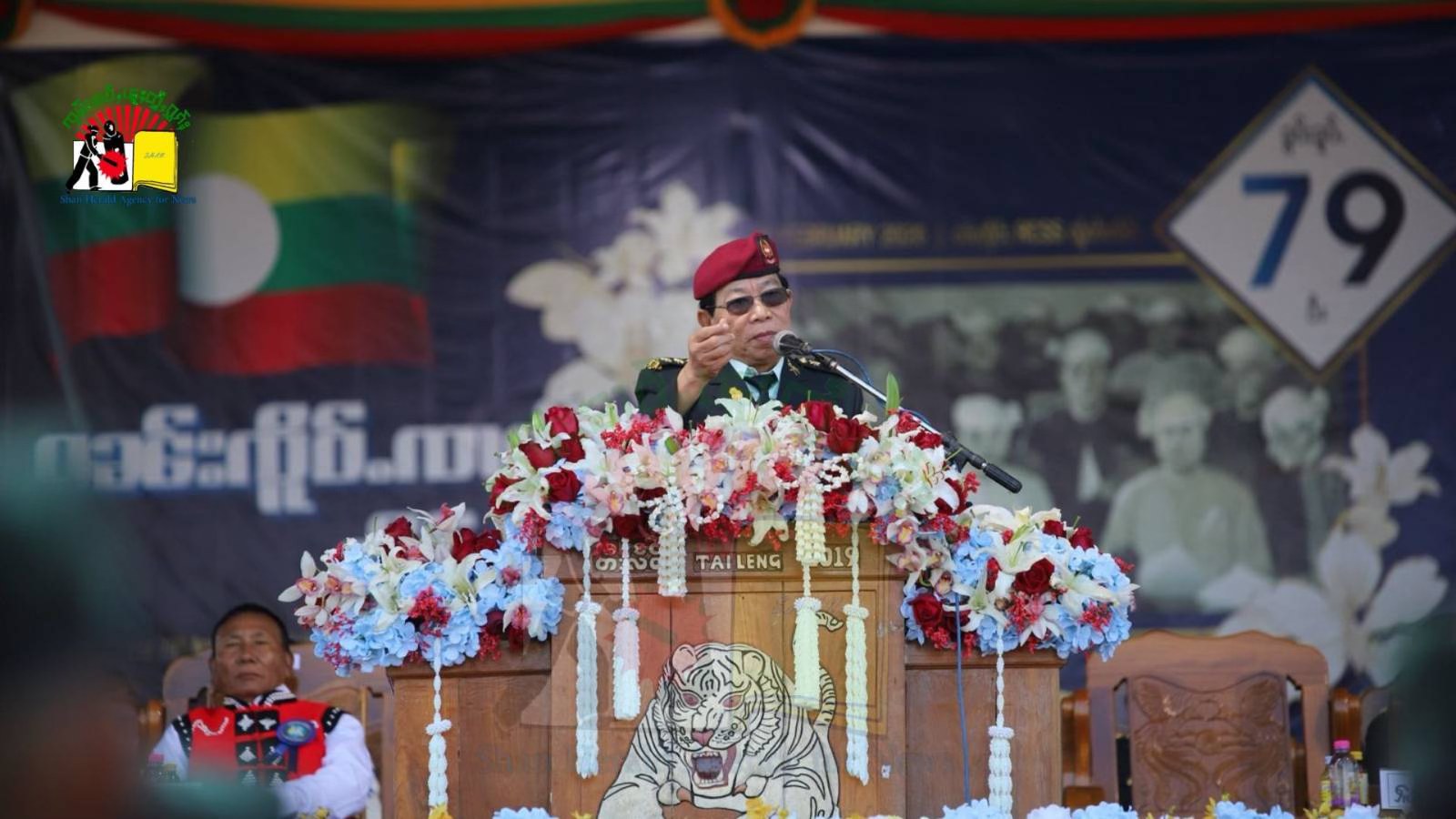
Restoration Council of Shan State/Shan State Army (RCSS/SSA) Chairman General Yawd Serk urged the new generation of Bamar and ethnic leaders to learn from past mistakes and prepare for a better future.
General Yawd Serk made the call at the 79th Shan National Day ceremony held on February 7 in Loi Tai Leng, the RCSS/SSA headquarters in southern Shan State.
He urged the new generation of leaders to first examine their own mistakes rather than blame others, build mutual trust, and implement the promises made in the 1947 Panglong Agreement.
General Yawd Serk also encouraged them to work together rather than seek to defeat, oppress, or outdo one another, and endorsed the establishment of a federal army to ensure the country’s defense and security.
“The revolution is not a fight against individuals, but an effort to dismantle the system. We have endured military conflicts for many years, and they have yet to end. In the end, it is the country and its people who suffer the most,” he said.
He said in his speech, delivered in Shan, that the current military conflict is rooted in leadership failures and the 2008 Constitution.
“The problems remain unresolved because our leaders lack unity. We must also amend the 2008 Constitution, which lies at the heart of the issue. It is exploited to justify staged coups, and when a coup occurs, the country and its people bear the suffering,” he said.
He emphasized that only dialogue among all stakeholders can lead the country to prosperity and that the Tatmadaw (Myanmar military) should also work for the welfare of the nation.
“In reality, the Tatmadaw is carrying out airstrikes on villages and burning homes. Because of this, there’s no hope of reducing the conflict. The country can only find peace if all sides give up aggression and violence and come to the table for dialogue,” he added.
The Shan National Day ceremony at Loi Tai Leng was also attended by representatives from the Shan Nationalities Democratic Party (SNDP), Shan State South National Defense Force (SSNDF), Shanni Nationalities Army (SNA), Pa-O National Organisation (PNO), Lahu Democratic Union (LDU), Democratic Karen Benevolent Army (DKBA), and Chin National Front (CNF).
Since the promises of self-determination and equality in the 1947 Panglong Agreement have yet to be fully realized, the diverse ethnic groups in Shan State remain united in their struggle against the dictatorship and in building a new federal union.
“The reason our country has stayed underdeveloped and fallen behind our neighbors, even after 78 years of independence, is that our leaders have abandoned the middle way, the path that’s balanced and not extreme,” General Yawd Serk said.
He also pointed out that in 2021, people who opposed the Tatmadaw’s coup took to the streets to protest peacefully, but the junta responded with violence, leaving the people no choice but to take up arms and launch the Spring Revolution.
The previous military regime that seized power in 1962 tried to obscure its origins by renaming Shan National Day as Shan State Day, but the Shan people continue to recognize and celebrate it as Shan National Day.
In Shan State, it’s not just the Shan who live there, Pa-O, Palaung, Danu, Intha, Lahu, Akha, Kachin, and Karen communities also coexist. February 7 is not a day for any one group, it marks the foundation for the goal of equal rights for all the people of Shan State.