
Political parties are aiming to secure parliamentary seat quotas in northern Shan State townships, where elections were disrupted by military conflict, through the proportional representation (PR) system.
The junta-led 2025–26 elections employed a Mixed-Member Proportional (MMP) system, combining First-Past-the-Post (FPTP) and proportional representation (PR) voting for Amyotha Hluttaw and States/Regions Hluttaw seats.
In the Shan State Hluttaw, townships and districts designated for the PR system have been grouped into six constituencies. These include areas where voting could not take place, and political parties are aiming to win seats from them proportionally.
“Political parties have put forward proposals to allocate seats proportionally under the PR system in ten townships, Naungcho (Nawnghkio), Kyaukme, Thibaw (Hsipaw), Tangyan, and Mongyai in northern Shan State, and Namhsan, Mantong, Namtu, Momeik (Mongmit), and Mabein in the Palaung Self-Administered Zone. Based on the number of seats available, each party is expected to win between three and five seats,” said a candidate from northern Shan State.
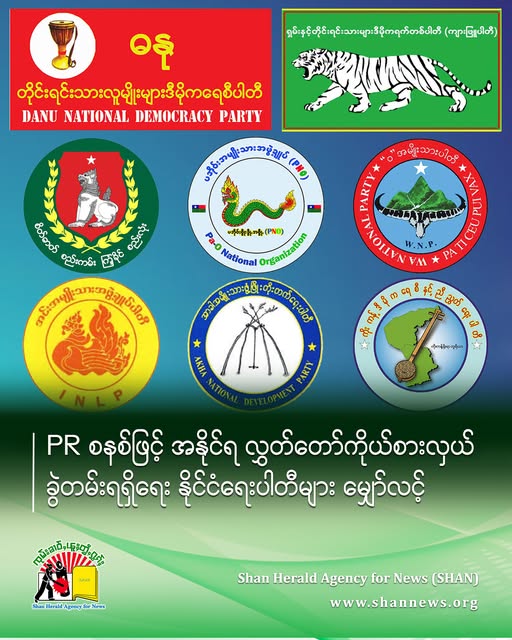
In the 38 northern Shan State townships where voting took place, the main contenders were the junta-backed Union Solidarity and Development Party (USDP), the Shan Nationalities Democratic Party (SNDP), also known as the White Tiger Party, the Pa-O National Organisation (PNO), and the Danu National Democracy Party (DNDP).
In most polling stations, USDP candidates lost the popular vote, but ultimately won when early votes collected from junta battalions were added, rival party candidates said.
The 2008 Constitution mandates that each township elect two representatives to the States/Regions Hluttaw. The junta later amended this, specifying that one be chosen through the FPTP system and the other through the PR system.
For the Shan State Hluttaw, six constituencies to be designated under the PR system, with 55 representatives to be elected through proportional allocation, the junta-controlled Union Election Commission (UEC) announced on August 15 last year.
On September 14 last year, the UEC acknowledged that only 38 of Shan State's 55 townships would be able to hold elections, as the remaining 17 were under the control of ethnic armed organizations (EAOs).
Similarly, the UEC announced in advance that voting for the Amyotha Hluttaw using the FPTP system would not be held in the Palaung and Kokang Self-Administered Zones.
In the recently concluded election, a total of 12 parties vied for seats in Shan State constituencies, 6 at the national level and 6 at the regional level.
Political analysts have suggested that the UEC’s changes to the methods of electing representatives could spark controversies over the selection of States/Regions Hluttaw members under the PR system.
The lists of Pyithu Hluttaw and Shan State Hluttaw candidates who won under the FPTP system have been released, but those who will be elected under the PR system have yet to be announced.