

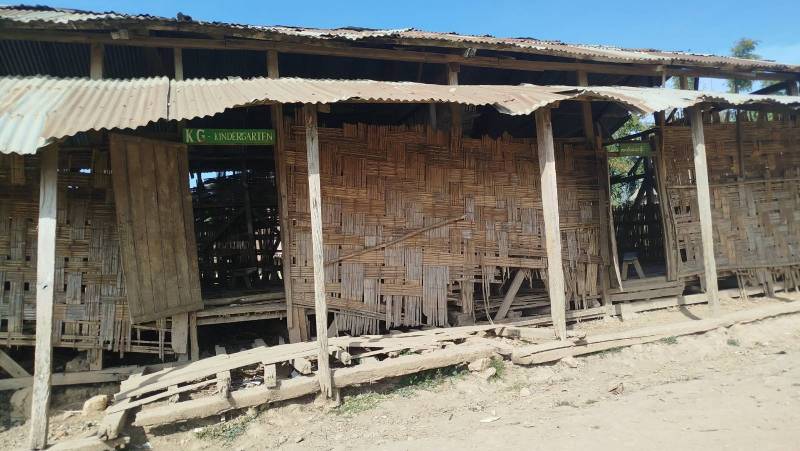
Over 40 schools in Nanyun Township, located in the Naga Self-Administered Zone of Sagaing Region, have closed, leaving local children without access to education, according to a survey by the Eastern Naga Women’s Association (ENWA).
The three-month survey, conducted ahead of the current academic year, reveals a sharp increase in closures across Nanyun’s 110 schools. Last year, more than 20 schools failed to open.
“Teacher shortages affect not only Nanyun but the entire Naga region,” an ENWA official told Mizzima. “Some primary schools offering up to Grade 5 operate with just a single teacher, functioning more like daycare centers than educational institutions.”
Survey respondents cited active conflict, security risks, severe teacher shortages, decaying infrastructure, transport difficulties, and widespread economic hardship as primary causes for the closures.
In some villages, schools have remained closed for over four years, causing many children to drop out or miss basic schooling entirely. Community members warn that the prolonged disruption has led to rising illiteracy, academic delays, child labor, early marriage, substance abuse, and forced recruitment into armed groups.
ENWA emphasized that while governing authorities bear primary responsibility for ensuring public education, local leaders and parents must also play a role. The association called for the immediate establishment of safe learning spaces, provision of teaching materials, and delivery of practical alternative education models.
Dr. Einwei Seingnyu, a scholar of Naga literature and culture, warned that the breakdown of the school system poses a severe threat to the region's long-term human resources.
“With children out of school and youth forced to work to support their families, this prolonged deprivation is alarming,” Dr. Einwei Seingnyu said. “ENWA’s study serves as a vital early warning. We must consider what kind of human capacity we will have in five to ten years.”
She added that extended school closures risk eroding indigenous languages, oral histories, and cultural identity. To mitigate the crisis, she advocated for community-based temporary learning centers, emergency local teacher training, and offline educational resources—such as pre-loaded SD cards, audio lessons, and radio broadcasts—to bypass severe internet restrictions.