
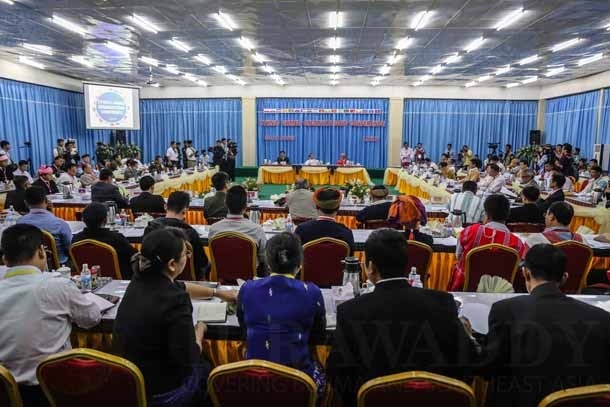
Ethnic armed organisations (EAOs) that did not sign last year’s nationwide ceasefire agreement (NCA) will not participate in the Union Peace Conference (UPC), which started on 12 January in the capital city of Nay Pyi Taw.
The government, who signed the NCA with only eight out of over 20 EAOs on 15 October, invited the EAOs who did not sign the NCA to also attend the UPC, but only to audit the event as observers rather than as participants.
U Htun Zaw, General Secretary (1) of the United Nationalities Federal Council (UNFC), an alliance of ethnic armed organizations (EAOs) founded in 2011 said: “In our UNFC, there are nine [non-signatory] ethnic armed groups. But these groups won’t attend. This is because there won’t be anything special accomplished by the groups joining the conference; we will only be present there as special guests. We won’t get the chance to take part in the discussion and decision-making. So, we decided not to attend.”
The eight EAOs who signed the NCA and were invited by the government to officially participate in the UPC are: the Karen National Union (KNU), the Democratic Karen Benevolent Army (DKBA), the KNU/KNLA-Peace Center, the Restoration Council of Shan State (RCSS), the Pa-Oh National Liberation Organization (PNLO), the Arakan Liberation Party (ALP), the Chin National Front (CNF), and the All Burma Students’ Democratic Front (ABSDF).
The non-signatory groups that the government invited to attend the UPC as observers were: the Kachin Independence Organization (KIO), the New Mon State Party (NMSP), the Shan State Army-North (SSPP), the Karenni National Progressive Party (KNPP). the Arakan National Council (ANC), the Ta’ang National Liberation Army (TNLA) and the United Wa State Army (UWSA) who are all UNFC members as well as non-UNFC members: the National Democratic Alliance Army (NDAA), the National Socialist Council of Nagaland-Khaplang (NSCN-K) and the Lahu Democratic Union (LDU).
But, the government did not invite the Arakan Army (AA) or the Myanmar National Democratic Alliance Army (MNDAA) to the conference.
All the non-signatory UNFC members agreed that none of them would attend the conference.
In an interview with IMNA General Sai La of the SSPP said: "We agree with the UNFCs decision. If all groups attend [the UPC] we will too, but if not we won’t attend either. We also do not think there will be anything special at the conference and another thing is that we do not get to participate in the discussions and decision-making.”
The only non-signatory group that decided to attend as an observer was the NSCN-K.
After analysing the NCA the UNFC issued a statement about the NCA on 5 January that said: "It [the NCA signing] is also not in accordance with Article (2-D) of the NCA, which requires all [EAOs] to sign [the NCA] and the essence of NCA has become spoiled. So long as all-inclusivity is not realised, the Framework for Political Dialogue and the so-called Union Peace Conference emanating from it will lack any meaning. Launching military offensives on the one hand and holding peace talks on the other is not the way to bring genuine, just, and honourable peace. Under these circumstances, just as democracy cannot flourish, a genuine federal union cannot be established.”
Edited in English by Mark Inkey for BNI