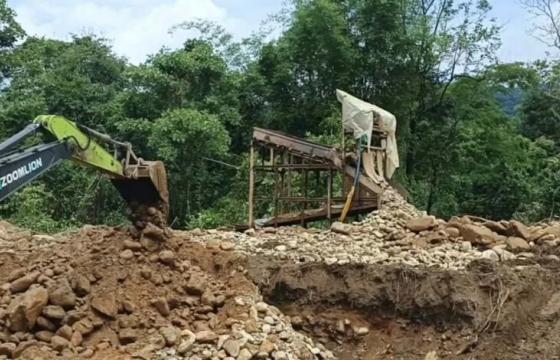

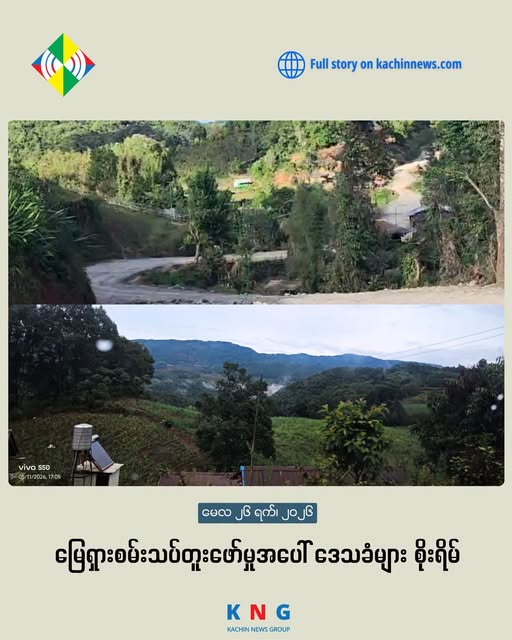
The Kachin Independence Organisation (KIO) has begun test mining for rare-earth minerals in the Manweinggyi area of Mansi Township, Kachin State, drawing opposition from local communities.
Rare-earth exploration has been underway in the Manweinggyi area for about two months, but local communities said they have not been consulted about the activities.
“They’re carrying out test mining near our village. Before starting, they didn’t consult residents; the decision was made at the village committee level and mining began near the village. Earlier, they told us they would leave after completing one round of test mining, but now they’ve started a second round, this time even closer to the village,” a local said.
Rare-earth test mining is currently underway in the Manweinggyi area and Ding Sing Pa Sub-township, as well as around Madangyang and Kaikhteik villages to the south.
Since March, experimental mining has been ongoing near several villages in Manweinggyi, while local objections have been largely disregarded.
In early 2025, a group identifying itself as the Road Repair and Stone Production Association donated 50,000 yuan to each village in the Manweinggyi area, stating that the funds could be used as needed.
Village elders accepted the donations and allocated them to specific needs in each village. However, in early 2026, locals began to realize the donor group’s involvement in rare-earth mining activities.
Since the donations have already been received and used, Manweinggyi residents find it difficult to effectively oppose the rare-earth mining operators.
“Our village’s water quality is poor, and the soil is not very fertile. Even seasonal farming has long been difficult. If rare-earth mining begins and further damages the soil, it’s hard to imagine what the future will look like. It’s really worrying,” a villager in the area told KNG.
The villages and hamlets in the Manweinggyi area are small, and locals are concerned about the potential entry of large-scale rare-earth mining operations.
“Our village is small, and the villages in this area are close to one another. Even if rare-earth mining doesn’t take place in our village, activities in nearby villages would still affect us. So, yes, we are concerned,” another villager said.
Some locals oppose potential rare-earth mining, fearing its negative impacts, while others are open to it if the compensation is attractive, leading to divisions within the community.
Environmental activists warned that rare-earth mining could have long-term negative impacts on the environment, public health, and the social and economic conditions of the affected region.
They said that, in particular, it could lead to deforestation, soil degradation, water pollution and contamination, harm to wildlife, as well as the displacement of local communities, along with security and social issues.
After mining, what often remains is damaged land and polluted water, as observed in areas where rare-earth extraction has taken place.
In 2024, the KIO withdrew a rare-earth mining project in the Inbarpar and Dingsing Pa villages of Mansi Township after it faced unanimous opposition from locals.