
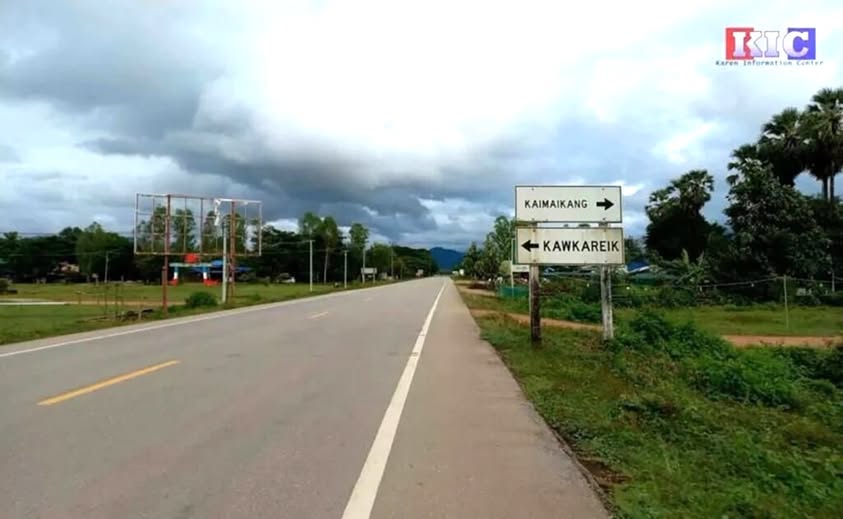
Residents in Karen State said they face mounting difficulties in travel and trade as the junta continues to block a key highway between Hpa-An and Kawkareik townships, along with several inter-village routes, while collecting numerous tolls at checkpoints along an alternative route.
According to locals, the junta has closed the Asian Highway 1 (AH1) Road linking the two townships, as well as several connecting village roads, severely disrupting transportation and the movement of goods.
Since April last year, amid fierce clashes and heightened military tensions in the area, the junta has shut down the AH1 section connecting Hpa-An and the Thai border town of Myawaddy. It has also blocked widely used inter-village roads linking communities such as Kyondoe, Kaw War Le and Nwarchankone.
As a result, residents travelling to Hpa-An must rely primarily on the Zarthapyin–Khayongu route. A journey that previously took around two hours now takes nearly four hours, according to local sources.
“In the past, it took at most two hours to drive from our village to Hpa-An. Since we can no longer use the main road, we have to take a detour through the Zarthapyin–Khayongu section. The trip now takes at least three and a half to four hours. The road is mostly a dirt track, so during the rainy season it becomes extremely muddy. Travelling on it is very dangerous,” a local trader who regularly travels between Kawkareik and Hpa-An told KIC.
Residents also said that checkpoints along the Zarthapyin–Khayongu Road primarily target cargo vehicles for toll collection. The burden has become particularly severe during the current harvest season, when local durians and other seasonal fruits are ripening, with some checkpoints demanding substantial payments from traders transporting agricultural produce.
“For a truck carrying durians, each checkpoint requires at least 20,000 MMK and one durian fruit. Vehicles carrying meat, fish, vegetables or other produce have to pay between 5,000 and 10,000 MMK at every checkpoint. Every time I transport durians to Hpa-An, I spend around 200,000 MMK on tolls alone. Once fuel costs and checkpoint fees are deducted, there is very little profit left,” the trader said.
According to residents, the checkpoints mainly collect money from vehicles transporting goods. Family vehicles used for daily commuting are generally not required to pay tolls, although passengers are occasionally subjected to questioning and inspections.
Residents further alleged that regime soldiers sometimes accuse passengers travelling through the area of having links to the People’s Defence Force (PDF) and then extort money from them. They added that strict inspections and travel restrictions have created numerous hardships for small-scale vendors, local produce traders and people travelling for medical treatment.