
Expanding iron ore mining in some Kachin State areas controlled by the Kachin Independence Organization (KIO) is causing environmental damage and health problems for local communities.
Iron ore mining is expanding in Shwegu and Waingmaw townships, with most operations run by Chinese nationals.
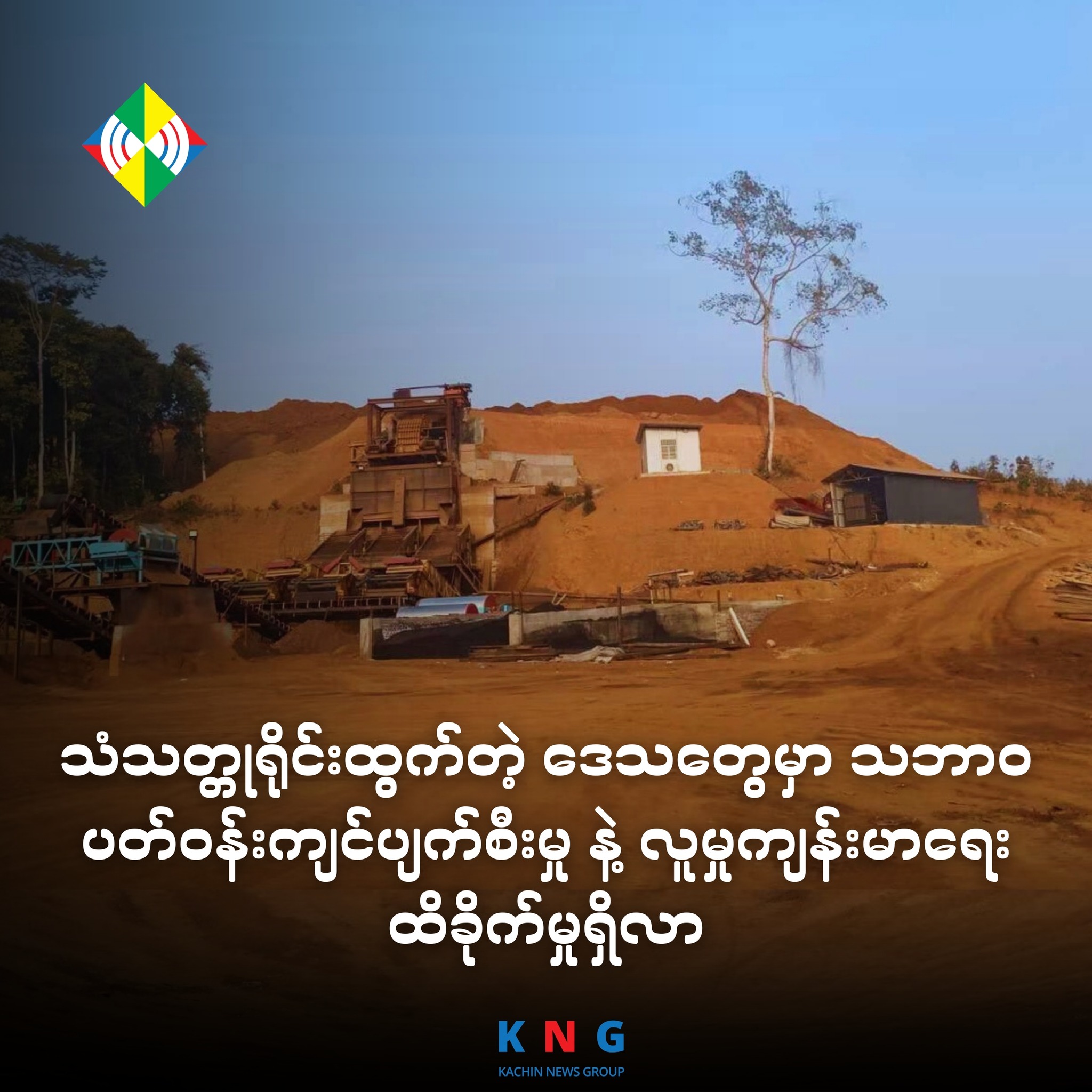
Large-scale iron ore mining began in June 2025 in a forest about five miles east of Sithar and Sithaung villages in eastern Shwegu Township, led by Chinese businessmen, a Shwegu resident said.
“They arrived in the area during the rainy season last year and mined throughout the season. They have continued their operations into this year, using large machinery to extract the ore, load it onto big dump trucks, and transport it to China,” he said.
The iron ore mining operation in Shwegu Township is run by four Chinese entrepreneurs using about 10 backhoes.
“They export the iron ore mined here to China, where it is refined. It is transported through Sithar and Sithaung to Mansi and Mang Weing Gyi, and from there the ore is sent on to China,” the source added.
Trucks carrying the ore usually travel in convoys of 20 to 30, damaging village roads, locals reported.
The iron ore mining site in Shwegu Township is located in an area controlled by Brigade 12 of the Kachin Independence Army (KIA), the armed wing of the KIO. Locals said the mining is being carried out with the KIO’s permission.
Locals are concerned that large-scale iron ore mining will reduce pasture for cattle, limit farmland and terrace farming, and damage water resources.
Iron ore mining requires backhoes and large earthmoving machines to tear down mountain slopes and excavate soil, causing significant deforestation and land degradation. In Shwegu, the mined ore is not separated or processed locally; instead, large lumps mixed with soil are transported to China.
Hsengmaing Village in Waingmaw Township along the Myitkyina–Bhamo Road is another iron ore mining area. Unlike the site in Waingmaw, the operation in Hsengmaing Village processes the ore further, grinding it into powder.
Concerns exist that dust released into the air by the process may cause respiratory health problems for villagers, including children, pregnant women, and the elderly. A filtering pond has also been dug near the site to separate the iron ore from the soil by liquefying it in the pond. The red, dirty water from the pond flows into nearby streams, contaminating them and polluting natural water sources, locals said.
Locals are also concerned that the expansion of iron ore mining will affect farmland their families have worked for generations.
Iron ore mining near Hsengmaing Village began around 2008 under the Htoo Company, owned by tycoon Tay Za. The operations were later taken over by the Myanmar military. Between 2023 and 2024, the KIA took full control of these areas. The KIO then allowed Chinese businessmen to continue the mining operations. The KIO said the permit is for a short period, but locals worry the mining is expanding daily. They also want the KIO to set clear rules for the operations.
When contacted by KNG about public concerns over iron ore mining in KIO-controlled areas, KIO spokesperson Colonel Naw Bu said he would respond at a later and appropriate time.
Iron ore mining also produces minerals such as magnetite, limonite and hematite. These minerals are used to produce iron and steel and are also used in construction and the manufacturing of automotive spare parts.
According to Chinese customs records, iron ore exports from Myanmar to China were valued at about 88 million USD in 2025, 83 million USD in 2024, and 95 million USD in 2023.