
A major shelter construction project for Rohingya refugees in Kutupalong camp has triggered fresh controversy in Cox’s Bazar, as Bangladesh’s Forest Department, local representatives and host-community members raise concerns over hill cutting, environmental damage and the possible long-term implications of stronger refugee housing.
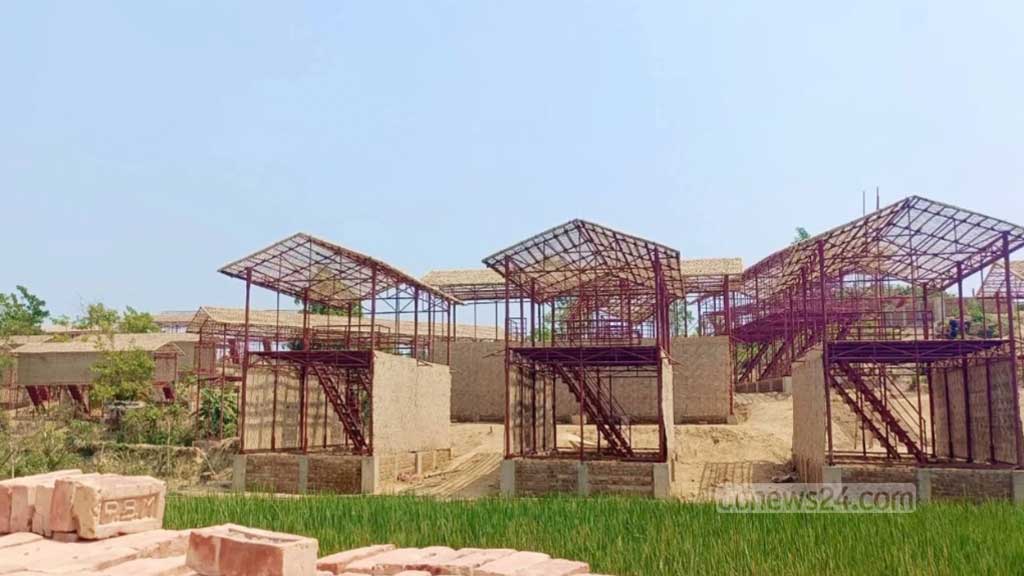
According to Forest Department officials and local sources, nearly 900 two-storey shelters with iron frames and concrete-based flooring are being constructed in Extension “E” block of Kutupalong Camp No. 4 in Ukhiya. The project has reportedly reached 80 to 90 percent completion.
The Refugee Relief and Repatriation Commissioner’s Office and UNHCR maintain that the structures are temporary, disaster-resilient shelters approved by the authorities. But local residents and environmental officials argue that the use of reinforced materials, road construction and hill levelling raise serious questions about whether emergency shelter work is gradually becoming semi-permanent infrastructure.
Forest Department Raises Alarm
Ukhiya Range Officer Abdul Mannan said the area was previously reserved forest land and that hill cutting, road expansion and tree destruction have caused visible environmental damage.
“This is reserved land of the Forest Division,” he said, adding that the department protested after learning about the project but could not directly control work inside the camp area.
Environmental researchers have long warned that the Rohingya influx has caused major ecological pressure in Cox’s Bazar. One study found a 9.58 percent decrease in forest area and an 8.25 percent increase in settlement area between 2017 and 2021 in the affected region.
A World Bank-linked study also examined forest loss around Rohingya camps in Cox’s Bazar, where nearly one million refugees have been hosted since the 2017 influx.
Government Says Concerns Are Exaggerated
Refugee Relief and Repatriation Commissioner Mohammed Mizanur Rahman rejected claims that the structures are permanent, saying the shelters follow a design approved by an inter-ministerial committee in 2021–22.
He said limited concrete flooring is being used only to prevent shelters from being placed directly on the ground. He also said work related to hill cutting had been temporarily stopped following objections.
The government’s position reflects a difficult balancing act: Bangladesh wants to improve safety conditions for refugees while maintaining that Rohingya presence in the country remains temporary.
UNHCR Defends Shelter Design
UNHCR said the shelters are designed to improve disaster resilience in one of the world’s most congested refugee settlements. The agency describes Rohingya shelters in Bangladesh as temporary and says refugees live in highly congested camp settings in Cox’s Bazar and Bhasan Char.
According to UNHCR, the new structures use bamboo, plastic sheets and detachable steel pipes connected with nuts and bolts, making them removable if required.
The Rohingya response’s Shelter-CCCM sector, co-led by IOM and UNHCR in consultation with the Bangladesh government, prioritizes emergency preparedness, climate adaptation and improved camp planning.
NGO and INGO Questions
The controversy also highlights tensions around the role of NGOs and INGOs in camp planning.
International agencies argue that stronger shelters are necessary because Rohingya families face cyclones, monsoon rains, landslides and fires. Recent reporting has shown that fires continue to damage shelters and displace families in Cox’s Bazar, underscoring the need for safer shelter systems.
However, local NGOs and community observers often complain that major infrastructure decisions are shaped by INGOs and donor priorities, while local actors and host communities have limited influence. This has deepened mistrust, especially when projects involve land, forests, roads or permanent-looking construction.
Host Community Opposition Growing
Local leaders say stronger shelters could weaken repatriation efforts by making the camps appear more permanent.
Palongkhali Union Council Chairman M Gafuruddin Chowdhury described the construction as worrying, saying strong infrastructure could create a path toward permanent settlement for Rohingya refugees.
Host communities in Ukhiya and Teknaf have already faced pressure from land loss, deforestation, higher living costs, security concerns and competition over local resources. Earlier assessments found that the refugee population sharply outnumbered host communities in Ukhiya, creating major social and environmental stress.
KPN Analysis
The shelter dispute is not only an environmental issue. It is a political and humanitarian test for Bangladesh, UN agencies and donor-backed NGOs.
For refugees, stronger shelters may mean protection from storms, fires and landslides. For host communities, the same structures appear to signal a long-term Rohingya presence. For the government, the project exposes the contradiction between temporary refuge and the practical need to keep nearly one million people alive in increasingly unsafe camp conditions.
Unless authorities, UN agencies, local NGOs and host communities improve transparency and consultation, shelter projects may continue to deepen public mistrust — even when they are designed for humanitarian protection.