

On a ten-day tour of Asian democracies, US President Barack Obama has chastised Indian legislators for their lack of support for the democratic aspirations of their neighbours ...
Chiang Mai (Mizzima) – On a ten-day tour of Asian democracies, US President Barack Obama has chastised Indian legislators for their lack of support for the democratic aspirations of their neighbours to the east in Burma.
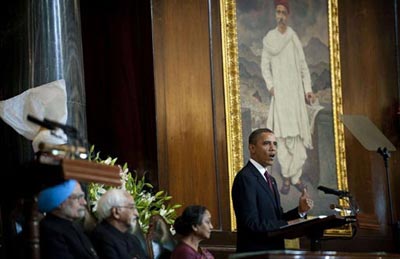 Addressing a joint session of the Indian parliament today in New Delhi, the American Head-of-State, while congratulating India on many of its democratic traditions, singled out the lack of support for democratic rights in Burma as a platform of New Delhi’s at odds with the greater interests of flourishing democratic governance.
“When peaceful democratic movements are suppressed – as they have been in Burma, for example – then the democracies of the world cannot remain silent,” Obama related to his captured audience. “It is unacceptable to hold the aspirations of an entire people hostage to the greed and paranoia of bankrupt regimes. It is unacceptable to steal elections, as the regime in Burma has done again for all the world to see.”
India last month warmly welcomed Burma’s authoritarian leaders, inking a number of memoranda while drawing the ire of Burmese pro-democracy supporters.
“Faced with such gross violations of human rights, it is the responsibility of the international community – especially leaders like the United States and India – to condemn it,” continued Obama. “And if I can be frank, in international fora, India has often shied away from some of these issues.”
“As the world’s two largest democracies, we must never forget that the price of our own freedom is standing up for the freedom of others,” furthered the US Nobel laureate. Obama argued that it is the responsibility of countries such as the US and India to assist in strengthening democratic norms abroad, as well as home.
The remarks came on the heels of Burma’s first general election in 20 years, an event the political opposition, and the United States among others, has derided for failing to hardly meet any criteria of a free and fair polling.
Meanwhile, in New Delhi, a group of Burmese activists staged a sit-in-protest urging Obama and Indian Prime Minister Dr. Manmohan Singh to reject the results of the November 7 election and secure the release of Burmese democracy leader Aung San Suu Kyi.
Reacting to the speech of Obama, Jaya Jaitely, a long-time supporter of the Burmese democracy movement in New Delhi, says she is glad that Obama spoke as he did to India’s policymakers.
Nonetheless, despite Obama’s harsh words reserved for New Delhi’s silence in the face of gross democratic infractions in Burma, his address also held considerable praise for the status of the South Asian behemoth.
The US President lauded India for its electoral heritage, independent judiciary, rule of law and free press, contending that such an environment allows for all voices to be heard.
The varied messages from Obama, however, were only further complicated with his apparent green light to India to engage with Burmese leadership, a policy his administration had championed but has been unable to fulfill owing to staunch political opposition and a perceived unwillingness on the part of Burma’s generals to reciprocate.
Encouraging New Delhi to pursue dialogue with regional security and economic partners, Obama iterated: “Like your neighbors in Southeast Asia, we want India not only to ‘Look East,’ we want India to ‘engage East’ – because it will increase the security and prosperity of all our nations.”
The American president, while not specifically making reference to Burma’s alleged clandestine nuclear weapons programme, reminded Indian legislators of their shared responsibility in preventing the spread of nuclear weapons.
The speech occurred during Obama’s first trip to India. His current tour will also take him to Japan, South Korea and Indonesia. Obama previously entertained Singh during the first official state visit of his presidency.