
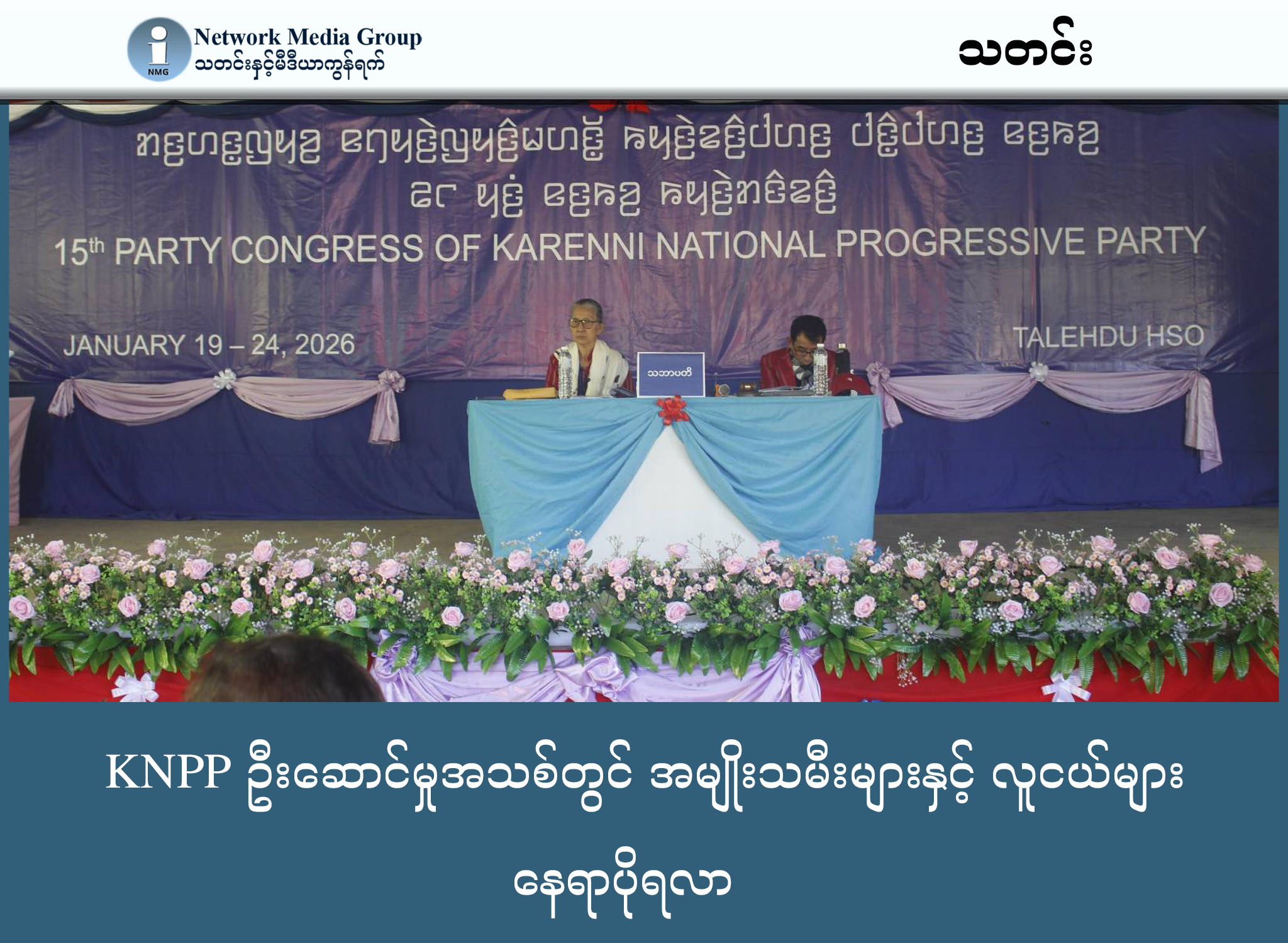
Following the reform of the Karenni National Progressive Party (KNPP) leadership, participation by women and youth in the central committee increased significantly.
The KNPP Congress, held in Talaidusi Town, Sibara Township, Karenni Township from January 19 to 24, elected 30 Central Committee members, including eight women and five young people under the age of 35.
In particular, women now make up half of the KNPP’s 12-member Central Committee, marking a significant shift in the party’s leadership structure.
KNPP General Secretary U Aung San Myint said the party’s future plans aim to better utilize the capabilities of the new generation of youth and provide greater space for women.
“This time, the Congress elected more young people to the committee. In addition, women now make up 50 percent of the 12 members of the Central Committee. As a result, many women are now in leadership positions,” he told NMG.
The KNPP’s top leadership remains unchanged, with Chairman Khu Oo Reh, Vice Chairman Khu Hte Bu, and General Secretary U Aung San Myint continuing in their current positions.
KNPP Vice Chairman Khu Hte Bu, who previously served as Deputy Minister for Immigration in the resistance-run National Unity Government (NUG), resigned from that position on December 24 to focus more on the KNPP.
“Khu Hte Bu was sent by the Interim Executive Council of Karenni State (IEC) to serve as a deputy minister in the NUG. But he said he wanted to focus more on Karenni State affairs, so the Karenni State Consultative Council (KSCC) recalled him. Our people in the NUG don’t just represent our organization, they actually represent Karenni State as a whole,” U Aung San Myint said.
The KNPP is adopting a bottom-up approach to federalism and has pledged to work alongside allied resistance forces in the struggle to establish a future federal democratic union.
“We will keep working hard to uproot the military dictatorship while improving the welfare, strength, and unity of Karenni State beyond what we have now. We also plan to work with other state federal units to develop and implement policies for building a future federal union,” U Aung San Myint added.
The KNPP, founded in 1957, was one of the first groups to join the Spring Revolution after the 2021 coup. It also led the formation of the post-coup IEC and KSCC and successfully managed a state-level administrative system.