

London-based Burma Campaign UK announced on Thursday that Denmark and Latvia have joined 10 other European Union nations in support of a UN commission of inquiry to probe possible war crimes in Burma...
Chiang Mai (Mizzima) – London-based Burma Campaign UK announced on Thursday that Denmark and Latvia have joined 10 other European Union nations in support of a UN commission of inquiry to probe possible war crimes in Burma.
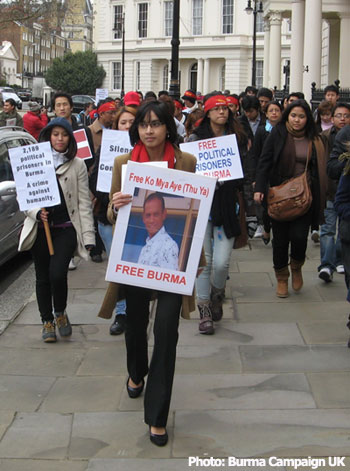 The announcement by the Danish foreign ministry that it ‘supports in principle the establishment of an international investigation into human rights abuses in Burma’ and a similar statement from the Latvian government came after a group of more than 100 Burma activists in London marched to six separate European embassies on Thursday to publicly urge the governments of Luxembourg, Sweden, Norway, Latvia, Denmark and Germany to come out in support of a commission of inquiry.
The marchers were led by Wai Hnin Pwint Thon, the daughter of a jailed Burmese political prisoner, Mya Aye. Mya Aye participated in Burma’s 1988 student-led uprising and was jailed for eight years beginning in 1989 for anti-regime activities. In 2007, he was jailed and given a six decade-long prison sentence for participating in demonstrations with student leaders Min Ko Naing that formed the early part of the Saffron Revolution.
In a statement issued by the Burma Campaign UK, Wai Hnin hailed the Danish and Latvian government’s decisions, saying ‘I am very pleased that two more European countries are supporting a commission into crimes against humanity in Burma. The European Union must now officially support a UN commission of inquiry’.
Latvia and Denmark are now the 11th and 12th EU member states to endorse the proposed commission of inquiry.
The Burma Campaign UK’s renewed push for more nations to support the establishment of a UN commission came three days after UN special rapporteur on the human rights situation in Burma, Tomás Ojea Quintana, released a report to the UN General Assembly in which he reiterated his call for the creation of a commission which he first proposed in a previous report delivered to the UN in March 2010.
Quintana stated in his latest report that due to the ‘systematic nature of human rights violations in’ Burma it is ‘essential for investigations of human rights violations to be conducted in an independent, impartial and credible manner, without delay’.
Germany Embassy calls police on Burma marchers
The Burma Campaign UK also reported on Thursday that in sharp contrast to other European embassies that warmly greeted the marchers and accepted the Burma Campaign letters addressed to the respective European foreign ministers, the German Embassy did not take kindly to the presence of Burma activists picketing its premises.
According to Burma Campaign UK Executive Director Mark Farmaner, when the marchers arrived at the embassy, German foreign ministry officials at first ‘refused to allow the delegation of three into the Embassy’ to deliver a letter urging Germany to support human rights in Burma.
After protest organizers pointed out that the other European embassies happily accepted the letters, the embassy eventually allowed the delegation to hand over the letter during an impromptu meeting in the embassy, but unlike what occurred at the other embassies this was done in the presence of security personnel.
The German Embassy then appeared to retaliate against the protesters by calling the police demanding that the group of more than 100 marchers move away from the embassy proper.
According to Mark Farmaner, the police relayed the demand issued by the German Embassy but then allowed the marchers to stand directly in front of the embassy as the protesters are permitted to do under local law.
Mizzima has requested that the German foreign ministry press office comment on their decision to ask for police intervention has so far not been answered.
In a response to a question asked earlier in the day about Germany’s stance on the commission of inquiry, German foreign ministry spokesperson Sebastian Fischer told Mizzima that Chancellor Angela Merkel’s government is ‘closely following the debate on the establishment and the working modalities of a commission of inquiry.’
Last November, a fellow German government spokesperson told Mizzima that with regards to the calls for a commission of inquiry, ‘to ensure that this new initiative [the inquiry] is successful and has positive consequences, it is important to continue to monitor the situation and crucial to find some co-operation mechanism with the [Burmese] national authorities’.
In a preface to his organization’s most recent state of the world report, Human Rights Watch’s executive director Kenneth Roth criticized the German government spokesperson’s claim that a commission of inquiry needed the assistance of the Burmese regime to move forward.
According to Roth, ‘Obtaining such cooperation from the Burmese military in the absence of further pressure is a pipe dream’.