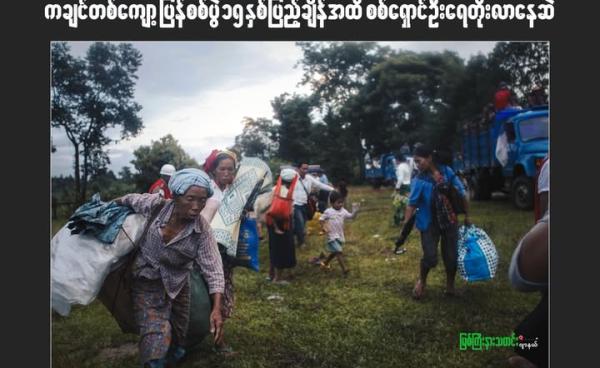
Chronicling the dire humanitarian conditions inside Burma and among refugee populations, the British House of Commons International Development Committee has recommended that the Department for International Development (DFID) seek to raise humanitarian assistance to the country to approximately 70 million dollars by 2013.
The recommendation comes as part of a detailed study, "DFID Assistance to Burmese Internally Displaced People and Refugees on the Thai-Burma Border," released yesterday.
The study lists four aims of its funding activities inside Burma and to refugee communities: health, education, sustainable livelihoods and supporting a transition to democracy.
"The public health situation is particularly worrying. Infectious diseases are approaching epidemic level: currently 71% of the population is at risk of malaria infection, the country has the third highest rate of HIV prevalence in South-East Asia and there are high rates of drug-resistant tuberculosis," reads the report.
While welcoming the 3D Fund for combating communicable diseases, the report recommends that an auxiliary form of the program be established to aid internally displaced and border populations, believing that the 3D Fund does not adequately meet the needs of these high-risk communities.
Additionally 60 percent of households are said to be without any education, while current per capita humanitarian aid, at two dollars and forty cents, is one of the lowest for any nation classified as a Least Developed Country (LDC).
Part of the proposed strategy to reach internally displaced people (IDPs) and communities along the border in largely inaccessible tracts is to channel money through community-based organizations (CBOs) while pursuing an increase in cross-border aid from Thailand.
In 2007/2008 DFID aims to direct an estimated $820,000 to CBOs for disbursement. CBOs are seen as groups that can gain access to otherwise unreachable populations through religious, ethnic and other organizations.
The report goes to lengths to assuage any concerns that humanitarian initiatives will instead lead toward DFID funding the military regime. Stating as a priority that such misuse of funds must be minimized.
"Funding aid work in Burma is fraught with difficulties, but aid can be effectively targeted and implemented, and constraints addressed, if there is sufficient commitment by donors."
In order to address concerns that DFID staff working out of Rangoon will be manipulated by Burmese authorities, the International Development Committee recommends maintaining a high-level presence in Bangkok to ensure a degree of independence.
However the Committee acknowledges that in order to carry out its work a humanitarian dialogue with the regime is a necessity.
"We believe limited engagement on specific poverty and humanitarian issues should begin and that the most sensible approach would be for DFID to do this as part of a group of international actors, under the banner of the UN."
The report calls on the United Kingdom government to encourage other countries to follow DFID's hoped for lead and significantly increase aid to Burma.
However the report also singles out the negative policies and influence of regional powers and neighbors China, India and Russia.
Correspondingly, the report recommends that the United Kingdom government engage these countries in a dialogue regarding their counterproductive approaches and dealings with Burma.
"India's uncritical relationship with the regime, and its appetite for arming and investing in the country, risks perpetuating Burma's illegal and brutal regime," reads the report.
The report lists both women and the Shan community as populations disproportionately neglected in the past and hence worthy target populations in future funding activities.
Since 2001, DFID has increased its funding to Burma from approximately five million to 18 million dollars.
| < Prev | Next > |
|---|