

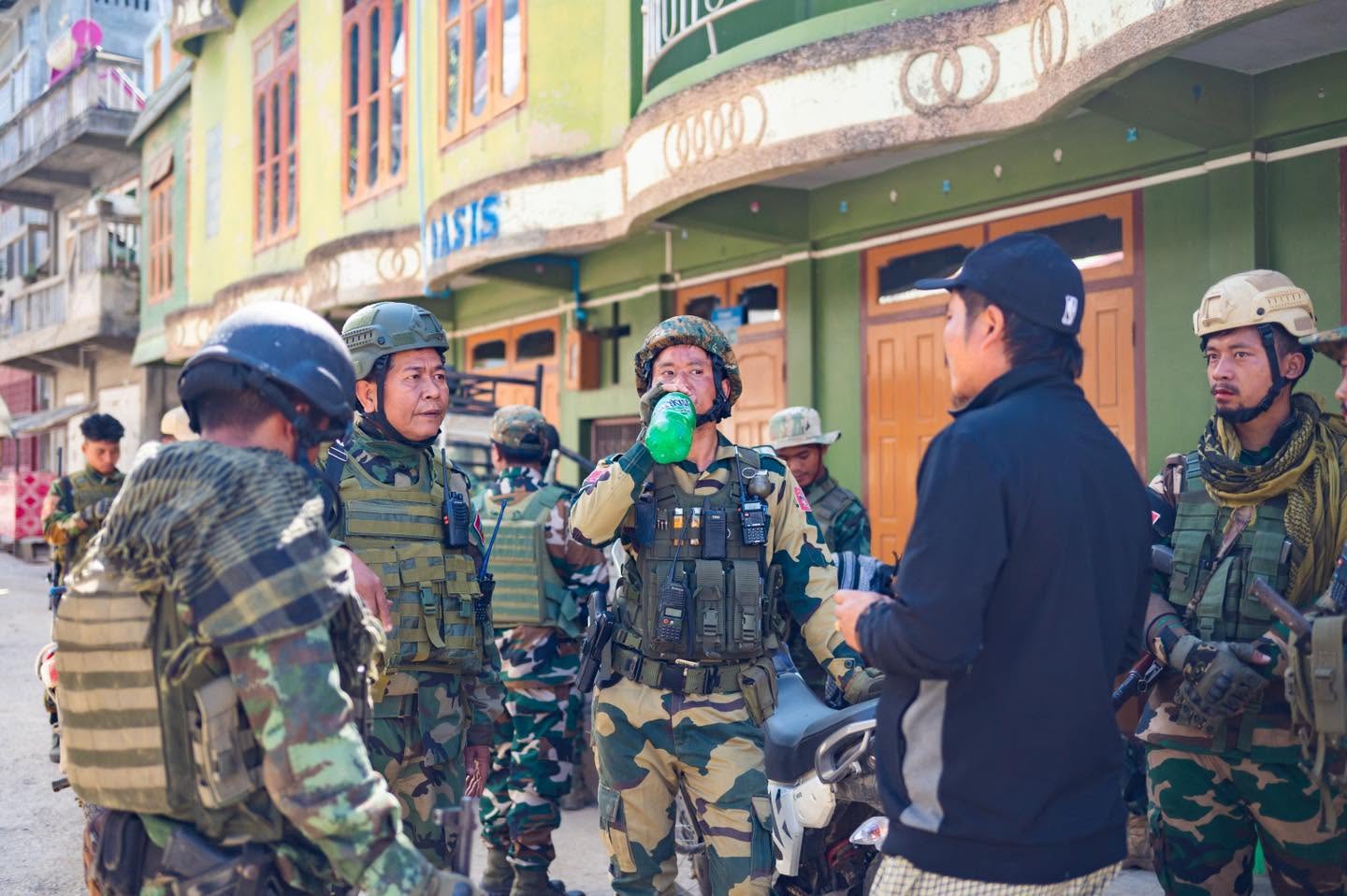
Although the Myanmar military has retaken several towns in Chin State, its administrative reach remains severely limited; Chin resistance organizations continue to control the vast majority of the territory, according to the Chinland Council.
Officials from the resistance-led Chinland Council shared this assessment during a press conference on August 28 following the release of their report, “Building Chinland: Exercising Self-Determination – Two and a Half Years of Alternative Governance by the Chinland Council.”
“Even previously, the junta’s influence in Chin State was confined to urban pockets in select townships, with no real authority over rural areas,” said Dr. Sui Khar, Foreign Minister of the Chinland Council-run Government of Chinland. “Official directives from the regime simply could not reach those regions. "Recently, the junta managed to retake towns such as Tonzang and Falam, but it still struggles to secure them. The regime is primarily focused on controlling key transit routes, such as the highways connecting Kalay in Sagaing Region with Hakha and Tedim in Chin State; it has failed to gain total control."
To secure the Kalay–Tedim and Kalay–Hakha highways, the military has established over 30 outposts and garrisons along the routes—an unprecedented deployment that highlights its precarious grip on the roads rather than firm control.
While the junta has reclaimed most parts of Falam, Tonzang, and Thantlang—towns previously liberated by resistance forces—it has been unable to restore its administrative machinery.
“The limits of the regime’s administrative reach were clearly exposed when it had to exclude numerous areas from its election,” said Salai Kep Chin Thang, secretary of the Chinland Council. “This demonstrates that the military still lacks total control. We retain the capacity to challenge them militarily at any time while maintaining parallel influence even within junta-controlled urban centers. In short, we continue to exert pressure through both military operations and governance.”
Across Chin State, the military’s administrative apparatus functions only in isolated urban centers. In contrast, Chin resistance forces continue to administer most of the territory, including vast rural areas and villages.
“While a few cities, towns, and their immediate surroundings remain under Naypyidaw’s control, the regime’s influence elsewhere is practically non-existent,” Dr. Sui Khar added. “Across those vast rural spans and liberated towns, the Chinland Council leads and operates the administrative system.”
Since the 2021 military coup, the junta has faced widespread armed resistance across Myanmar. In Chin State, various resistance groups initially captured numerous towns and established local governance structures.
Although the regime has launched counter-offensives to retake strategically vital territories, the majority of Chin State remains firmly under resistance control.