
Rescue and humanitarian operations across Rakhine (Arakan) State are facing severe operational bottlenecks due to poor ground-level communication flows and a critical shortage of emergency transport vehicles, local civil society organizations reported.
With Myanmar military junta airstrikes posing a daily threat, aid workers say delayed reporting on bombing targets hinders their ability to deliver rapid medical care and assistance to victims.
“We hear the sound of approaching aircraft and bombs dropping, but due to poor information flow, we don't know where the strike occurred or what happened,” said Ko Pyae Phyo Naing, chairman of the Ponnagyun Youths Association. “We are urging the United League of Arakan (ULA) to establish a dedicated mechanism to accelerate real-time information sharing for rescue groups.”
Local humanitarian groups have called on the ULA’s armed wing, the Arakan Army, to facilitate faster communication so emergency responses across the state can be launched without delay.
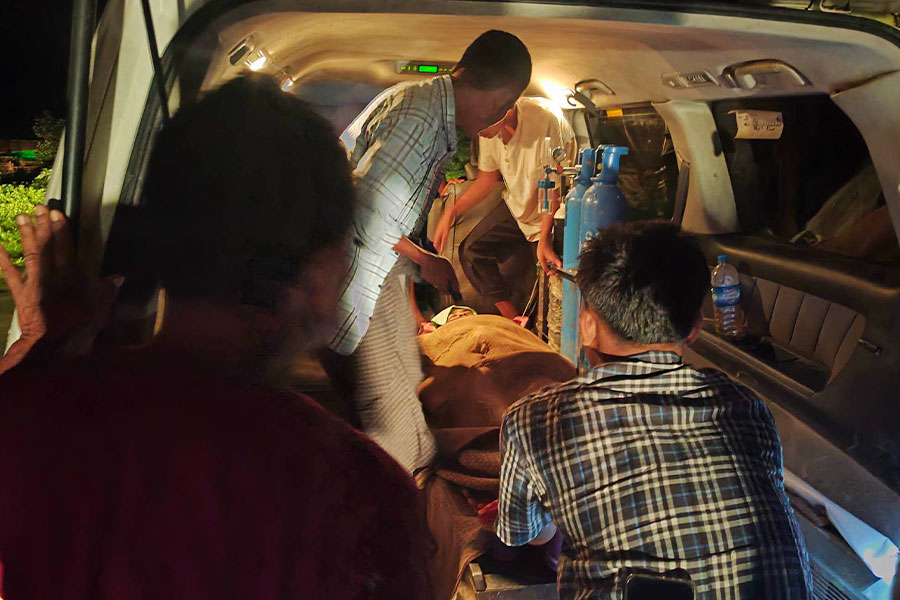
Compounding the intelligence lag, a severe lack of operational transport vehicles has left rescue teams struggling to respond to mass-casualty events.
“Our foundation has three vehicles, but two are broken down because we cannot afford to repair them,” said Ko Khaing Hein Htet, chairman of the Phyu Sin Yin Khwin Foundation. “With cluster bombings occurring frequently, we often face incidents with nearly a dozen casualties at once. When that happens, our available transport is completely inadequate.”
Ko Khaing Hein Htet added that declining domestic and international funding has prevented humanitarian organizations from repairing or expanding their fleets, forcing them to operate under severe constraints.
Civil society groups have been the backbone of local relief operations since intense fighting broke out across Rakhine State.
However, mounting logistical hurdles, severe security risks, and resource shortfalls have forced numerous local NGOs to cease operations entirely, leaving the remaining groups overwhelmed as civilian casualties continue to mount.