

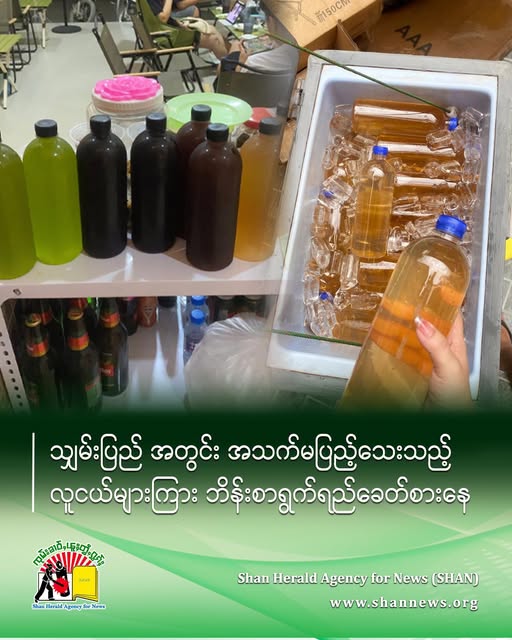
Kratom juice consumption is becoming more widespread among young people, including minors, across Shan State, with some individuals openly selling it.
The use of kratom juice, extracted from the leaves of the tropical evergreen kratom tree native to Southeast Asia, was first observed in Tachileik, Monghsat, and Mongton townships in eastern Shan State around the time of the February 2021 coup, before gradually spreading across Shan State among young people.
Today, many young people, including girls under the age of 18, are consuming kratom juice as a recreational beverage.
Kratom juice is being openly sold and consumed in Mong Hsu, Wan Hai, Namhsan, Panglong, Laihka townships in southern Shan State, as well as Tangyan, Mongyai, and Lashio townships in northern Shan State, a witness told Shan Herald.
“I frequently travel between northern and southern Shan State, and I see many shops selling kratom juice in towns and cities along the way. I’ve also bought and tried it myself. It was not very common before, but now it is widely available, with many shops selling it openly,” he said.
Some consumers said that people also mix the juice with beer, wine, or other alcoholic beverages.
“Our shop sells kratom mixed with soft drinks, and people under 18 also buy it. It comes in different flavors, so the taste is quite acceptable. Girls tend to prefer kratom juice more,” said a shopkeeper in Tangyan Town.
A bottle of concentrated kratom oil costs between 25,000 and 30,000 MMK and is reportedly exported from Tachileik Town in eastern Shan State, which borders Thailand, to both northern and southern Shan State.
Merchants reported that authorities have not taken action to curb or address the growing consumption of kratom juice among young people in Shan State.
Kratom was removed from Myanmar’s list of controlled drugs in 2023, and the United Nations Office on Drugs and Crime (UNODC) also does not classify it as a drug, making its use difficult to treat as a criminal offense.
Mitragynine, a compound found in kratom leaves, may help relieve pain, reduce inflammation, and ease some symptoms associated with drug withdrawal, according to a 2024 medical study from Chulalongkorn University in Thailand.
However, the study also highlighted that excessive use or combining it with other drugs can cause health problems, and that it should not be used by children, pregnant women, or people with liver or kidney disease.
Additionally, the research suggested that kratom use can cause side effects such as rapid heartbeat, dizziness, and nausea. Its potential medicinal uses are still being studied.