

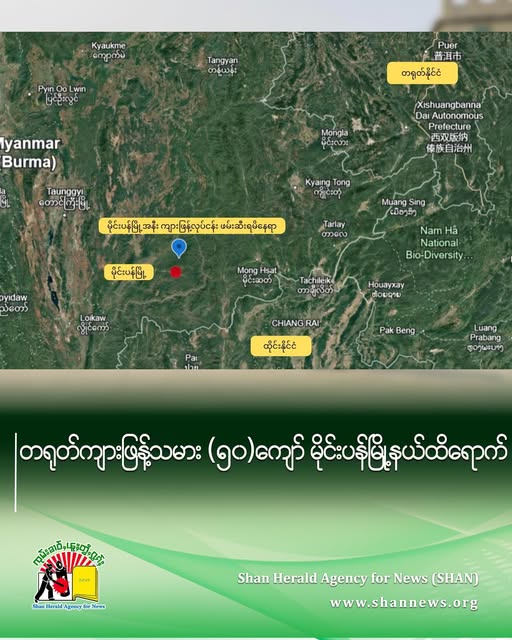
The junta announced it had arrested 52 telecom scammers who had reached Mong Pan Township in southern Shan State.
The junta released photos of a telecom scam hideout covertly built and operated in a forest near the road linking Kengtawng town—about 20 miles north of the township seat, Mong Pan town. A raid on the site on April 24 reportedly led to the arrest of 52 Chinese nationals and 4 Myanmar nationals.
A Mong Pan resident told Shan Herald that the Chinese telecom scammers could not have infiltrated the township without the backing of armed groups and authorities.
“The telecom scam compound in Mong Pan Township is quite far from the Thai border, so it’s usually almost impossible for Chinese scammers to enter from Thailand or Laos because the checkpoints along the way are very strict. The only way they could have reached Mong Pan is with the support of certain organizations or the authorities,” he said.
The route connecting Mong Pan and Kengtawng towns—where the telecom scam hideout is located—is an area where the junta, the Restoration Council of Shan State/Shan State Army (RCSS/SSA), and several local armed groups are active.
“None of the locals knew the scammers were hiding in the forest. It would be impossible for them to operate there without links to armed groups. And, both the junta and other armed groups are active in the area,” the source added.
The junta said that during the raid, it found computers had been burned to destroy evidence and discovered three scam workshops, eight residential huts, one all-in-one PC, 12 laptops, 4 Starlink devices, 4 power stations, 2 generators, and other equipment.
Locals said that if the junta had effectively, or even actively, cracked down on Chinese telecom scammers, such criminal activities would have already disappeared from Myanmar. They accused the coup regime of only carrying out symbolic or showcase operations against these networks. This is the first time such operations have been uncovered and nabbed in Mong Pan Township.
“It’s possible the junta deliberately allowed these scammers to enter Mong Pan through connections with its allied militias, and then arrested them as a kind of showcase operation—I’d say that’s about a 50–50 possibility. Locals had no idea such an operation was running in the jungles around Mong Pan, and everyone was surprised when they heard about the arrests,” the aforementioned Mong Pan resident said.
The telecom scammers hiding in the forest did not come into Mong Pan town or buy supplies, so residents believe that armed groups may have helped provide them with food and other necessities.
The junta has carried out more visible, but largely superficial crackdowns on these criminal operations following warnings from the U.S. Federal Bureau of Investigation (FBI) that it may pursue telecom scammers across international borders if needed.
On April 27, the junta arrested a total of 52 Chinese and Myanmar telecom scammers in Tachileik Town in eastern Shan State.
Similarly, on April 29, 28 Chinese nationals and 12 Myanmar nationals involved in telecom scam operations were arrested in Muse Town in northern Shan State.