
Bangladesh’s Refugee Relief and Repatriation Commissioner (RRRC), Mohammad Mizanur Rahman, has welcomed a new humanitarian food assistance programme funded by the King Salman Humanitarian Aid and Relief Centre (KSrelief), describing it as a vital contribution to sustaining Rohingya refugees and strengthening bilateral ties between Bangladesh and Saudi Arabia.
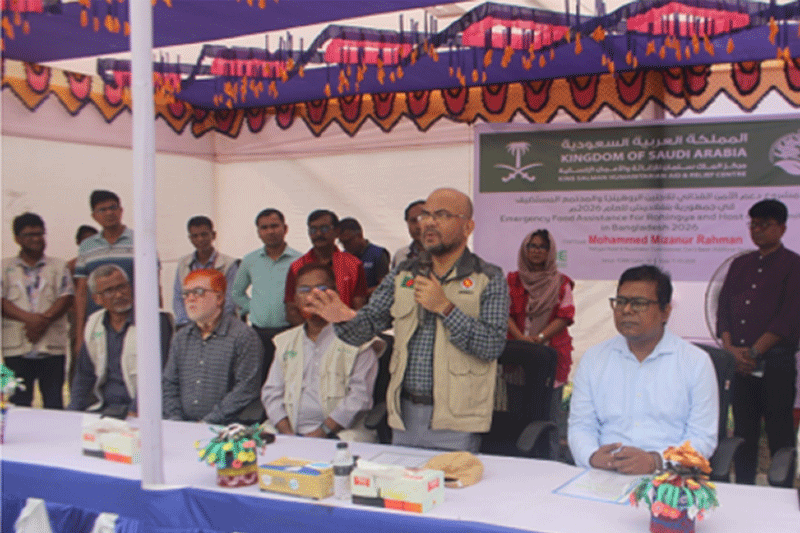
The programme, launched at Kutupalong-Unchiprang Camp-22 in Cox’s Bazar, will provide food assistance to approximately 60,000 vulnerable families, including 42,000 Rohingya refugees and 18,000 members of host communities. The initiative is being implemented by ISDE Bangladesh.
Speaking at the inauguration ceremony, Mizanur Rahman emphasized that Bangladesh has continued to provide shelter to Rohingya refugees on humanitarian grounds for nearly a decade, while international partners have played a critical role in sustaining essential services.
He noted that the KSrelief-supported assistance, particularly during the holy month of Ramadan, would significantly help address food insecurity and nutritional gaps among vulnerable populations, including children, widows, elderly individuals, and persons with disabilities.
Each beneficiary family is receiving essential food items, including rice, lentils, cooking oil, sugar, and salt.
Rahman also reiterated Bangladesh’s position that humanitarian assistance, while necessary, cannot substitute for a durable political solution. He stressed the urgent need for safe, voluntary, and dignified repatriation of Rohingya refugees to Myanmar through strengthened international cooperation.
The programme is chaired by SM Nazer Hossain of ISDE Bangladesh, with participation from camp authorities, humanitarian officials, and Rohingya community leaders.
Investigative Analytical Context
The continuation of large-scale humanitarian aid underscores the protracted nature of the Rohingya displacement crisis, now approaching a decade without meaningful repatriation progress.
While donor-funded interventions such as those by KSrelief remain essential, analysts warn that chronic dependency on aid is deepening structural vulnerabilities within refugee camps. These vulnerabilities intersect with developments inside northern Rakhine State, where reports indicate increasing militarisation, movement restrictions, and coercive practices affecting Rohingya civilians.
Humanitarian actors have also raised concerns that food insecurity and funding shortfalls may increase susceptibility to exploitation, including forced recruitment, trafficking, and irregular migration attempts—trends increasingly documented among Rohingya populations on both sides of the Bangladesh–Myanmar border.
In this context, aid programmes serve not only as relief mechanisms but also as stabilisation tools in a fragile regional security environment, where humanitarian deprivation can directly influence protection risks.