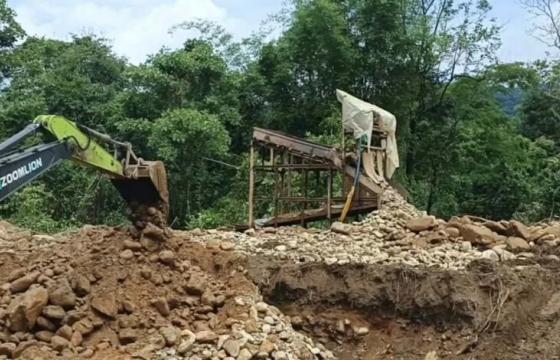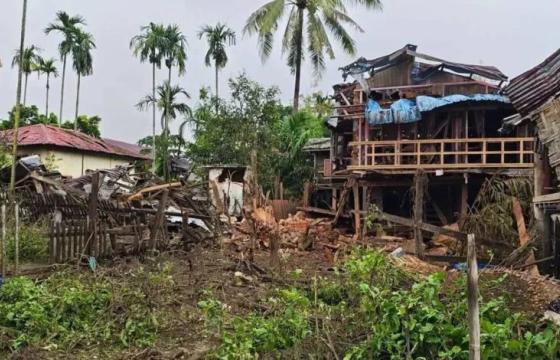

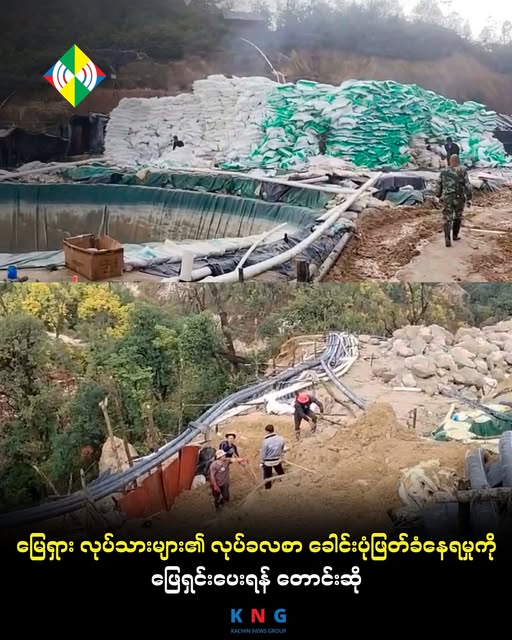
Workers at rare-earth mines in Mongjaryang and Inkhaungpar villages in Momeik Township, Kachin State, are demanding an end to wage exploitation and irregular pay.
The basic monthly wage for miners at rare-earth sites in the two villages near the China border is typically set between 2,600 and 3,000 yuan, but many workers said they often wait nearly five months to be paid.
“When wages aren’t paid on time, we have to borrow money just to get by. When we ask why our pay is delayed, the middlemen tell us the Chinese employers haven’t paid them yet. We can’t ask the employers ourselves because we don’t speak Chinese. They only pay us once every four or five months, and even if the monthly wage is set at 3,000 yuan, we often receive only 1,000 yuan, with the rest delayed. This situation is very difficult for us,” said woman from a miner’s family.
When mine workers seek explanations for delayed or underpaid wages, they can only raise their concerns with interpreters and labor leaders, while some Chinese-speaking supervisors reportedly exploit miners by taking a share of their pay.
Last year, mine workers lodged complaints about wage exploitation with the Mongjaryang branch of the Kachin Independence Organization (KIO), which controls the area, but the situation remained unchanged.
“We went to the KIO office to complain and ask for help, but the officials told us they had not encouraged us to work at the mining sites, implying it was our own choice and not their responsibility. We had no one else to turn to and felt very helpless,” the aforementioned woman added.
When asked by KNG about complaints that workers at rare-earth mines in Mongjaryang and Inkhaungpar are not receiving full wages and are being exploited, KIO spokesperson Colonel Naw Bu responded:
“The KIO has a policy to protect the livelihoods of the public. When people are hired to work in mines, they do so based on agreed wages and terms between the company and the employee. If they are not paid in full, they have the right to file a complaint with us. However, we are not aware of the specific details of the cases in Mongjaryang. What I want to emphasize is that the KIO sees it as its duty to protect people’s livelihoods, and those who are truly facing hardship can reach out to us,” he said.
He added that the KIO has urged mining companies to ensure the public does not suffer.
Similarly, mining workers said that at rare-earth sites around Pang War town in Chipwi Township, supervisors linked to Chinese employers are oppressing and abusing workers.
“Some supervisors are very obsequious toward Chinese employers while oppressing the workers under them. There are many like this,” a worker from a Pang War mining site said. In Chipwi and Pang War, workers at some mining sites had still not received their January salaries by March.
Since the KIO took control of rare-earth mining deposits across Kachin State, companies have been paying workers even lower wages, with miners in Mongjaryang and Inkhaungpar particularly hard hit by the cuts.
There has been a sharp increase in rare-earth mining sites along the China–Kachin State border, including in Chipwi, Pang War, Momauk, Mongjaryang and Inkhaungpar. In Momauk Township, the number of sites rose from just 9 in 2021 to more than 40 by the end of 2023, according to a Global Witness report released in May 2024.
Reports by several research groups claimed that the KIO charges a tax of 35,000 yuan per metric ton of rare-earth mineral production and also takes the equivalent of 2 tons for every 10 metric tons exported across the border. It is therefore believed that, in addition to collecting taxes from the mines, the KIO also generates income by selling minerals to China.
According to the Global Witness report, Shitu Shewei–Shewei Huisheng, a rare-earth industry association based in Yunnan Province, China, mediates disputes between local workers and Chinese companies.
Additionally, the Institute for Strategy and Policy–Myanmar (ISP-Myanmar) reported that Chipwi and Momauk townships have more than 370 rare-earth mines and 2,700 mineral filtering ponds, with over 240 of the mines expanded after the coup.
Myanmar’s rare-earth mineral production rose steadily year by year—from 5,000 tons in 2018 to 25,000 tons in 2019 and 30,000 tons in 2020—before slightly declining to 26,000 tons in 2021. Despite this, the country remained the world’s third-largest rare-earth producer for four consecutive years, according to a United States Geological Survey report.
Myanmar’s rare-earth production currently stands at about 26,000 metric tons annually, with China as the main buyer.