
(Special Analysis Report on 2025 Chin State Election)
DonBosco — The 2025 election, held by the coup military commission for the first time since the 2021 coup in Myanmar, has created the most significant legitimacy and representation crisis for Chin State. Out of the nine townships in Chin State, elections could not be held in seven at all; instead, the 2025 election was conducted as "Phase 1" only in Hakha, Tedim, and Khaingkam, which are under the control of the military commission.
Chin State Election 2025: Seat Allocation by Parliament and Party
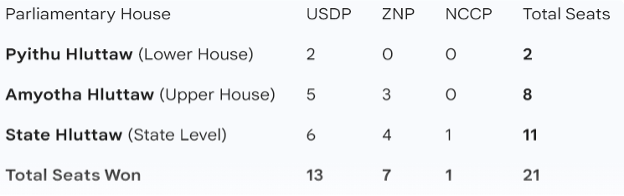
On December 28, elections were held for a total of 21 seats across three parliamentary houses: two Pyithu Hluttaw (House of Representatives) constituencies, two Amyotha Hluttaw (House of Nationalities) constituencies under First-Past-The-Post (FPTP), one Amyotha Hluttaw constituency with six seats under Proportional Representation (PR), two State Hluttaw constituencies under FPTP, and one State Hluttaw constituency with nine seats under PR.
In this election, for the Amyotha Hluttaw seats of Chin State, the Union Solidarity and Development Party (USDP) won five seats while the Zomi National Party (ZNP) won three. For the Chin State Hluttaw seats, the USDP won six, the ZNP won four, and the New Chin Congress Party (NCCP) won one. For the Pyithu Hluttaw seats, the USDP won both constituencies in Hakha and Tiddim.
This process is an attempt by the coup military commission to nullify the 2020 election results and the public's will, implementing their "Political Exit Strategy" through a new Proportional Representation (PR) system. In Chin State, 83 candidates from the USDP, NCCP, ZNP, People’s Pioneer Party (PPP), and Khumi National Party (KNP) contested the election.
Voter Statistics & Comparison
Before the 2021 military coup, Chin State had a population of over 500,000; however, Chin civil society organizations estimate that approximately 250,000 people have fled the state due to conflict and for their survival since 2021. Reflecting the lack of substance in the current election, one observer noted: "It is natural that there is little interest in voting for an election that was held after nullifying the 2020 results and excluding the popular winning party, the NLD. That is the reality".
Voter Data for Hakha and Tiddim Townships
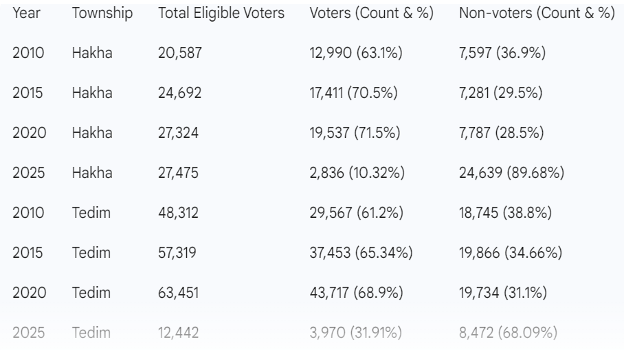
Note: The figures for 2010, 2015, and 2020 represent the entire township, including urban and rural areas. The 2025 list for Tiddim is only for the areas where the election could be held, which is why it is lower than previous years.
In 2025, due to regional instability, although there were 27,475 eligible voters in Hakha Township, only 10.32% (2,836 people) actually voted.
Brief Analysis of Voting Data
Ground Situation of the Election in Hakha
The 2020 election saw the highest voter turnout in Hakha's history at 71.50%. Compared to the 2025 turnout of 10.32%, public participation was exponentially higher in previous years.
Among the 2,836 people who voted in Hakha in 2025, local military battalions and police forces based in the town were also major participants. It can be concluded that the over 600 "advance votes" received were from such security forces and departmental staff. In summary, the voting situation in Hakha appeared to be more of an administrative process based on government employees and armed forces rather than the willing participation of the local public.
A department head disclosed that this voter count was achieved through systematic pressure: "Staff members were instructed that, except for those who were ill, everyone must go to vote on the election day itself and were not allowed to cast advance votes. Regarding the large number of advance votes, I don't know about the military circles". Despite such forced voting, the low turnout remains a major obstacle for the military council’s search for legitimacy.
The scene on election day was also the complete opposite of previous years. A Hakha resident said: "On election day, people no longer gathered with friends to go as they used to. There were only groups of two or three people going to the polling stations". This proves that the happy tradition of communal voting after church service has vanished, replaced by people going to polling stations out of fear. The fact that only 2,820 (10.32%) out of 27,324 eligible voters in Hakha cast their ballots demonstrates the total disengagement of town residents and internally displaced persons (IDPs) residing in Hakha.
Ground Situation of the Election in Tedim
Similar to Hakha, Tedim Township had seen a gradual increase in public participation throughout successive elections since 2010. Specifically, voter turnout reached 68.20% in the 2020 general election, but dropped significantly to 31.91% in 2025, more than halving compared to the previous election.
However, Tedim's turnout of 31.91% is notably higher than Hakha's turnout of around 10%. The main factor for this is the participation of the locally based Zomi National Party (ZNP). Tiddim residents have strong party loyalty to the party representing their ethnic group, leading them to vote despite security challenges to ensure their party’s victory.
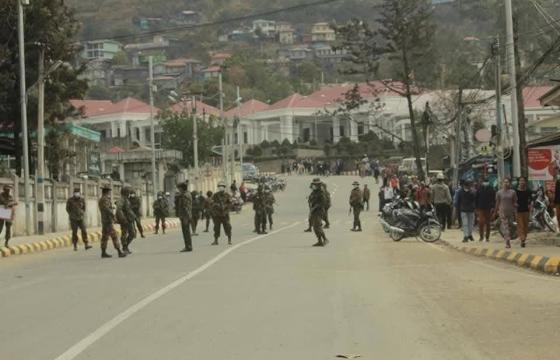
Regarding security, the blockades and attacks by CDF-Hakha were intense even within the urban areas of Hakha, leading the public to boycott by not leaving their homes at all. In Tiddim, although PDF-Zoland blocked the town's entrances and exits, there was slightly more opportunity for some urban residents and party supporters to reach polling stations in five urban wards and in Khaingkam.
Furthermore, the inclusion of over 600 advance votes in Tiddim's results is a noteworthy point. Out of a total of 3,970 voters, this number of advance votes is proportionally high and primarily consists of departmental staff and those close to armed organizations, which numerically boosted the public participation rate.
Across both townships, only 6,806 out of 39,917 eligible voters (17.05%) participated in the election held by the military commission. The sharp decline in turnout in Chin State, which historically had high participation rates since 2010, signifies an active boycott by the public.
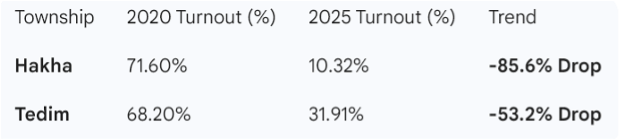 Analytic Note: The higher turnout in Tedim compared to Hakha is attributed to Zomi National Party (ZNP) loyalty and a relatively less intense urban conflict compared to the total blockade in Hakha.
PR System and Seat Inflation: Results of Systematic Pre-planning
Although the military commission could only hold elections in two townships, it utilized the PR system to strategically inflate the number of representatives. According to the allocation for Chin State Hluttaw, the USDP won 14 out of a total of 21 seats (66.6%) in both Union and State legislatures. Additionally, the fact that the new NCC party secured one seat in the State Hluttaw due to the PR system is a result of the military commission’s Proxy Party Mechanism.
During the campaign, USDP candidates promised, "If we win, there will never be another coup," according to one attendee. However, this appears to be a form of institutional capture, gaining an advantage through the system rather than through public support. Although the new PR system used by the Union Election Commission (UEC) is ostensibly for multi-party inclusion, it is found to be systematically designed for the USDP and pro-military groups to gain dominance within the parliaments.
Pyithu Hluttaw and the Military Council's "Winner-Takes-All" Strategy: Paving the Way for Government Formation
As the Pyithu Hluttaw is the key pillar in shaping the Union-level administrative machinery, the military council did not apply the PR system here. Instead, they maintained the original FPTP system to "completely" capture seats in urban constituencies where they have an advantage.
Securing Government Formation
The Pyithu Hluttaw is crucial in electing the President and Vice Presidents. By combining the 25% military representation with FPTP wins for the USDP, the military council created an advantage of strategic dominance to manipulate the government formation as they wish. This is an "Administrative Capture" strategy, attempting to seize the administration of the entire country using results from only a few townships where elections could be held.
Amyotha Hluttaw and the Military Commission’s Strategic Dominance
The Amyotha Hluttaw is a house created to ensure equal rights for ethnic states. Since its members have nearly a veto-like impact on Union-level legislation and policy decisions, the military commission carefully calculated to achieve strategic dominance here, effectively silencing the voice of Chin State within the Union Parliament.
The eight Chin MPs created through the PR system (5 USDP + 3 ZNP) are intended to serve as "Voting Machines" supporting the military council's agenda rather than advocating for the interests of the Chin people at the Union level. Under an FPTP system, two MPs with full public support could have a loud voice in the Union; however, these eight MPs multiplied by PR lack legitimacy due to their high numbers but low representation, rendering Chin State's voice meaningless in Union-level discussions.
The military commission exploited mathematical weaknesses when calculating results to inflate the number of seats. If the FPTP system had been used, only U Paung Lun Min Thang (ZNP) and U Thla Htan (USDP) would have been elected to the Amyotha Hluttaw. Instead, by using PR, the USDP's few votes were aggregated to "create" five MPs. This act is a mathematical trap designed to gain an advantage over the public's will.
The USDP obtaining five seats in the Amyotha Hluttaw was not an accident. It was intended to build a solid "Majority Bloc" by combining with the 25% military representation when forming the Union government or passing critical laws in Nay Pyi Taw. While the USDP should have only received one seat under FPTP, the PR system gave them five "gift" seats, providing the military council with extra votes for Union-level decisions. This is not only a mathematical trap of the people’s will but also a destruction of the Union’s democratic balance.
Diplomatic Manipulation with False Representation
By showing a total of 10 MPs from Chin State (eight in Amyotha Hluttaw and two in Pyithu Hluttaw) attending the Union Parliament, the military council can falsely claim to the international community that "ethnic groups are fully represented in our country". However, as all 10 individuals have no contact with the public in seven townships (77%) of Chin State, their representation is merely "Hollow Representation". The decisions made by these MPs at the Union level will not improve the lives of the Chin people on the ground but will only serve to prolong the military council’s administration.
The military commission's move to increase USDP seats in the Amyotha Hluttaw by 500% (from one to five) using the PR system is a calculated strategic move to manipulate future Union-level politics as they desire.
Chin State Hluttaw: USDP Dominance through Exploiting Minority Parties (Divide and Capture Strategy) and Political Façade
The allocation of seats in the State Hluttaw is even more complex and strategically planned than the Amyotha Hluttaw. If the winner-takes-all FPTP system had been used, only four representatives from Hakha and Tedim would have emerged for the State Hluttaw; however, the PR system inflated this to 11 seats.
The key point to note here is the granting of one seat to small parties like the NCC through the PR system. This benefits the USDP in two ways:
Multi-party Illusion: It creates an image to deceive the international community by showing that even small ethnic parties receive seats. The new ethnic NCC party did not win directly in any constituency but was strategically given one seat in the State Hluttaw through PR so the military commission could show the world that ethnic parties also won in their election.
Fragmentation of Votes: By fragmenting ethnic tribal votes between the NCC and ZNP, the path was cleared for the USDP to easily dominate with six seats (over 50%).
The transition to the PR system for the Amyotha Hluttaw and State Hluttaw was intended to split the strong vote counts of ethnic parties like the ZNP and create more seats for the USDP.
Status of State Government Formation
As it has been officially announced that Phase 2 and Phase 3 of the election will not proceed in Chin State, no representatives will emerge for the remaining seven townships, leaving only the 11 elected members from Hakha and Tiddim. Compared to the history of 2010, 2015, and 2020, where a stable government was formed with 18 elected members and six military representatives (totaling 24) for the entire state, there is now a state of political vacuum where even the emergence of a government is uncertain.
Nevertheless, the military commission may forcibly form a "Partial Administration" by combining the current 11 members with the 25% military representation (approximately four members) to demonstrate technical legitimacy. If a government is forcibly formed, the pool of human resources for ministerial positions will be so narrow that nearly all MPs would have to become ministers, resulting in a "Virtual Government" with no actual authority on the ground.
Representatives without Representation and Lack of Political Recognition
The military council may try to use the elected Chin representatives to mask its illegitimate administrative machinery under the guise of "Chin people discussing among themselves". This is a strategic calculation to drive a political wedge between revolutionary forces—the Chinland Council (CC) and Chin Brotherhood (CB)—or to use these representatives as intermediaries in ceasefire negotiations to give the military-controlled "Virtual Government" actual power on the ground.
However, this attempt to create an intermediary based on shared Chin ethnicity is unlikely to work in practice. These representatives were elected with very few votes (e.g., only 10.32% in Hakha) and thus lack representation for the entire Chin people and moral legitimacy. Therefore, any attempt to use them as intermediaries will be viewed by Chin revolutionary organizations not as dialogue partners, but as a "political deception" designed to prolong the military dictatorship, potentially complicating the conflict on the ground further.
Although the Chinland Council (CC) and Chin Brotherhood (CB) have differing political paths, they both clearly and firmly opposed the military council's 2025 election with a unified stance. Commenting on this situation, a senior advisor to the Maraland Territorial Council (MTC) stated: "I don't think those who win in this election can do anything. From a revolutionary perspective, this election is not recognized, and it is impossible to talk with those who won".
The Vanishing Essence of Representation
While the 10 Chin representatives sent to the Union Parliament are responsible for representing the voice of the entire state, the fact that they all come from only two out of nine townships creates a massive Legitimacy Deficit. One candidate who contested a Pyithu Hluttaw seat shared their position: "Whether liked or not, the election is over for Tedim District. ... I hope for the expansion of the civil space and for a political landscape to emerge. Beyond being elected or not, I feel I have fulfilled a certain duty as my conscience is clear regarding my reasons. No matter who wins, a shift is needed".
While this statement emphasizes individual "conscience" and "fulfillment of duty," the actual political reality remains far from the hoped-for "expansion of civil space". This is because the election was intended to build a "Democratic Facade" for the military commission rather than providing genuine representation for the people. While representatives may consider themselves to have fulfilled their duties, in practice, they lack public trust and are likely to be viewed in history as "Political Stooges" serving the military council's political exit. Thus, the "shift" expected from these representatives does not lead toward the democracy desired by the public, but toward a facade of political movement leading to a new landscape that prolongs the military dictatorship.
The results of Chin State's 2025 election may show success on paper through statistics, but politically and socially, it is a total failure. Attempting to form a government or take seats in the Union with 21 members from only two townships of a nine-township state cannot gain international legitimacy. It only pushes Myanmar’s politics into a deeper constitutional impasse. This 2025 multi-party election landscape, attempted by the coup military council as a political exit, may affect Myanmar and Chin politics to some extent.