
As the junta intensifies its attempt to reclaim lost territories nationwide, resistance forces have also launched renewed offensives against areas still under coup regime’s control, military analysts noted.
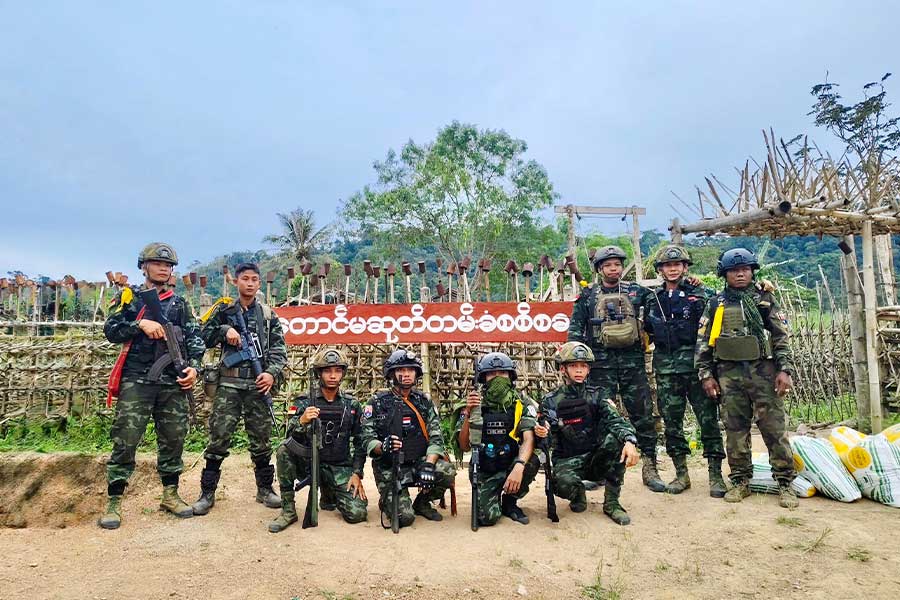
A coalition led by the Karen National Liberation Army (KNLA), which had besieged Mawdaung Town in Tanintharyi Region’s Tanintharyi Township for months, began its final push on November 11 and succeeded in capturing the town on November 14.
The fall of Mawdaung came as the junta was scrambling to retake territories it had previously lost. Military analysts said the sudden loss of the town exposed how the regime’s vulnerability, and complacency had cost it dearly. They added that resistance attacks targeting junta positions with weak communications and fragile supply lines could give anti-regime forces a decisive advantage.
“For the junta, it’s a case of being caught off guard. Resistance forces should target camps and positions that the mainland can’t reinforce quickly, especially where communication lines are weak. If our forces can launch practical, well-timed strikes, we can capture towns with minimal casualties, like in Mawdaung. That’s why we have to keep fighting. Whenever we can attack, the military gains will follow automatically,” said Captain Zin Yaw, a former junta officer who joined the Civil Disobedience Movement (CDM), in which civil servants and security personnel refuse to work for the regime.
Despite the junta’s heavy offensives, it continues to suffer significant losses from the resistance’s coordinated counterattacks.
On November 14, more than 40 junta soldiers were captured by the KNLA-led coalition during the Mawdaung clashes. On November 11, the Arakan Army (AA) announced that about 70 junta soldiers had surrendered with their weapons.
Meanwhile, resistance groups are doubling down on attacks in areas where the regime is weakest, and analysts predicted that a major offensive could also emerge in mainland Myanmar, where the National Unity Government’s (NUG) combat units primarily operate.
“In northern Shan State, the junta has been able to take back some territories because the Ta’ang National Liberation Army (TNLA) hasn’t been cooperating with its allies. And the recent fighting in Kanbalu Township in Sagaing Region shows that we can also overpower the enemy’s military strength with our own in Anyar (Myanmar’s central dry zone). If the NUG can lead a general offensive in mainland Myanmar with support from ethnic allies, the whole military balance will clearly shift,” said Maung Tamar, a political analyst.
Fighting continues to intensify across the country ahead of the upcoming election, as the junta aims to hold polls even in towns currently under resistance control, prompting it to escalate efforts to reclaim them.
In a statement on November 11, the AA said it has been carrying out defensive operations and counteroffensives in response to junta attacks along Arakan State’s borders with the Bago, Magway, and Ayeyarwady regions.