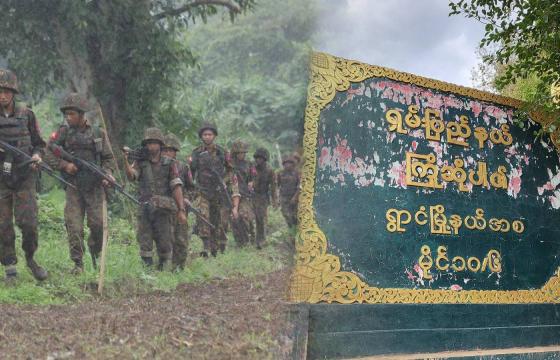
After retaking Naungcho (Nawnghkio), Kyaukme, and Thibaw (Hsipaw) in northern Shan State, the junta reopened the Mandalay-Lashio Road, which had been closed for nearly two years.
As a result of Operation 1027, which began on October 27, 2023, the Three Brotherhood Alliance, comprising the Myanmar National Democratic Alliance Army (MNDAA), Ta'ang National Liberation Army (TNLA), and Arakan Army (AA), seized control of trade routes in northern Shan State, effectively halting cross-border trade between China and Myanmar.
Among these routes, the junta reopened the Mandalay-Lashio Road, a key trade route that had been closed for nearly two years, on October 18, a motorist using the road said.
“Traveling from Mandalay, the main city in central Myanmar, to Naungcho, Kyaukme, and Lashio in northern Shan State is now possible. But right now, only small passenger cars can use the road. Big trucks still can’t travel there,” he told Shan Herald.
The Kyinthi Bridge between Kyaukme and Thibaw and the Goketwin Bridge between Naungcho and Kyaukme are still temporarily closed to heavy trucks, as they were damaged during the fighting and have not been fully repaired yet.
Previously, the trip between Mandalay and Lashio took just over four hours, but now, with more than 20 checkpoints along the way, it takes about 10 hours because of frequent inspections.
“Anyway, with the road open again, getting around northern Shan State has become a bit easier. Before, travelers had to take a detour through Taunggyi in southern Shan State, which meant spending a night on the way. Now, the trip can be done in a day, and it’s a bit cheaper too,” said a trader from Muse Town in northern Shan State.
The fare for traveling the Mandalay-Muse route has also come down, from 200,000 MMK to 150,000 MMK. And for the passenger-only service using Crown and Mark II vehicles, the price has dropped from 500,000 MMK to 450,000 MMK per person.
But when it comes to importing goods from China, traders now have to pay two to three times the taxes they used to.
“There are some challenges when transporting goods from China to Mandalay. If the goods aren’t imported legally or haven’t had the taxes paid, checkpoints along the way often seize them. So, bringing in goods ends up costing a lot along the road,” the Muse resident trader added.
So, each truck carrying goods often has to spend between 200,000 and 700,000 MMK just to get through the checkpoints. Drivers have to carry a lot of cash with them on every trip.
Those involved in border trade are closely watching to see if the junta can fully reopen all trade routes in northern Shan State after retaking Lashio, Thibaw, Kyaukme, and Naungcho with China’s support.
Lashio, now back under the junta’s control, is a key economic hub for northern Shan State’s trade. It sits at the crossroads of routes linking major China-Myanmar border trading posts, Muse and Chinshwehaw, to Mandalay.
“We’ve heard that the junta plans to focus on reopening the whole Mandalay-Lashio-Chinshwehaw route now that it’s back in control of Lashio. Only after that will it gradually move on to reopening the Mandalay-Muse Road. They’re expected to make a deal with the MNDAA so goods coming from Chinshwehaw can pass through Theinni (Hsenwi), which is controlled by the MNDAA,” a 30-year-old Muse resident said.
Among the border trading posts in northern Shan State, Nandaw, Sinphyu, and Manwein in Muse are under the junta’s control. The Kyansangkyawt border gate in Muse’s 105-Mile trading zone is jointly controlled by the Three Brotherhood Alliance, while Chinshwehaw, Laukkai, Monekoe, and Pang Hseng (Kyu Koke) are controlled by the MNDAA.
The junta has repeatedly asked China for help in regaining control of border trade routes, worth billions of dollars each year, from ethnic armed groups, but so far, China has not agreed.
Not only that, but on January 19, China reopened the Yanlongkeng and Chinshwehaw border gates controlled by the MNDAA, along with the Namtit gate under the United Wa State Army (UWSA), all of which had been closed after Operation 1027.
China also reopened the Kyansangkyawt border gate, controlled by the Three Brotherhood Alliance, though not very visibly. As a result, the alliance was able to start collecting taxes online on vehicles passing through Muse’s 105-Mile trading zone at the Kyansangkyawt gate beginning July 1.
The border gates in Muse Town, controlled by the junta, allow goods to pass through, but only small amounts that a person can carry, not large-scale shipments.
Muse is a major border trading town, with total trade in the 2022–23 fiscal year amounting to 33.924 billion USD. Of this, exports were valued at 16.575 billion USD and imports at 17.349 billion USD, according to the junta’s Ministry of Commerce.