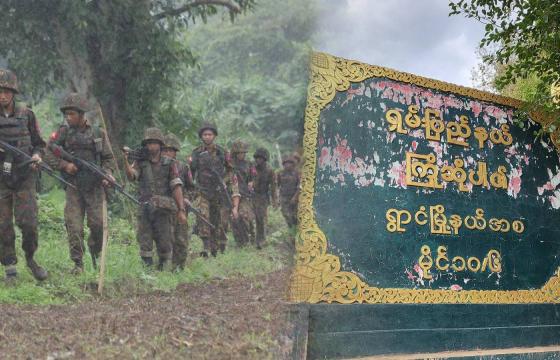

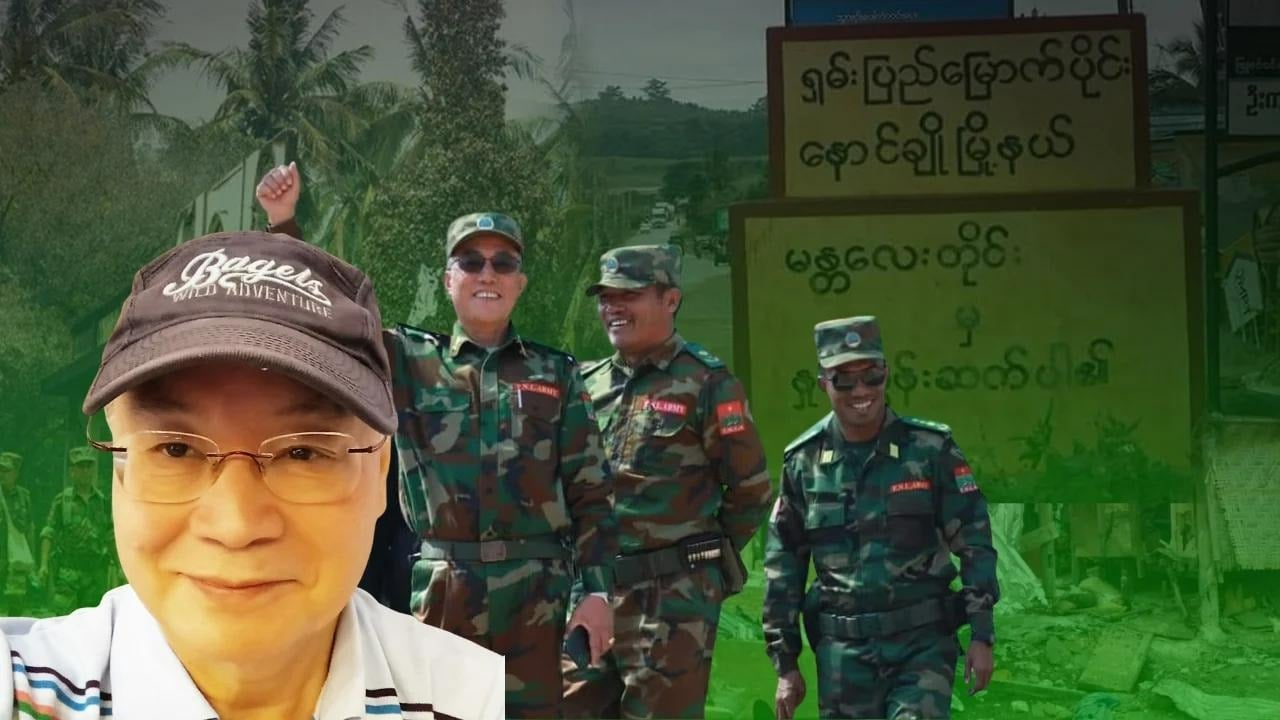
Operation 1027, launched by the Three Brotherhood Alliance, a coalition of three ethnic armed organizations (EAOs), marked a significant shift in the political and military landscape of Shan State. Two of the Alliance’s members, the Ta’ang National Liberation Army (TNLA) and the Myanmar National Democratic Alliance Army (MNDAA), had previously seized large swathes of territories in northern Shan State. However, pressure from the Chinese government, combined with large-scale counteroffensives by the junta, has forced the TNLA and MNDAA to relinquish parts of their gains.
On October 27 and 28, Palaung ethnic armed group TNLA and junta representatives met in Kunming City, in talks brokered by the Chinese government, resulting in a ceasefire agreement. Before the deal was reached, due to massive junta offensives, the TNLA had already lost control of Naungcho (Nawnghkio), Kyaukme, and Thibaw (Hsipaw) in northern Shan State, which were towns it had captured during Operation 1027.
Under the ceasefire agreement, the TNLA also pledged to withdraw from Momeik (Mongmit), a town in northern Shan State, as well as from Mogok in neighboring Mandalay Region. The TNLA has agreed to hand over these towns to the junta, raising questions about whether this move is a step toward expanding junta control ahead of the junta-led election in December.
Shan Herald Agency for News (SHAN) reporter Sai Hseng Leng interviewed Shan political analyst Sai Wansai to discuss how recent developments could affect both the political and military landscape of Shan State.
SHAN: After the October 27–28 talks, the TNLA and the junta reached a ceasefire agreement. As part of that deal, the TNLA agreed to hand over the towns of Mogok and Momeik to the junta. How do you see this development?
Sai Wansai: Overall, this should be seen as a compromise. Recently, the TNLA has faced heavy setbacks, and I think it chose this path to reflect on the situation. The TNLA needed to manage the damage, while the junta will continue to do whatever it can to gain the upper hand. So, I see the current development as the result of both sides acting according to their own interests.
SHAN: The junta retook Naungcho, Kyaukme and Thibaw towns by military action. The TNLA also resisted at that time. Now there is no fighting and the TNLA has stopped resisting. Why do you think this is?
Sai Wansai: The TNLA’s fierce resistance in the battles of Naungcho, Kyaukme, and Thibaw may have been driven by the belief that negotiating with the junta was unnecessary at that time. Since then, however, the TNLA has engaged in both negotiations and military actions, reflecting a period of indecision. It is likely they chose the path they considered most appropriate for that moment.
In the case of Mogok and Momeik, the TNLA appeared to favor prioritizing a negotiated ceasefire. Meanwhile, the United Wa State Army (UWSA), which had been supplying arms to the TNLA, stopped its support under pressure from China. Additionally, the TNLA acted unwisely and harshly in its dealings with allies. Its relations with other EAOs in Shan State—the MNDAA, the Kachin Independence Army (KIA), and the Shan State Progress Party (SSPP)—deteriorated. The TNLA also mistreated the People’s Defence Force (PDF) and the Mandalay PDF (MDY PDF), who had come from the plains to provide assistance. As a result, despite seizing large areas of territory, the TNLA lost its ability to manage them effectively and was no longer able to control the situation properly.
On the other hand, the TNLA lacks the resources to replenish its depleted weapons and ammunition. At the same time, the junta became highly focused on targeting the TNLA, making it increasingly difficult for the TNLA to withstand the regime’s attacks. As a result, the TNLA found the option of reaching a compromise with the junta more compelling than continuing the fight. When China intervened and encouraged a ceasefire during the ninth meeting in Kunming, the TNLA reached a deal with the junta. That is why it agreed to return Mogok and Momeik.
SHAN: TNLA spokesperson Lway Yay Oo once blamed the SSPP for opening the roads, which led to the TNLA losing Thibaw Town. The SSPP also responded to these allegations. Based on this incident, I would like to ask: what consequences can criticism and blame among EAOs lead to?
Sai Waisai: I see this incident as a case of inter-ethnic tension—that is, conflict between ethnic groups living in the same area. In fact, the SSPP and TNLA have coexisted for a long time, and there is a historical record of the two groups joining forces to drive out the Restoration Council of Shan State (RCSS). Since both the RCSS and SSPP are Shan groups, the likelihood of a military conflict was low. However, the SSPP valued its alliance with the TNLA more, which led it to take action against the RCSS.
The TNLA and SSPP were originally allies, but the TNLA’s actions became the main factor behind the rifts that later arose between them. The TNLA sought to expand, showing a desire to take over territories without regard for local communities. After fighting and driving out the junta, it began to exercise excessive control over the areas it held, undermining local literature, culture, and customs, and mistreating the people. As a result, it lost public support.
At the same time, the public also directed blame at the SSPP, particularly among the Shan ethnic groups. People accused the SSPP of failing to respond effectively while the TNLA oppressed the population, despite the taxes, funding, and contributions they had provided to the SSPP. This led to resentment toward the TNLA and frustration with the SSPP’s inability to offer protection.
In conclusion, the primary cause of the bitterness between the two groups is the TNLA, though the SSPP also bears some responsibility. The SSPP failed to protect the people it was meant to safeguard when they needed help, while the TNLA oppressed locals who were never supportive of it in the first place. This has led to ethnic tensions in areas where they should not have existed. The current situation, therefore, does not look promising.
SHAN: The people have already suffered from the junta’s coup, and now they are also bearing the consequences of rifts between the EAOs. What steps can be taken to prevent these ethnic tensions from worsening?
Sai Waisai: To prevent ethnic tensions from escalating, both top-down and bottom-up approaches must be properly implemented. Policymakers, in particular, need to be thoughtful and strategic. They must always remember that Shan State is a multi-ethnic state, home to diverse communities living together. If we cling to the notion that certain areas belong exclusively to the Palaung or the Shan, harmonious coexistence will remain out of reach.
If we want to live in harmony, we must first accept the reality of a multi-ethnic state. Once this acceptance is in place, the next step is to identify ethnic characteristics and interests that are acceptable to everyone. We must engage in dialogues and negotiations until a solution that satisfies all parties emerges. Efforts like those of Hkun Pan Sein in the past, who worked to form a Shan State government representing all ethnic groups in the region, should be recognized and built upon.
If we divide the region into separate portions and claim each as our own, peaceful coexistence will be impossible. Even with good top-down policies, it is essential to educate the public through social organizations and NGOs, creating conditions that foster mutual understanding, friendship, and harmony.
Only then can inter-ethnic conflict be overcome. As I mentioned earlier, insightful top-down and bottom-up approaches are necessary. Without a broad vision and by clinging to narrow ethnic ideologies or chauvinism, there can be no foundation for mutual understanding. The most fundamental requirement is that all stakeholders accept the concept of a multi-ethnic state; without this, living together peacefully will remain extremely difficult.
SHAN: TNLA Secretary General Tar Bone Kyaw has offered explanations on social media regarding the ceasefire agreement with the junta. He said the TNLA opted for the ceasefire because the timing was right, the group was under intense pressure, and it needed to regroup. Should these explanations be understood to mean that fighting could resume in the future, and that the current ceasefire is only temporary?
Sai Waisai: In my view, he is speaking in a circumlocutory, double-edged way, offering explanations that lack real practical substance. His words can be read in two directions. One interpretation is that the ceasefire reflects a weakened TNLA that needs time to regroup. Another is that internal divisions have emerged within the TNLA, with one faction pushing for a ceasefire while another prefers to continue fighting.
As I mentioned earlier, the TNLA’s downfall stemmed from its own policy errors. Its actions were driven by greed, an excessive desire to expand its territory, and mistreatment of other ethnic groups. Put simply, the TNLA expelled the PDF and LDF (local defence force) units that had once supported and fought alongside it. It also tried to bully and intimidate the SSPP, KIA, and MNDAA. These missteps alone led to the TNLA’s setbacks.
Now the TNLA can no longer seek help from its former allies. Tar Bone Kyaw has not apologized for the TNLA’s mistakes, and the group’s current strength is nowhere near enough to stand against the junta on its own. Because the TNLA mistreated its allies, those groups are now reluctant to assist it. The junta understood this dynamic and applied intense military pressure, striking the TNLA hard. In the end, the TNLA walked into the very trap the junta had set for it. Its downfall is the result of its own lack of strategic thinking and poor policy decisions.
SHAN: During the eighth round of talks in August, the junta demanded that the TNLA withdraw from all the towns it controlled except Mantong and Namhsan. However, during the ninth round of talks, the junta agreed to a ceasefire in exchange for the TNLA handing back only Mogok and Momeik. Does this indicate that the ceasefire is temporary? And is there any possibility that this move is connected to the upcoming election the junta plans to hold?
At that time, the junta demanded that the TNLA return all towns except Mantong and Namhsan, which caused the talks to fail. The junta then launched a series of relentless airstrikes on TNLA-controlled areas. Eventually, the TNLA offered to withdraw from Mogok and Momeik, and the junta accepted. This can be seen as a temporary ceasefire, but it may also be a move by the junta to facilitate the upcoming election.
The TNLA appeared to believe it could negotiate with the junta to retain more territories by signaling that it would not disrupt the junta-led election. So, the agreement may be both a short-term ceasefire and something linked to the election. For the TNLA, it could also be a damage-control strategy to prevent further losses and protect the areas it still holds. The junta likely accepted the deal because it believed it would gain an advantage if the election proceeded as planned.
SHAN: We all know the TNLA didn’t take Mogok and Momeik on its own, the PDFs operating in the area helped them a lot. So, when the TNLA decided to withdraw from those towns, it faced a lot of criticism. The PDFs even said it would defend the towns as best as it could. What’s your take on this situation?
Sai Waisai: The criticisms are understandable. The TNLA was able to capture many towns only with the help of its allies and the support of the people for the resistance forces. The people have always hated junta rule. So, it’s not surprising that people criticized the TNLA for handing over the towns to the junta on its own, without any resistance. On the other hand, the locals aren’t particularly fond of the TNLA either, so they aren’t deeply upset by this shift. It’s also natural that resistance groups like the PDF and MDY PDF, who fought alongside the TNLA to take those towns, said they wanted to continue defending them as much as possible.
The TNLA’s decision to withdraw doesn’t make much sense. The PDF, made up mostly of Bamar people, now has around four years of military experience. Since the Bamar make up about 60 percent of the country and strongly oppose the junta, it’s clear that no one is willing to accept junta rule. In fact, the PDFs’ determination to resist rather than hand over Mogok and Momeik shows its strong desire to keep fighting against the junta.
Now, both the TNLA and the MNDAA have decided to withdraw. They’ve chosen a path that preserves their military strength, focusing on self-survival and compromising with the junta to avoid further attacks. Meanwhile, the PDFs in Anyar (the central, arid regions of Myanmar) will continue fighting the junta and defending its lands as much as it can.
One thing to note is that the TNLA hasn’t shared any details about its agreement with the junta. When it withdraws from Mogok and Momeik, will it coordinate with the junta, or will it pull out on its own and leave its allies to deal with the situation when junta forces move in?
SHAN: What do you think the military situation would look like if only the PDFs were left in Mogok and Momeik after the TNLA pulled out?
Sai Waisai: It looks like the fighting in northern Shan State has mostly ended for now, so the junta is likely to shift its focus to other battlefields in the country. In particular, they may launch a full-scale offensive in Anyar. They are also carrying out operations in Arakan (Rakhine) State, but with limited success. So in the coming days, Anyar will probably be their main focus. Reports suggest that PDF fighters, along with KIA and Arakan Army (AA) units in Anyar, are preparing to resist by any means necessary. This makes it very likely that fighting will intensify there, and the conflict is expected to worsen rather than ease.
SHAN: So, you’re saying the fighting in Anyar could get even worse, right? And what do you think is likely to change in Shan State after the election?
Sai Waisai: The whole world knows that the junta-led election is a sham. Even a United Nations representative has said that an election held while dropping bombs cannot be fair and will not be accepted by the public. That’s absolutely true. When we look at Shan State after the election, we need to separate north and south. In southern Shan State, the fighting is still ongoing. In the north, the MNDAA and TNLA have reached a ceasefire with the junta. The UWSA and SSPP, who weren’t fighting the junta even before, mean that the war in the entire northern region can be considered effectively over. As China wants, northern Shan State is now focused on reviving trade. Thanks to Chinese intervention, the military situation in the north is likely to remain calm.
In southern Shan State, especially in Ywangan Township where the PDFs are active, as well as areas with Karenni Nationalities Defence Force (KNDF) presence, these groups are still fighting against the junta and the Pa-O National Organisation (PNO) alliance. So, the war in the south is set to continue. On top of that, the junta is trying to push into neighboring Karenni State from southern Shan State, which raises the possibility of even more intense fighting along the border between the two regions.
Overall, the fighting in northern Shan State is likely to calm down somewhat, while in the south, the conflict will continue. Violence in the north won’t disappear entirely; it will be like burning charcoal under ashes, still smoldering. The TNLA could resume offensive operations at any time, especially if negotiations with its allies go well. However, given the current situation, the likelihood of that actually happening is quite low. Meanwhile, the KIA will focus on holding and protecting the areas it currently controls.
SHAN: Is there anything else you’d like to add?
Sai Waisai: As I mentioned earlier, the election won’t improve people’s lives or social conditions. In other words, it’s not something we can rely on. What we can rely on is the unity of ethnic groups, fighting for their rights, protecting those rights, and figuring out how to make them a reality.
Whether in Shan State or across all of Myanmar, such unity is extremely important. Right now, different groups are opposing the junta, each pursuing their own agendas. If this continues, the situation won’t get any better. Currently, the AA has gained a lot from the junta, but once fighting in other areas calms down, the junta will likely turn its full force against the AA. AA commander-in-chief Major General Twan Mrat Naing has already recognized this, which is why he shifted his message—emphasizing that the struggle is for everyone, not just for Arakan State, which had been his focus before.
For the liberation of everyone, the key is building a broad, diverse, and genuinely strong coalition. This kind of cooperation has to be both military and political. If all resistance forces stand together and fight as one, the junta will inevitably fall. Even with its air superiority, able to drop a few more bombs and take a few more lives, the junta cannot withstand the united strength of the entire resistance movement coming at it from all sides.
So, all the key stakeholders really need to come together with a broad, long‑term vision and think seriously about what they can collectively achieve. If that doesn’t happen, the war will drag on, the people will suffer even more, and the revolutionary forces themselves will grow increasingly exhausted. What I want to say to the resistance forces is this: take collaboration seriously. Think deeply about how you can work together, how responsibilities can be shared, and how each group can contribute to a common goal.
SHAN: Thank you very much, Sayar Sai Hseng Leng, for taking the time to share your insights.
Sai Waisai: I’m also grateful for the opportunity to share my thoughts.