
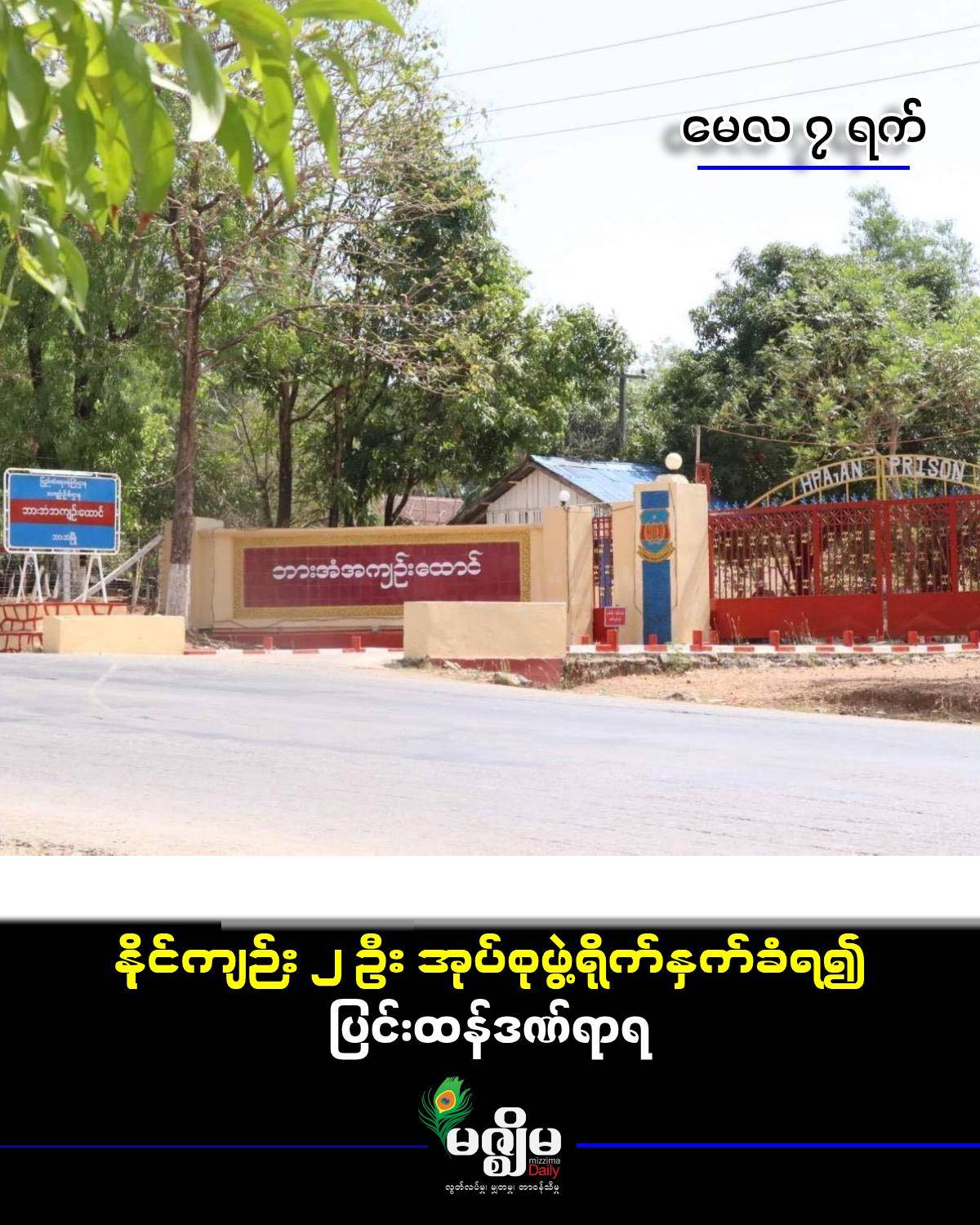
Two political prisoners held at Taungkalay Prison in Hpa-an, Karen State, suffered serious injuries after being brutally assaulted by a gang of criminal inmates, according to a statement released by the Political Prisoners Network Myanmar (PPNM) on 7 May.
The victims have been identified as Ko Kyaw Kyaw Myint, currently serving a 15-year sentence, and Ko Min Thu Soe, serving a four-year term.
The assault occurred on 30 April when the two were instructed by a trusted aide of Deputy Warden Thet Naing to enter the prison dormitory to explain a delay in the distribution of fish curry. There, they were attacked by a group of 12 criminal prisoners known as the “Barcode Gang.”
The gang, reportedly established under former deputy warden Soe Moe Aung to intimidate political prisoners, comprises around 100 inmates identifiable by barcode-style tattoos on their necks.
As a result of the attack, Ko Kyaw Kyaw Myint sustained a fractured skull, multiple lacerations, facial swelling, and bruising on his elbow and forearm. Ko Min Thu Soe also suffered a fractured skull requiring seven stitches, a severe cut above his left eyebrow, and heavy bruising and swelling across his body and face.
Despite the assault taking place directly in front of the dormitory officer’s office, officials including Lieutenant Aung Ye Naing, Corporal Win Maung, and Corporal Thein Than Oo (aka Phyaung Gyi) allegedly failed to intervene, the PPNM stated.
A Departmental Enquiry (DE) led by the Karen State Director is currently investigating the incident. The two victims are reportedly preparing to file an external lawsuit. Of the 12 assailants, only five have so far been placed in solitary confinement, according to PPNM.
Political prisoners and fellow inmates are closely watching how the prison authorities and judicial system handle the incident.
PPNM further emphasized that since the 2021 military coup, political prisoners across Myanmar have routinely faced systemic abuse, both by prison staff and criminal inmates, often with impunity. In addition to physical abuse, many have suffered or died due to grossly inadequate medical care and the confiscation of medicine sent by family members.
From January to April 2025 alone, nine prisoners—eight men and one woman—died in detention across Thayawaddy, Daik-U, Myaungmya, Obo, and Katha prisons. PPNM states that while two deaths were linked to pre-existing conditions, most were due to a lack of timely medical treatment.
“One inmate with kidney stones died because the water in the prison was unclean, and they received no proper care. Even healthy young detainees died after being denied regular medication or given expired drugs. Medicines sent from outside were often confiscated, leaving them dependent on untrustworthy prison staff,” said Ma Khin Yaung Ni Lynn, PPNM’s information officer.
The actual death toll may be higher, as many cases go unreported. The military junta has released little to no information on these incidents, or on the broader pattern of human rights abuses within the prison system.
As of 6 May 2025, the Assistance Association for Political Prisoners (AAPP) reports that 29,116 people have been arrested since the 1 February 2021 coup, with 22,199 still in detention and 10,792 sentenced to prison.