
Interviewer – DonBosco
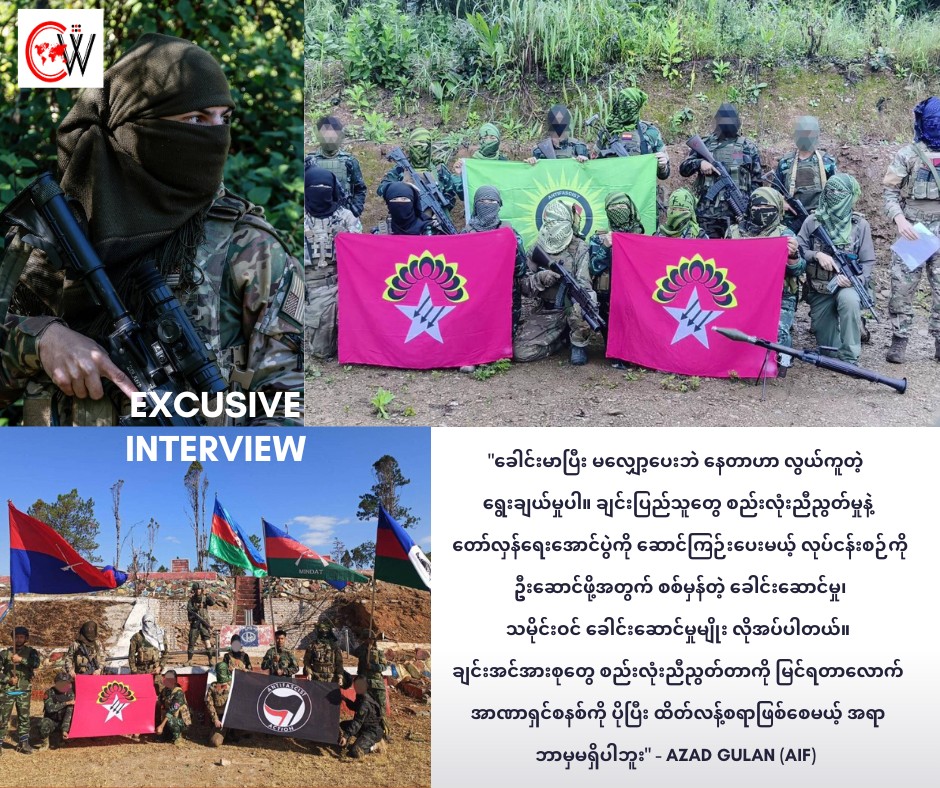
Today, we present an exclusive interview with Azad Gulan of the Anti-fascist Internationalist Front (AIF), an organization of international revolutionaries actively engaged in Myanmar’s Spring Revolution.
This is a hard-hitting and essential discussion from a neutral international perspective, covering the current situation in Chin State, the impact of the internal armed group conflicts on the revolution, the accountability of leadership, and the path forward towards victory. Read on for Gulan’s candid analysis.
Q: Could you start by introducing your organization, specifically what the Chin public, supporters, and leaders should know about you? And, how exactly has your organization been involved in supporting the current revolution against the dictatorship?
A: Thank you. My name is Azad Gulan. I am a member of the Anti-fascist Internationalist Front (AIF), a team of internationalists from around the world who have come to Myanmar to stand in solidarity with the many peoples of the country who have risen up against the dictatorship. I am speaking now personally, not on behalf of my comrades or the organization. Our organization recently passed its first anniversary, having formed in the countryside of Falam on October 15th, 2024, in preparation for the battle which would go on to liberate the town. Since then, the AIF has grown alongside our local comrades to become an organic and effective part of the Spring Revolution. Members of the AIF are Revolutionary Internationalists. We see that the forces of oppression, chauvinist nation-statism, and patriarchy receive global and international support, including for dictatorships like the SAC. When governments and states have abandoned the rebellious peoples of Burma, our natural response is a true internationalism of the peoples. By uniting our struggles, we strengthen the ever-widening frontline against fascism. Members of the AIF have participated in military operations in Tedim and Falam, as well as responding to the SAC offensive on the Khaikam-Taingen road, inflicting dozens of casualties on the forces of the dictatorship. More importantly, we seek to implement our principles of free life, ecological society, and women’s liberation with our participation in the revolution. In this
regard, off the frontline we have held training in the fields of Sniper, Mortar, Medical, Drones, and Sabotage, with hundreds of comrades from dozens of revolutionary organizations around the country attending. Our organization continues to grow and is actively involved in training and military preparations for further strikes against the dictatorship. We see the revolution against the dictatorship not just as the fight of the peoples of Burma, but as the fight of humanity. We have given our promise to our comrades, to the martyrs, and to the revolution that we will fight until victory.
Q: As you are aware of the divisions among the Chin armed groups, could you clearly explain your organization's position on the revolution and share your assessment or perspective on the Chin armed actors involved?
A: The driving mission of the AIF is solidarity with the peoples of Myanmar in the fight against the dictatorship. As a part of our military and political strategy, the frontline in Chin State has been our primary focus and an area where we have been effective. Naturally, this means that we have worked closely with revolutionary armies in the areas we operate. For the fighting in Tedim, we worked with PDF-Zoland; for the fighting in Falam, we worked with the CNDF. In the defense of Mualpi, we stood alongside the CNA and CDF-CDM Siyin. Both our message and our practice have been clear: regardless of the political situation, we will stand on the frontline with our comrades against the dictatorship, whether that is in Chinland or anywhere else in Myanmar. The AIF is not permanently affiliated with any organization, and more than firmly maintaining our neutrality, we strongly condemn any attempt to solve the internal issues of the revolution through military methods.
Q: Regarding the internal conflicts and the creation of separate control areas among the armed groups, what are the main problems occurring on the ground? What significant difficulties or negative consequences are you seeing arise directly from these issues?
A: First, to be clear, I want to say that as foreigners and internationalists, we cannot expect to lecture the revolutionary organizations on the current situation. We approach this topic with sensitivity and respect towards the parties in question. Therefore, we can only comment on the practical outcomes of this conflict. It is clearly seen that at the same time as the Chin youth are defending their country against the dictatorship, there are also hundreds of revolutionary soldiers stationed inside already-liberated areas for the purpose of "defense" against other organizations. Weapons, ammunition, and critical supplies are diverted from the fight against the junta for fear of internal conflict. Youth who have decided to sacrifice everything to free their people are instead worried they may be ordered to fight their own brothers. Due to the conflict, revolutionary armies are dedicating as many resources to self-defense against other organizations as they are to preparations against the dictatorship. This has had a direct effect on the tempo of the revolutionary forces in Chin State and their ability to attack the junta.
Q: In your view, if this internal conflict continues, what specific long-term dangers or severe negative impacts does it pose to the overall success of the revolution?
A: In every discussion I have ever had with revolutionary leaders on either side, one thing remains constant: lack of trust. Considering any feasible step towards peace and co-operation must necessarily rest upon the foundation of trust, this is deeply concerning. Discussions of practical or theoretical frameworks for progress are largely meaningless if the current situation of trust does not improve. Mistrust is a vicious and self-fulfilling cycle—easy to perpetuate and hard to break. Breaking this cycle of mistrust will require historic leadership from the leaders of the Chin people. We are currently in a uniquely energetic period in the revolutionary history of Myanmar. Should genuine agreement be reached, the Chin people could be the inspiration for the country and the world, driving the dictatorship from Chinland and taking the offensive. However, if the cycle of mistrust is not broken, the situation could develop into something truly irreconcilable. I believe it is the responsibility of Chin leaders to prevent that.
Q: Considering your respected position as a close supporter and helper to the anti- dictatorship movement, but without taking a specific side within the movement itself, what are your key observations regarding the current challenges and strategic requirements for the Chin Revolution?
A: The lack of trust is one of the most difficult things to witness as a foreigner in the revolution. We have fought alongside our Chin comrades from many different organizations, and on every side, our comrades say the same thing: “We don’t want to fight; we want to focus on the dictatorship.” I know that this is true—we have seen countless comrades from both sides become martyrs in the fight for freedom. The responsibility lies with the leaders of the revolution to come to a point of agreement. The biggest strategic victory for the Chin revolution would be the creation of an environment where political issues can be handled in a good-faith democratic process. I am in no position to comment on the specific grievances between the revolutionary organizations, but as a comrade in revolution, I can acknowledge it is unacceptable that it has come to the point that rifles are turned against ourselves.
Q: From a definitive Third Party perspective, how significantly does a lack of unity among the revolutionary forces pose a risk of derailing or fundamentally altering the initial goals of the entire anti-dictatorship revolution in its current stage? Please provide a clear and sharp assessment of this danger.
A: If the current cracks are not healed, there is a risk that the situation will widen into a conflict that does irreparable damage to the Chin nation, creating divisions that will last for generations. We can take countless examples from contemporary and historic civil wars: when the infighting is remembered, it will be remembered as senseless, ignorant bloodletting that gained nothing, while sacrificing the lives of youths and distracting from the broader war against the dictatorship. Those responsible will not be remembered for defending their honor, but for their shortsightedness. We owe it to the people and the revolution not to fall into this historic mistake. The key to rebuilding trust is not in Europe, the USA, or Mizoram. It is not in any NGO or community organization, nor is it the responsibility of the NUG. It does not need to be handed to
the Chin people from outside. It can be rebuilt, as we speak, on the ground in Chinland. I sincerely hope and believe that the relevant leaders will make the proper steps towards reconciliation, as do the entire Chin people.
Q: To effectively reduce these problems and prevent the situation from deteriorating further, what concrete, practical recommendations would you give to the leaders regarding truly understanding the ground situation and cooperating to find a solution?
A: I don’t think I can say anything that the responsible parties don’t already know. I would instead ask a question. I believe, in the present day, there are enough soldiers, weapons, and supplies in Chin State to liberate it completely from the dictatorship. If we woke up tomorrow, had a meeting, and coordinated our frontlines, we could very quickly take Tedim, Hakha, and Thantlang. From there, we could descend from the mountain and take the fight to the dictatorship, with armies thousands strong of brave and experienced soldiers. I think it is important to say this is not a fantasy—the necessary material exists as we speak. What is truly the obstacle then? We can cite the countless political differences that currently exist. If our opportunity for revolution passes, if we look back in 20 years at this moment, will we feel justified that we allowed those differences to prevent us from achieving victory? To dig in and refuse to compromise is the easy choice. It takes real leadership, historic leadership, to
lead the process that will bring unity to the Chin people and victory for the revolution. Anything short of that should be seen, in my opinion, as a failing of leadership and a disappointment to the people and comrades who have sacrificed everything for the revolution.
Q: Regarding these internal conflicts, what kind of pressure or encouragement do you believe the Chin public and Supporting Committees should be exerting on the groups involved?
A: The Chin diaspora is excellently organized and has played a critical role in the support of the revolution. It goes without saying that so much is supplied due to the tireless work of supporters all over the world, and we understand that every grain of rice, every liter of fuel is provided by the sacrifice of the revolutionary public. That is why we make the promise to the people not to misuse their trust—we can be confident in asking for support when we know 100% of that support will go towards the liberation of the people and the defeat of the dictatorship. Unfortunately, it is a reality today that money being collected in the churches and community centers of the Chin people is now being spent in ways other than combating the dictatorship. I encourage the organizations who are diligently supporting the revolution to be demanding of the armies they support, especially when such funds are raised from religious and community institutions.
Q: As a supporter of the main revolution against the dictatorship, what essential message would you like to convey to those directly or indirectly involved in the conflicts between the Chin revolutionary armed organizations?
A: The conflict today rests on a foundation of mistrust and historical grievances. As a result, both factions have consolidated their forces into two effective organizations. CB and CC (referring to the main opposing groups/alliances) are both fighting for their people and for the liberation of the country. However, leaders on both sides appear to have convinced themselves that their own power alone is enough to achieve victory—in other words, that even without a practical unification of the forces of the Chin revolution, victory is still possible. Maybe this is true. We can see in the battles of the past years that even without practical unification, many victories have been gained. At this pace, in another year or two, we will finally drive the Junta from Chin State. The question is only: at what cost? Why must we wait so long, divide our forces, and suffer so many additional losses when a unified front could bring us victory? Some leaders have calculated that the political grievances of the day justify the cost in
time and lives. I pray that those leaders can re-evaluate. At the same time, there are some “lobby” groups and individuals which perpetuate this division. Some people are profiting and cheering while Chin revolutionary forces are fighting each other. We should recognize this division as the work of the enemy, and militantly refuse to perpetuate it. Against hate, our message as revolutionaries is love.
Q: In closing, is there anything else you would like to add that would benefit the Chin community during this crucial time? What is your hopeful vision for the future?
A: I want the Chin people and the revolutionary public to be confident. There is no possible path other than victory—this is the promise we made to our martyrs, our wounded comrades, our comrades in prison, and the people who labor every day in support of the revolution. I truly believe that one day, the demands of this revolution will bring together all forces fighting for freedom. In front of us, in Chinland and elsewhere, there are still many battles ahead. No matter what, we will continue the struggle, but we hope and pray that these fights will be waged together. There is nothing that would cause the dictatorship more panic than to see Chin forces unite.
We, as Internationalists, join you here not as outsiders, but as your brothers and sisters in the struggle. The fight against the dictatorship is not just a fight to liberate Chin State, or a fight to democratize Myanmar. It is the fight for human dignity, the instinct to refuse oppression. Every victory we gain on the battlefield is a victory for those everywhere who are standing up for their rights. Your frontline is our frontline. We send our greetings and revolutionary regards to all comrades resisting the dictatorship, and thank you for your questions.