
Diplomatic and security exchanges between Thailand and Myanmar’s military regime have intensified following a visit to Thailand by junta chief Min Aung Hlaing, with both sides focusing on curbing cross-border arms trafficking and logistics for anti-junta resistance forces.
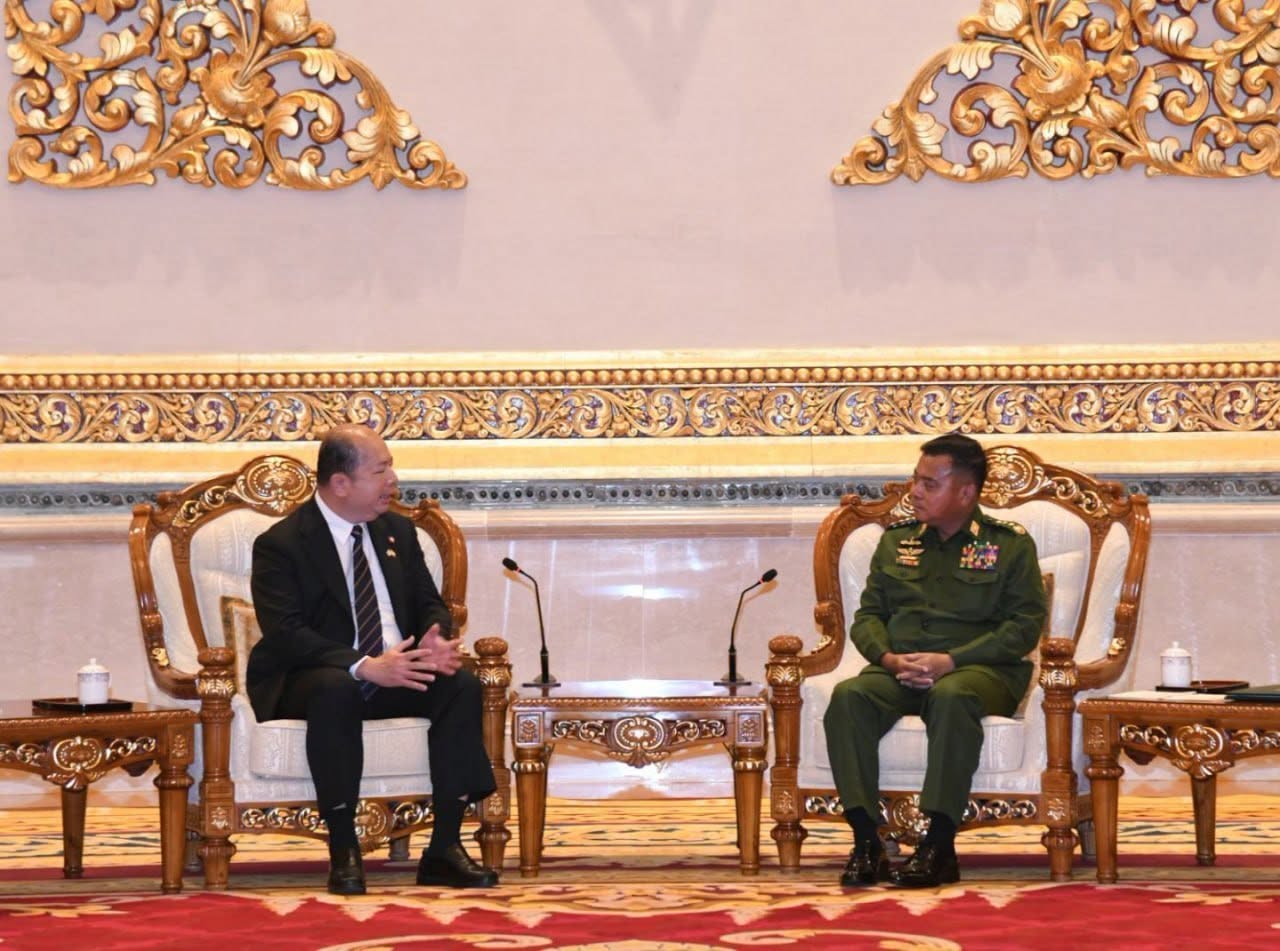
In late August, high-level Thai delegations led by the secretary-general of Thailand’s National Security Council and Thailand’s ambassador to Myanmar held back-to-back meetings in Naypyidaw with General Ye Win Oo, the military’s chief of staff.
According to junta state media, discussions centered on real-time intelligence sharing, border security, trade, and joint efforts to suppress illicit flows of arms, ammunition, narcotics, and precursor chemicals.
The diplomatic push follows an early August meeting in Thailand where Min Aung Hlaing requested Thai assistance in severing weapon supply routes along the porous 2,400-kilometer border, which spans Myanmar's Shan, Karenni, Karen, and Tanintharyi regions.
Military analysts and anti-coup figures warn that stricter border controls could disrupt logistics for resistance groups operating east of the Ayeyarwady River.
"Regions east of the Ayeyarwady River rely heavily on the Thai border for weapons and essential supplies," said Captain Zin Yaw, a former military officer who defected to the Civil Disobedience Movement (CDM). "With Thailand potentially tightening restrictions, resistance forces must explore alternative supply routes."
However, resistance commanders expressed skepticism over whether effective enforcement is feasible given the border's vast terrain.
"There are countless border crossing points," said Saw Dar Kou, a tactical commander with the National Unity Government’s (NUG) People’s Defence Force (PDF) in Tanintharyi Region. "The junta is attempting to project strength and cause hesitation, but resistance forces acquire roughly 70 percent of their arms directly from battlefield seizures during engagements with regime troops."
Thailand’s deepening engagement with the junta has drawn scrutiny from regional observers, as Bangkok has historically maintained working relationships with various ethnic armed organizations (EAOs) along its western border.
Beyond security talks, Thai officials also met with parliamentary leaders in Naypyidaw to discuss cross-border trade and joint measures against transnational crime, telecommunications scam hubs, and human trafficking.