
July is usually the time when farmers in the Ponginn region begin harvesting their summer rice, but this July, Sai Kyaw Hla hesitated to enter the flooded fields, as contaminated water had entered the fields, causing skin irritations among the farmers.
“The deeper the water, the itchier it gets all over. If it reaches your knees, the itching goes up to your knees. If it reaches your chest, it itches all the way up there. It’s so unbearable that even scratching until you bleed doesn’t make it stop,” said Sai Kyaw Hla, a local farmer from the Ponginn region.
In the past, farmers in Ponginn never faced problems with contaminated water. In fact, during their ancestors’ time, there was even a saying that the water in Ponginn’s fields was so clean it could be drunk.
Ponginn region, located in Taunggyi Township in southern Shan State and bordering Hsihseng and Hopong townships, is known for the saying that locals live six months on land and six months under water. For this reason, it is often called the “second Inle,” as it lies just a mountain away from the famous Inle Lake, where people live in stilt houses over the water. Ponginn Village and about 30 surrounding communities together make up the Ponginn region.
The people of Ponginn mainly make a living through rice farming and fishing, relying heavily on the Namhtabat Stream for their livelihood.
Unlike some war-torn areas in Shan State, the Ponginn region is relatively peaceful. However, locals face hardships imposed by the junta-aligned Pa-O National Organisation (PNO), which collects excessive taxes under the pretext of military expenses and targets young people for conscription. As a result, many young people have left Ponginn, seeking safety or better opportunities elsewhere.
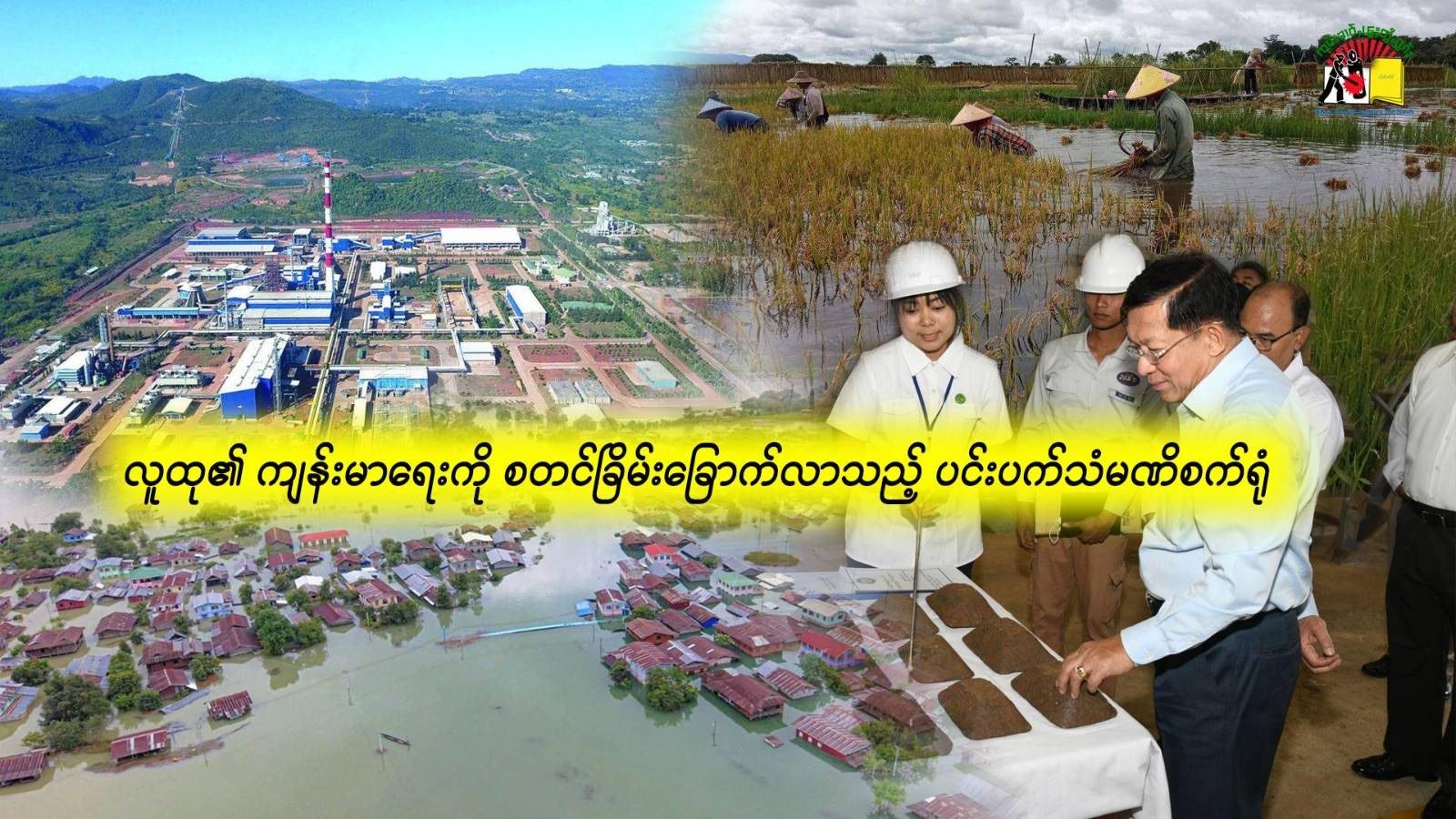
Ponginn, the main source of the renowned Nawngmun Shan rice, also faces annual flooding, and in recent years, environmental degradation, worsening floods, and climate change have further affected the region's ecosystem. As a result, farmers in the region suffer economic losses from the annual floods.
“The situation we farmers are facing is really a serious dilemma,” said Sai Kyaw Hla.
In September 2024, the remnants of Cyclone Yagi caused unprecedented flooding in the Ponginn region, destroying over 9,000 rice fields.
Cause of water contamination
Environmentalists, experts, health workers, and local farmers all agree that the main cause of the water contamination is the Pinpet steel plant, located north of the Namhtabat Stream. Wastewater from the plant flows into the farmland. Some also suggested that the excessive use of pesticides and fertilizers by certain farmers has contributed to polluting the water source.
“It’s true that the water is contaminated by toxic wastewater from the Pinpet plant, but we can’t blame the plant alone. Pesticides and fertilizers used by farmers are also polluting the water,” environmentalist Sai Khay Sai told Shan Herald. He also pointed out that some locals dumped rat poison and leftover mosquito coils into the stream, making the water even more contaminated.
Pinpet steel plant is situated north of the Namhtabat Stream, roughly 17 miles from Hsengle Village in the Ponginn region.
On October 30, 2023, the Pa'O Youth Organization (PYO) reported that the plant’s wastewater has been discharged into the Namhtabat Stream. According to PYO, over 100 villages rely on the Namhtabat Stream for their livelihoods as it flows through the Ponginn region.
The Namhtabat Stream, nearly 30 miles long, flows into neighboring Karenni (Kayah) State and empties into the Thanlwin (Salween) River.
A local nurse who provides healthcare to Ponginn farmers also suggested that the wastewater might be the primary cause of their skin irritations.
“Skin irritation often lasts for months. Farmers come to me for injections because medicine alone doesn’t get rid of it. We believe the problem is caused by the wastewater,” she said.
Sai Kyaw Hla commented that the Pinpet steel plant was also affected by last year’s floods, which caused its wastewater storage tanks to overflow, likely sending contaminated water into the rice fields.
“Being exposed to this contaminated water damages the rice plants. It also harms the cattle nearby, and even people who just step into the water during harvest suffer badly,” he said.
Revival of steel plant
The Pinpet steel plant, built near Myanmar’s second-largest iron ore deposit in Pinpet Town—about 7 miles southeast of Taunggyi, the capital of Shan State—was shut down in 2017 by the National League for Democracy (NLD)-led civilian government after incurring billions of MMK in losses.
However, after the 2021 coup, the junta's Ministry of Industry began trying to restart the steel plant in collaboration with the Russian company VO Tyazhpromexport.
The junta-controlled newspaper The New Light of Myanmar reported on August 25, 2021, that the steel plant was expected to reopen within the next two and a half years from October 2021.
The junta also brought in experts from Russia to help restart the plant and set up the necessary equipment.
The junta announced on May 18, 2025, that Russian experts had reached the final inspection stage of the equipment installed in the Pinpet steel plant's air separation unit.
According to the PYO's report, Tyazhpromexport, which is assisting the junta in restarting the Pinpet steel plant, is a subsidiary of the Russian corporation Rostec, a company that supplies arms to the junta.
According to a February 2023 report by the Shan State Frontline Investment Monitor (SSFIM), the steel plant will be powered by coal mined in Kyethi Township in central Shan State, with a planned daily supply of 1,500 tonnes to the facility. Coal mining is mainly carried out by Ngwe Yi Pale, Min Shwe Hlwar, and Nampan Development and Investment companies.
The Pinpet steel plant project was jointly launched by the military-controlled Myanmar Economic Corporation (MEC) and Russia’s TPE Company in November 2004, with construction starting in 2006. However, it was not completed within the planned timeframe and was handed over to the government in 2012.
The Pinpet steel plant occupies 5,122.16 acres in the Pinpet region. It comprises 22 workshops in total, including an iron smelting workshop, 19 of which began test runs in 2022 and 2023. The junta stated in 2023 that large-scale production would begin once the remaining three workshops were up and running.
The junta also predicted that once fully operational, the Pinpet steel plant would be able to produce and sell 200,000 tons of refined iron per year.
The Shwenyaung–Taunggyi–Nawngkar–Pinpet Road was completed in 2023 to transport refined iron from the Pinpet steel plant to the No. 1 steel plant in Myingyan Town, Mandalay Region, central Myanmar. The opening ceremony of the new railway was held on October 22, 2023, at Taunggyi City Station, attended by coup leader Min Aung Hlaing himself.
Even before the coup, over 11,000 acres of agricultural land were set aside for the steel plant’s construction, with more than 5,000 acres forcibly purchased at 5,000 MMK per acre, roughly 1.25 USD at the current exchange rate, according to a PYO report from 2009.
The Hopong plain in Taunggyi Township, selected for the steel plant project, is land that local people have farmed for generations and also serves as a transportation hub.
Following the forced seizure of agricultural land, local farmers, terrace farmers, and orchard owners were left without work. Many were forced to leave their homes in search of new employment opportunities in distant areas or abroad, according to the PYO.
After the coup, the junta paid compensation to the original landowners, but former landowners lamented that it was never a fair settlement.
“Now, we’re completely barred from the land we once owned. We’re not even allowed to go there just to gather mushrooms,” a local who wished to remain anonymous told the Shan Herald. The Pinpet steel plant is secured not only by junta troops but also by PNO members serving as guards, he added.
Shan Herald is still investigating whether the PNO, alongside MEC and TPE, holds any stake in the Pinpet project.
There are also rumors that the junta plans to use the Pinpet steel plant, which poses a significant threat to communities in the Ponginn region, for weapons manufacturing and nuclear purposes.
In June 2023, the junta's mouthpiece, The New Light of Myanmar, reported that Russia was planning to provide technical assistance worth 10.5 million euros to support the success of the Pinpet project.
We’ve also heard reports that materials needed for nuclear purposes are being produced at that plant. Now, nobody can go near the area,” said Sai Kyaw Hla.
On March 4, during a visit to Russia, junta leader Min Aung Hlaing signed an agreement to build a small nuclear power plant in Myanmar. Russia has also confirmed it will assist in building a small nuclear power plant in Myanmar. According to the junta leader, the plant, constructed with Russian support, will have a capacity of up to 330 megawatts.
The junta is collaborating with Russia’s state-owned nuclear agency, Rosatom, to build a small modular reactor and has also opened Myanmar’s first nuclear technology information center in Yangon.
Over the past decade, the Shan Yoma cement factory and the expansion of the Ngwe Kabarkyaw antimony mining area near the Pinpet steel plant have also impacted the water quality of the Namhtabat Stream, a vital water source for the people of Ponginn.
According to SSFIM, local communities are now grappling with issues such as polluted stream water, declining fish stocks, skin irritations among farmers, and reduced rice yields.
Once the Pinpet steel plant begins operating at full capacity, its negative impact on the social life of Ponginn communities is expected to be even greater.
“The Pinpet plant is expected to be fully operational soon, and when that happens, it could become a serious hazard for the whole Ponginn region. Even now, farmers are already facing heavy losses. Even without a natural disaster, the entire region will be at risk because of the steel plant,” said Saw Kyaw Hla, his voice slightly trembling with worry.
(For security reasons, the sources’ names have been replaced with pseudonyms)