
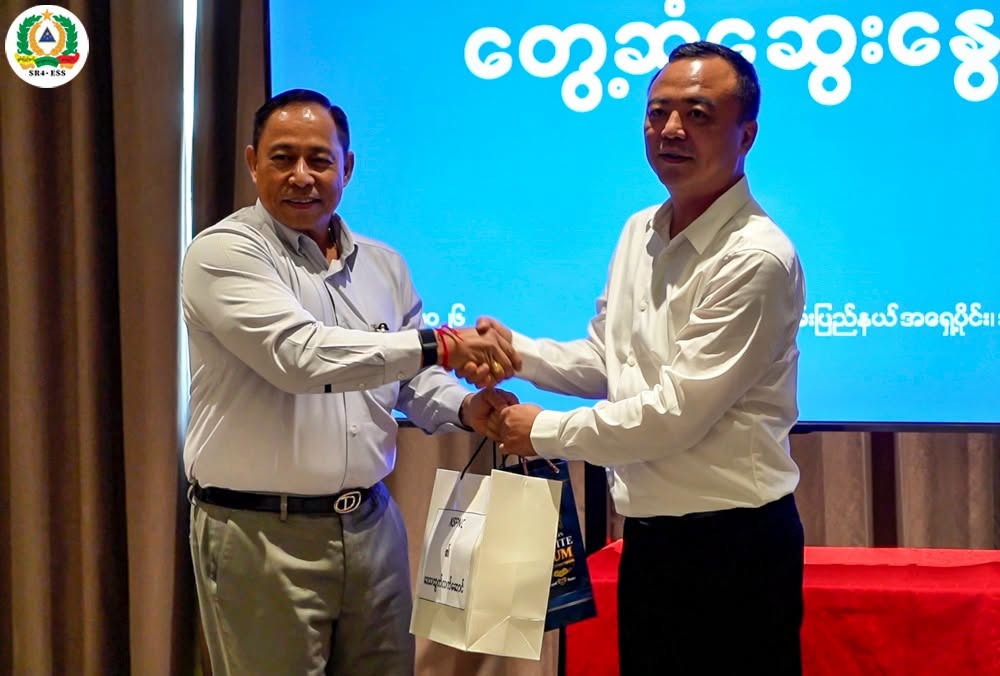
During a meeting with a junta delegation, the Shan State-based armed group National Democratic Alliance Army (NDAA), widely known as the Mongla Army, reiterated that its political objective is to secure advanced self-administration.
On June 17, a delegation led by Lieutenant General Yar Pyae from the junta’s National Solidarity and Peacemaking Negotiation Committee (NSPNC) visited Mongla Town—the NDAA's territory in eastern Shan State—and held talks with NDAA representatives.
During the discussions, the NDAA informed the NSPNC delegation that its ultimate goal is attaining advanced self-administration.
According to a statement issued by the NDAA, the talks with the NSPNC focused primarily on peace matters but also covered additional issues, including efforts to combat local opium cultivation and promote alternative crop farming, building mutual trust, maintaining border stability, and other related concerns.
On June 18, the NSPNC delegation also traveled to Pangkham (Panghsang) Town in the Wa Self-Administered Division, where it held discussions with leaders of the United Wa State Army (UWSA), according to the UWSA-controlled Wa State Television (WSTV).
The NSPNC–UWSA dialogue reportedly focused on peace, unity, and regional development.
Both the NDAA and the UWSA—members of the Federal Political Negotiation and Consultative Committee (FPNCC)—described their respective meetings with the NSPNC as informal talks.
Earlier, on June 12, the NSPNC had already met in Naypyidaw with another FPNCC member group, the Shan State Progress Party/Shan State Army (SSPP/SSA).
The FPNCC was formed in 2015 and currently comprises seven member organizations. The remaining members are the Kachin Independence Army (KIA), the Arakan Army (AA), the Ta’ang National Liberation Army (TNLA), and the Myanmar National Democratic Alliance Army (MNDAA).