
The Shan Human Rights Foundation (SHRF) reported on May 18 that Myanmar citizens are being trafficked in southern Mong Hsat Township—an area along the China border under the control of the United Wa State Army (UWSA)—before being forced to work in Chinese-owned mines.
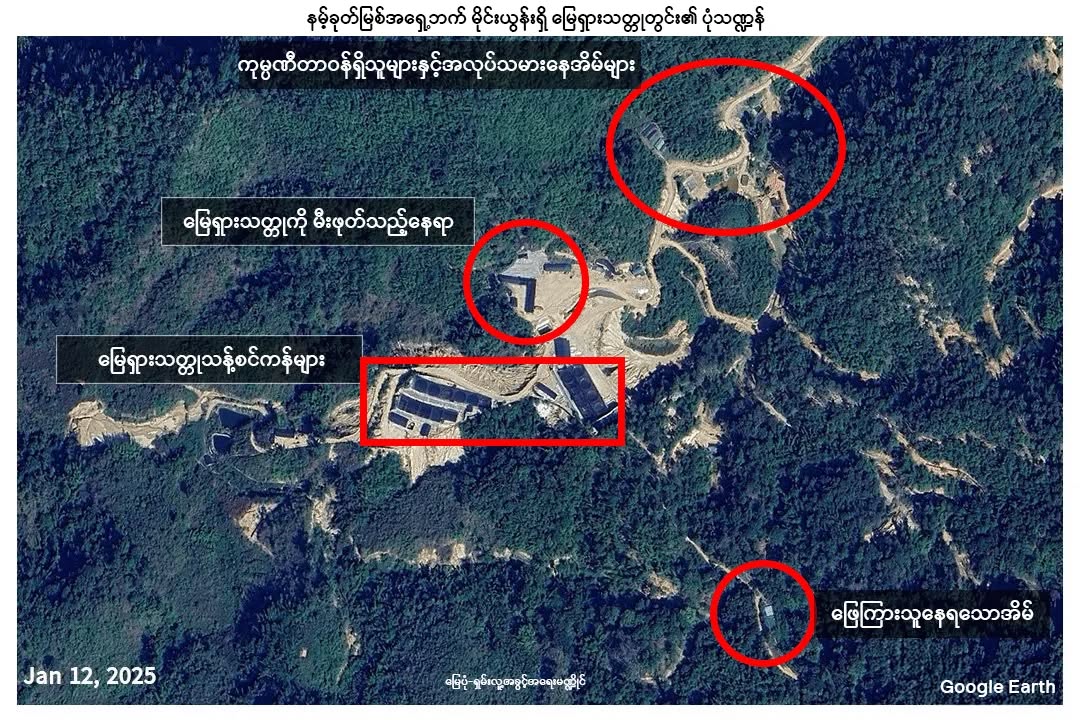
According to the SHRF, citing an escaped trafficked survivor, three Myanmar nationals who had worked for telecom scam operations in Tachileik Township, eastern Shan State were forcibly taken to a rare-earth mine on the Kok (Namhkoke) River, about 8 kilometers east of the Chinese border in southern Mong Hsat Township, where they were enslaved as forced laborers.
The three men were kept detained with about thirty UWSA convicts, some shackled, at the mining site, and together with these prisoners were forced to do hard labor jobs, such as digging earth and carrying loads – sometimes at another rare earth mine operated by the same Chinese company on the west of the Kok River, the SHRF reported. They were kept apart from the approximately 100 regular mining laborers, who were from different parts of Myanmar.
Anyone attempting to escape would reportedly be beaten if recaptured and then transferred to other detention facilities.
Human rights activists in Shan State pointed out that although the mining site is controlled by the UWSA, it is also influenced by the interests of the junta, and that the junta allegedly allows telecom scam operations in Tachileik in exchange for bribes.
“At the checkpoint, the man from the front seat — who I assumed was an important figure — got out and saluted the main police officer at the gate. After he went over to talk to them, they let us through without any inspection. That was when I realized he was a policeman. Later, when I returned to Tachileik, I saw him frequently at various checkpoints. I found out his name was Win Kyaing from the Anti-Human Trafficking Task Force, and he was a sergeant,” said the man who escaped from the site.
Moreover, the exploitation of Shan State’s land and natural resources by Chinese mining companies and cross-border criminal organizations, without compliance with environmental conservation regulations, is also contributing to river pollution, the SHRF warned.
Shan human rights activists said the issue can only be meaningfully addressed if the region’s mining sector is placed under the authority of a genuine federal democratic government that protects the sovereignty of the country’s land and resources and prioritizes the well-being of its people, rather than relying on the junta to resolve it.