
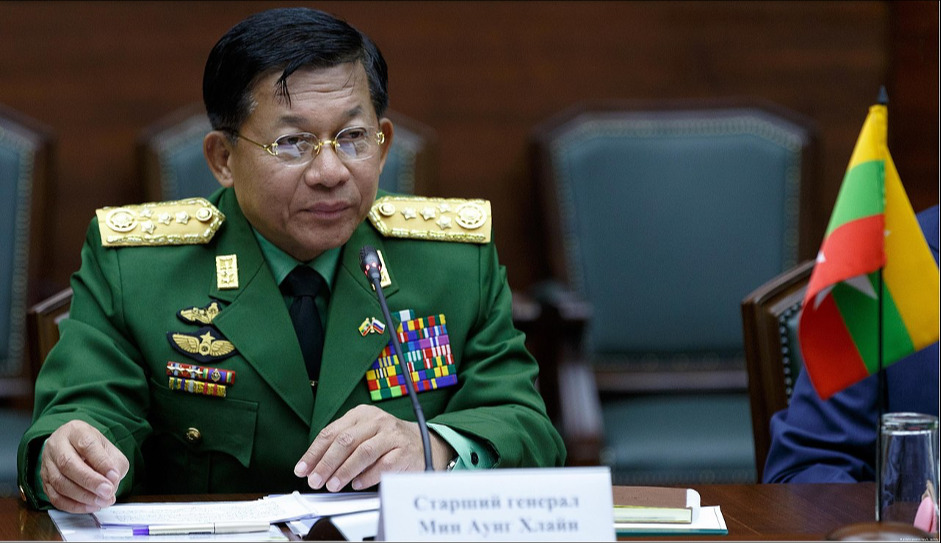
Junta leader Min Aung Hlaing’s second junta unilateral ceasefire was criticised as just window dressing to curry favour with the international community before his trip to Russia.
Following the deadly 28 March earthquake that hit Myanmar and had its epicentre close to Mandalay, the junta declared a unilateral ceasefire from 2 to 22 April to facilitate earthquake relief efforts. Before that ceasefire expired it was extended till 30 April.
That ceasefire was allowed to expire on 30 April. Then, on 6 May, the day before Min Aung Hlaing and his wife were due to leave for Russia, the junta's Office of the Commander-in-Chief of Defence Services (CINCDS) announced that the junta’s State Administration Council (SAC) had declared a new unilateral ceasefire to run from 6 to 31 May 2025.
The junta claimed that this new ceasefire was to allow ongoing reconstruction of government buildings, homes and infrastructure in Naypyidaw.
But, Captain Zin Yaw, a former army officer who joined the anti-coup Civil Disobedience Movement (CDM), claimed this was not the real reason for the junta’s ceasefire. He explained that the statement declaring the ceasefire had been carefully timed to come just before Min Aung Hlaing’s trip to Russia and that the ceasefire was far less about assisting earthquake victims and far more about presenting a facade of goodwill to the international community before engaging with world leaders, including the Chinese president, in Moscow.
He said: “Min Aung Hlaing is scheduled to meet leaders from around 20 countries, including China. When he meets them, he’ll claim that he voluntarily announced a ceasefire extension. But the truth is, he’ll spin a narrative, he’ll say resistance forces are still launching attacks, and that his troops have no choice but to respond. He wants to make it look like the ceasefire came from a place of goodwill, when in reality, it's a calculated move. He and his wife are leaving for Russia on 7 May and he announced the extension just one day before. That’s no coincidence. It’s all part of a strategy to present a false image of peace and goodwill ahead of his trip.”
Captain Zin Yaw’s theories about why this new ceasefire was declared seem to have a ring of truth to them, as when the junta's initial ceasefire expired on 30 April it failed to renew it immediately, despite calls for another ceasefire extension from the Malaysian government, the current chair of the Association of Southeast Asian Nations (ASEAN). Instead, they only announced a new ceasefire six days later, coincidentally the day before Min Aung Hlaing left for Russia.
At Russia's invitation, a delegation led by Min Aung Hlaing will attend Russia's 9 May Victory Day celebrations commemorating the 80th anniversary of the Soviet victory over Nazi Germany in World War II.
On 5 May, the junta announced that Min Aung Hlaing planned to hold separate meetings with world leaders attending the Victory Day ceremony. Then, the next day the junta announced the new ceasefire.
The junta's truce extension statement also warned that if ethnic armed organisations (EAOs) or resistance forces attack junta bases, expand their control, carry out aggressive military actions, or reinforce their forces during the ceasefire period, junta troops will respond accordingly.
Captain Zin Yaw commented that whatever the junta says, it is unlikely to stop launching airstrikes during the ceasefire period.
He said to Than Lwin Times: “There's a saying that many people joke about: the junta's ceasefire only means they will cease firing, but not bombing. I think that's what we're going to see play out. I don't believe the junta will stop ground operations either. We’ll have to wait and see if it continues launching airstrikes on the 12 townships controlled by the Ta’ang National Liberation Army (TNLA). Personally, I think the junta will keep up air raids in conflict zones like Sagaing, Magway, Bago, and the [Ayeyarwady] delta regions, where they are still fighting with the resistance forces.”
During the first junta ceasefire, from 2 to 22 April, there were 71 junta airstrikes on 40 townships that killed 118 civilians, according to data compiled by the Burma News International - Myanmar Peace Monitor (BNI-MPM).
During its first ceasefire the junta launched airstrikes in every state and region, except Yangon. Two of the regions hardest hit by the earthquake, Mandalay and Sagaing, also experienced some of the heaviest airstrikes.
BNI-MPM said that though ASEAN and the international community have welcomed the latest junta ceasefire they should also focus on the junta’s actions during the ceasefire period and criticise them if they break their ceasefire.