
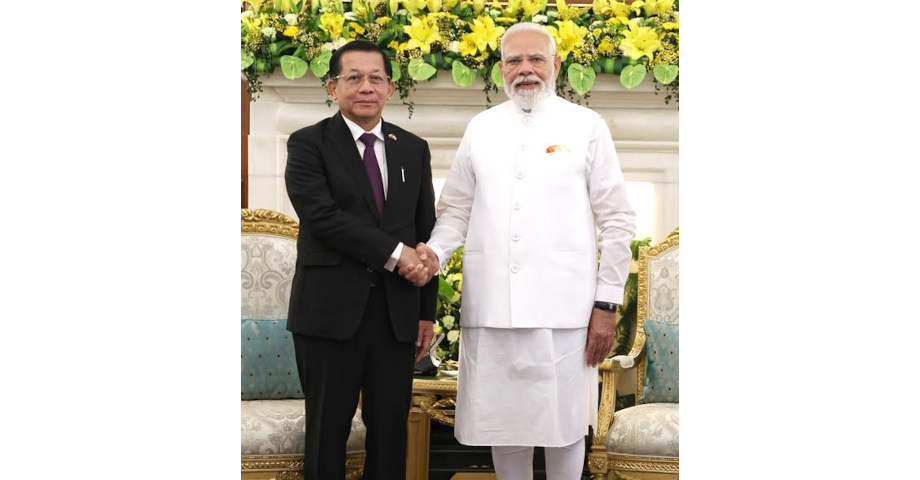
The Indian government, led by Prime Minister Narendra Modi, urged visiting coup leader Min Aung Hlaing to prioritize completing the Kaladan Multi-Modal Transit Transport Project (KMMTTP) and the India-Myanmar-Thailand Trilateral Highway.
Indian media reported that Modi raised the issues during a May 30–June 3 visit to India by a Myanmar junta delegation led by Min Aung Hlaing.
According to junta-controlled state media, Modi said that further improvements in transport connectivity between the two countries would benefit both sides, and the two agreed to work closely to complete the projects.
The KMMTTP, implemented with Indian investments, is a strategic project linking the port of Sittwe, the capital of Arakan State, to India’s northeastern state of Mizoram via Paletwa Township in southern Chin State.
The Sittwe Deep-Sea Port and Paletwa Cargo Jetty, two components of the project, have been completed, but the remaining infrastructure in Paletwa Township and the road connecting Paletwa to the Indian border have stalled due to ongoing fighting.
Paletwa Township and most of the areas along the project route are controlled by the Arakan Army (AA) and Chin resistance forces.
Signed in 2008, the KMMTTP comprises Sittwe Port, the Paletwa Cargo Jetty, and other logistics infrastructure, with an estimated cost of around 160 million USD. The Paletwa Township–India border highway is estimated at 324 million USD, bringing the total project value to 484 million USD.
The Trilateral Highway is planned to start from Moreh, a border town in India’s Manipur state, and pass through Tamu in Myanmar’s Sagaing Region. It will then run via Mandalay, Naypyidaw, and Bago, before reaching Myawaddy in Karen State near the Thai border and connecting to Mae Sot in Thailand.
The 870-mile highway project, aimed at boosting trade, economic activity, health, education, and tourism in the region, was originally expected to be completed in 2019.
During Min Aung Hlaing’s visit to India, the two sides discussed issues including trade, the economy, defence, border security, and the use of the Indian rupee and Myanmar kyat in bilateral trade.
Additionally, both sides discussed preventing insurgent groups from using border areas as bases to carry out attacks against either country.