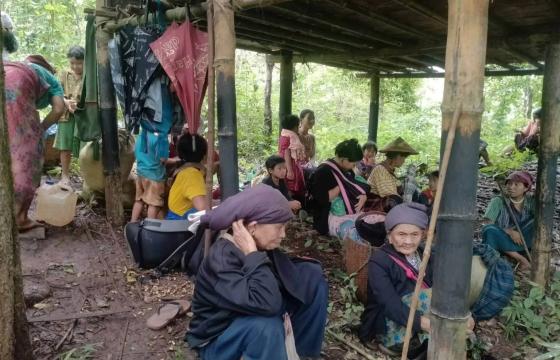

In Karenni State, which has a population of around 300,000, about 250,000 people have become internally displaced due to the ongoing conflict. It is now entering its fourth year. Although some people from certain townships were able to return home temporarily, renewed offensives by the junta’s forces during July and August, ahead of the planned election, forced many to flee once again.
As a result, the needs of both existing and newly displaced people have significantly increased. Although some people had returned to their villages to resume farming in areas under revolutionary control, they have now been forced once again to abandon their fields due to the attacks.
While many had the opportunity to farm, they had already invested their limited savings or borrowed money to restart cultivation. However, due to the renewed offensives by the junta, they were forced to flee again, which worsened their food insecurity.
With the growing number of displaced people and shrinking areas available for farming, Karenni’s food crisis is worsening by the day.
Lessons from the Border Refugee Camps
Since around the 1980s, many Karenni civilians, displaced by fighting, moved to safer areas and ended up in the Thai-Karenni region.
As those displaced people were unable to return home, they sought refuge along the Thai border. Over time, the area was officially recognized by Thailand in 2006 as Karenni Refugee Camp No. 1. The camp initially hosted just over 1,000 people, but its population grew steadily. Many had fled there during the 1994–1995 ‘Four Cuts’ (Phyat Lay Phyat) military offensive.
At its peak, the camp hosted around 18,000 people. Although some have since resettled to third countries, about half of that population still remains. Residents have not been allowed to work outside or access farmland. For over 40 years, they have survived almost entirely on humanitarian aid provided by donors.
For the past 41 years, food assistance in Karenni Camp No. 1 had come from The Border Consortium (TBC). However, following a directive issued by former U.S. President Donald Trump on January 24 this year to suspend international humanitarian funding, all such assistance was halted.
As a result, refugees are now expected to sustain themselves by finding their own sources of income. According to a committee member from the Karenni refugee camp, only about 20% of camp residents in Mae Hong Son’s Karenni Camps No. 1 and No. 2 are capable of working.
After years of relying solely on aid, refugees are now being forced into work to survive.
The sudden cutoff of U.S. humanitarian assistance has become a wake-up call, not only for border refugees but also for IDPs (internally displaced persons) and aid organizations working in other sectors.
As Trump’s cuts to humanitarian aid, together with global conflicts and political crises, multiply, Myanmar’s humanitarian crisis is fading from the world’s attention. International aid to Myanmar is decreasing. For instance, just last month, Sweden also withdrew its humanitarian support to the country.
These funding suspensions have left millions, including those in Karenni and across the country, without access to crucial food and survival assistance amid war and displacement.
The Daily Struggles of Internally Displaced People
“We never have enough. It is just enough to eat,” said a displaced man living in one of the IDP camps in Mese Township.
Currently, displaced families survive on their small food reserves and the wages from occasional day labor. But daily job opportunities are unpredictable.
In some camps, local administrators rotate families for day work so everyone can have a fair chance. Most earn around 15,000 kyats a day, depending on the job, but this is barely enough for one large family meal with given current prices.
So far, displaced people still depend on humanitarian donations to survive. Yet, as it is also hard for donors to support long-term, refugees and IDPs worry about worsening food shortages.
In two IDP camps in western Demoso Township, families have already run out of rice and have been eating only rice porridge for more than a week.
“It’s been over a week since we, from this camp and nearby camps, started eating only rice porridge. We check on each other, but no one has extra rice to share anymore,” said a displaced woman in one of the camps.
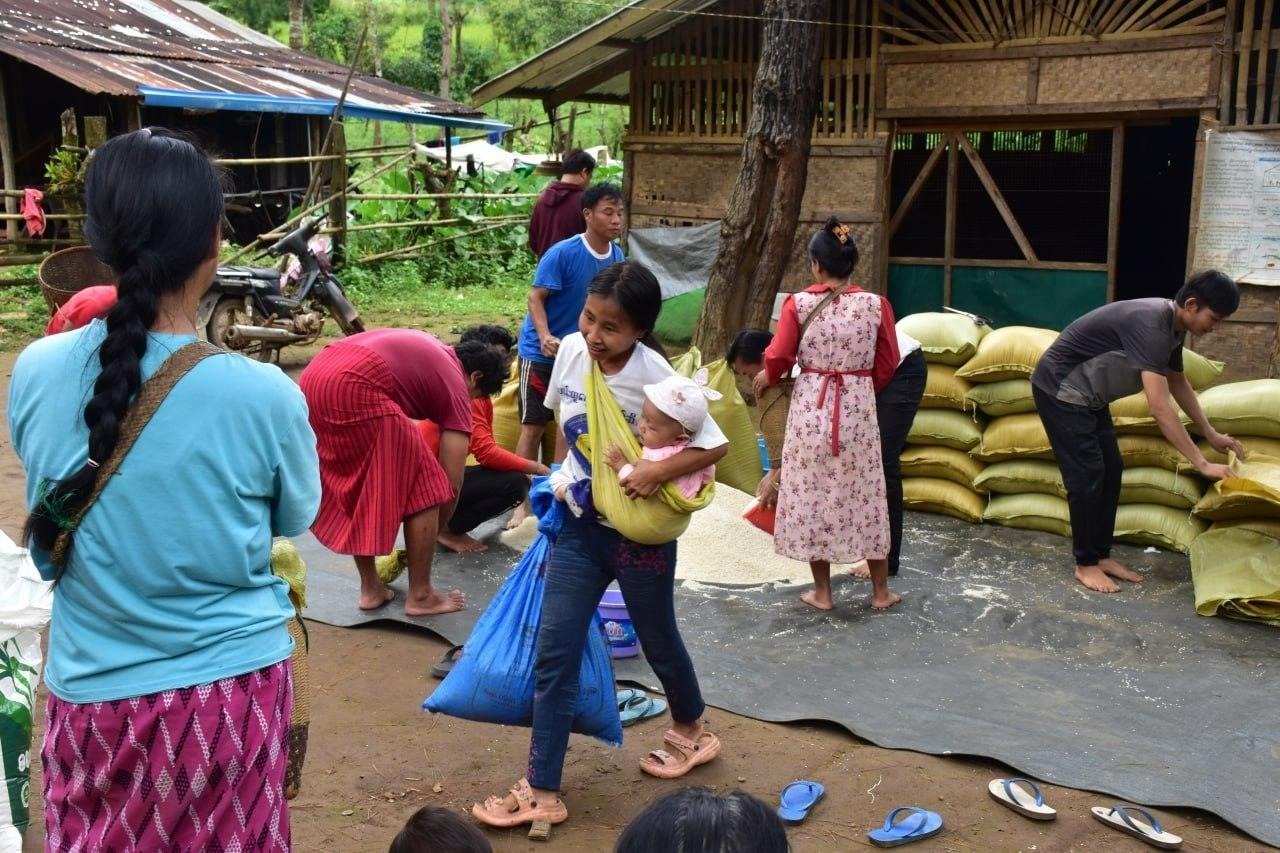
In response to appeals from displaced people, the group ‘Job for Kayah’ provided rice aid to those two camps that had been surviving only on rice porridge on October 1. On that day, the woman shared with Kantarawaddy Times the situation her camp was facing.
When People Become Refugees
Displacement is usually seen as temporary, as people flee with hopes of returning soon. But now, some have been displaced for over four years, while others have only recently fled in 2025. If displacement continues for a decade or more, these people will no longer be just “IDPs” but long-term refugees, and they will need sustainable livelihood plans rather than short-term relief.
For now, most still survive through donations, but this is not sustainable.
“The people are mentally exhausted. It’s a situation of being stuck between a rock and a hard place. Saying this doesn’t mean we will stop. We will keep going,” said a young volunteer assisting displaced communities, describing the current displacement situation.
One of the most urgent questions now is, “What preparations are the leaders in the administrative sectors making for long-term food security?”
Inside the country, displaced people cannot find safe or stable areas because the junta continues to launch airstrikes and heavy artillery attacks daily. Civilians who go to their hill fields and farms to make a living are sometimes hit by artillery, resulting in injuries, and some have been arrested and tortured. While IDPs try to make a living by any means available, they also fear for their lives.
Those who manage to cross borders may gain some safety, but the subsequent worries are already demonstrated by the situation in the border refugee camps.
Myanmar is now the fifth most food-insecure country in the world. In Myanmar, 1 in 3 people, totaling 16.7 million, are facing food insecurity. This number increased significantly from 13.3 million in 2024 to 16.7 million in 2025. Among them, 2.8 million people are in an emergency situation, struggling daily for a single meal. This information is based on data released by the UN World Food Programme (WFP) on September 5th.