

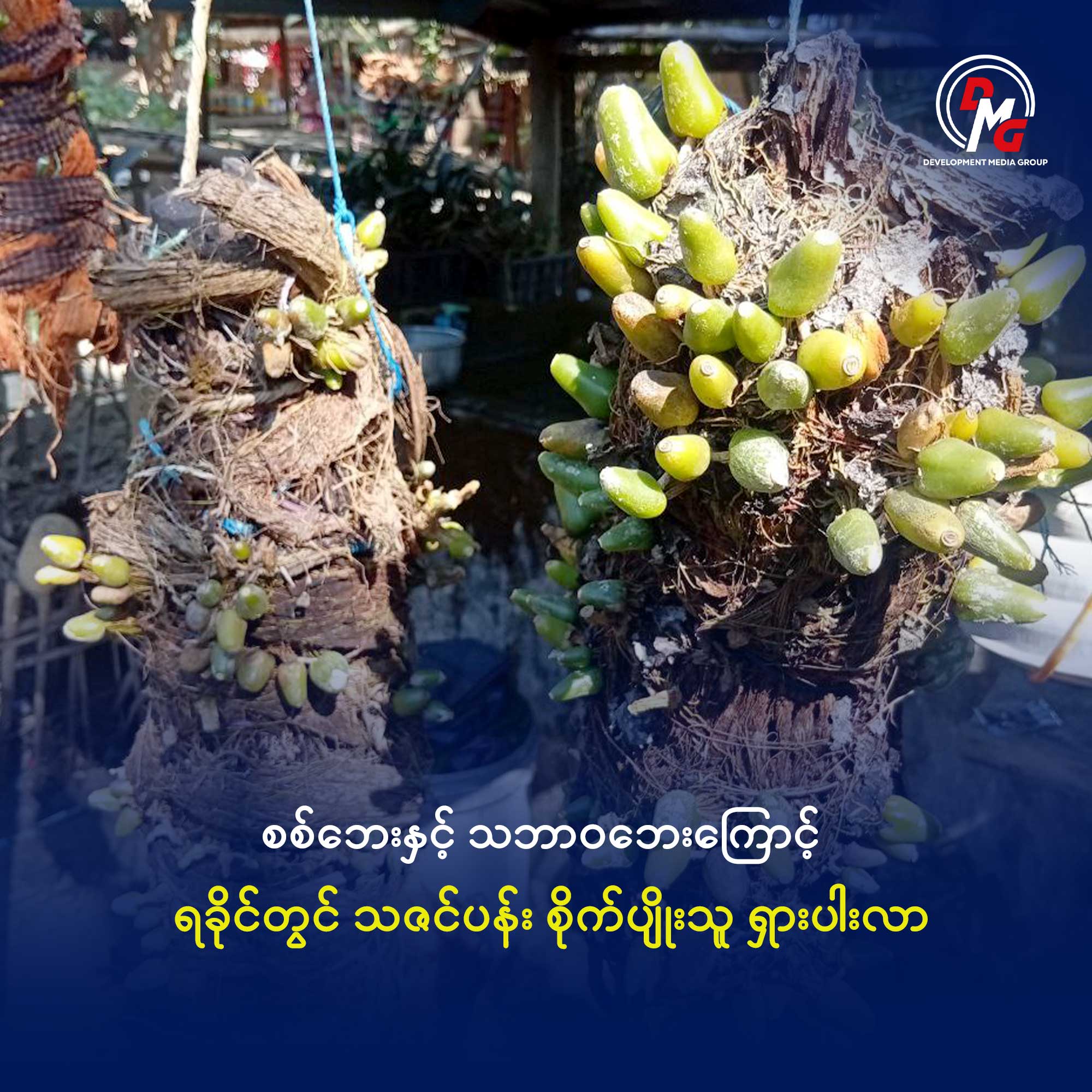
Thazin flower cultivation in Arakan (Rakhine) State is in decline due to armed conflict, natural disasters, and a shrinking number of growers, raising fears that the prized orchid—Bulbophyllum auricomum, also known as the Royal Flower of Myanmar—could face extinction.
Highly valued by the Arakanese and considered sacred across Myanmar, the Thazin flower requires careful cultivation, suitable technology, and constant delicate care to survive.
The Thazin flower industry was hit hard by Cyclone Mocha in May 2023, and it has struggled to bounce back. Renewed fighting in Arakan State has further disrupted growers, many of whom had to leave their plants behind.
"When Cyclone Mocha hit, my house collapsed and I lost many plants. But I managed to save my Thazin flowers. I had heard the cyclone was coming with winds of around 100 miles per hour, so I put the Thazin plants in a special structure. They survived, but almost all my other plants were destroyed. Some Thain plants even ended up growing on other stems," said Daw Ni Ni Aung, a flower grower in Kyauktaw Township.
She added that many Thazin plants have also died because growers could not provide daily care while displaced by conflict.
Daw Ni Ni Aung has been cultivating Thazin flowers for more than a decade. Previously, Thazin farming was popular in Kyauktaw, Mrauk-U, Sittwe, Ponnagyun, and Buthidaung townships.
Thazin plants thrive in cool, humid conditions and need careful, daily maintenance with water and nutrients. Neglect causes them to wither and perish quickly.
"Before the fighting, I used to take care of my Thazin flowers at home every day. But when the war started, I had to run away and couldn’t tend to them. If they don’t get water, they just die. They mostly need water and a cool place to grow," Daw Ni Ni Aung explained.
Wild Thazin flowers in Arakan State are also becoming rare due to deforestation. With fewer people cultivating them, growers warn the species could disappear entirely if the situation continues.
"From what I see, Thazin flowers are becoming very rare, almost gone. In the past, people used to collect wild Thazin from the forest to sell, but now they’re almost impossible to find because of deforestation. They mostly grow in the mountains, and if those forests are destroyed, there’s a 75 percent chance these flowers will go extinct. We really need special protection for this species," Daw Ni Ni Aung warned.
Thazin flowers are often grown by placing them in coconut husks, tying them with ropes, and hanging them, or by attaching them directly to trees. Proper cultivation requires the roots to firmly anchor into the husks.
After flowering, the mother pseudobulb dies, leaving new offshoot pseudobulbs to continue the cycle. Growers say it can take at least a month to produce a new inflorescence, which is a blooming branch bearing white flowers.
"We grow Thazin in coconut husks. Once the roots take hold, one main pseudobulb and two or three smaller ones appear. The main one is the mother, and after it flowers, it dies. The offshoots grow from the smaller ones and produce flowers. It usually takes about a month to get a new blooming branch," said U Bo San Thein, a grower in Kyauktaw Township.
A blooming branch of Thazin flowers sells for 2,500 to 3,000 MMK in Arakan State. However, sales are low due to the lack of festivals and ceremonies in the war-torn region.
U Bo San Thein, a Thazin grower for 20 years, now cultivates them mainly as a hobby. Efforts to expand sales have been held back by weak demand, he added.
Thazin flowers do not grow in soil and cannot tolerate direct sunlight, requiring constant specialized care, growers noted. These flowers stand as a symbol of Arakanese pride and reflects the grace and dignity of women, so protecting it is crucial, they insisted, despite the challenges.