
‘We won’t disintegrate from the Union and we won’t demand a separate state,’ an NDAA spokesperson says.
Special Region 4 in eastern Shan State will still strive for self-determination, the chairperson of the National Democratic Alliance Army (NDAA)—also known as the Mongla group—recently said publicly.
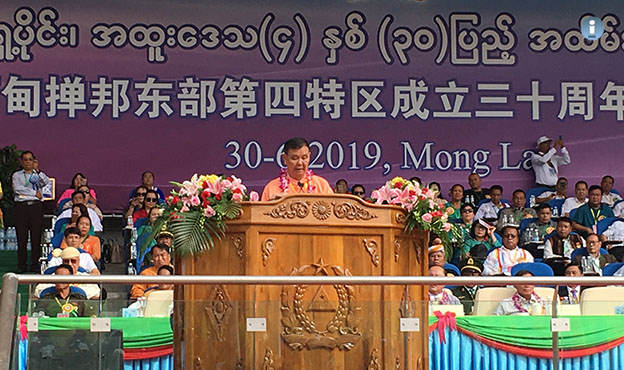
Sai Leun, in his opening speech on the organization’s 30th anniversary of its ceasefire with the government on June 30, said that recognition of the area was important.
“We will try to build our Special Region 4 as a peaceful and developed region. We will try to get autonomy in this region as well,” he said. “We will try to make our region recognized by the Union government and the international community.”
Burma’s government recognized Mongla, Silu and Nam Pang as the territory making up Special Region 4 after the NDAA signed a ceasefire with them in 1989. According to the NDAA, the next step would be getting greater independence.
Ethnic affairs and political analyst Maung Maung Soe told NMG that the move could be popular among locals, and it will be interesting how the government responds.
“Shan, Akha, Loi and Kokang people are living in the Mongla region. They want to get autonomy for the region. I think it’s an important issue for the Union government whether to demarcate for autonomy, as well as how Shan state will consider it,” he said.
The NDAA has been calling for autonomy since 1993, according to organizational spokesperson Kham Maung, but he highlighted that this is not to be confused with secession.
“Our demand is still the same,” he told NMG. “We won’t disintegrate from the Union and we won’t demand a separate state. Our political objective is to get ethnic autonomy in our region. We are demanding it.”
The 2008 Constitution identifies self-administered areas for the Danu, Pa-O, Ta’ang, Kokang, Wa, and Naga.
The NDAA, which controls Mongla Special Region 4, broke away from the Communist Party of Burma in 1989 and signed a ceasefire with the government on June 30 of that year. There have been no clashes between the NDAA and the military since the signing of the ceasefire.
Leaders of ethnic armed organizations signatory and not signatory to Burma’s Nationwide Ceasefire Agreement, political party representatives, government members, army officials, a Chinese special envoy, and media attended the NDAA’s event in Mongla, which they called “the anniversary of peace building.”